



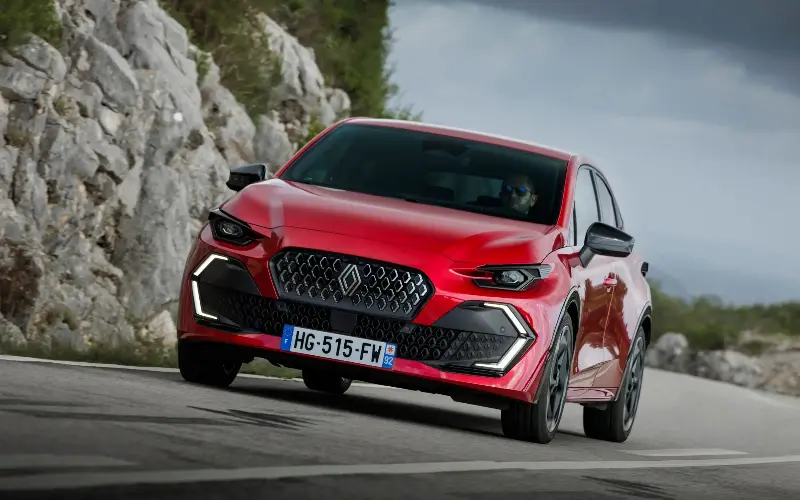
One of the world’s best-selling cars, Renault’s Clio has sold more than 17 million since the launch of the first generation in 1990 – 1.3 million in the UK, partly thanks to a series of memorable adverts featuring “Nicole and Papa”, then the footballer Thierry Henry.
This sixth-generation model is built in Bursa, Turkey. I don’t know about you, but I’m not sure about the looks. The face-lifted previous-generation model looked pretty good, but this comes over as frankly beaky, with a huge central bonnet bulge and distinctive front wings which run into menacing headlights with black plastic “eyebrows”.
The rear looks less fussy, but there’s not much distinction at the sides with carry-over panels from the previous model, including the roof. To be frank, if you parked old and new together you’d be hard pressed to tell which was the latest version.
This Mk6 is larger though, which some might regard as retrograde. It’s 4,116mm long (67mm longer than the outgoing model), 1,768mm wide (39mm wider) and 1,451mm tall. Lest we forget, the original Clio was 3,709mm long and 1,616mm wide…
Rivals include the Toyota Yaris from £22,845, VW Polo from £22,040, Vauxhall Corsa from £20,225, Peugeot 208 from £20,495 and Dacia Sandero from £15,715. Apart from the Dacia outlier, this is clearly a highly competitive market.
Why the delay?
While this new Clio is in French showrooms now, the UK won’t get it until 2027; in the interim the Mk5 remains available. Renault claims the reason is the UK Government’s vacillations over its Zero Emissions Mandate, which were going on in the middle of the new car’s development, so the French didn’t think it worth tooling up for a right-hand-drive version if it wouldn’t be allowed in the UK. If nothing else, this gives us some idea of just how little politicians understand the motor industry.
This B-segment hatchback market enjoys a high proportion of private (rather than fleet) sales, worth two million units per year across Europe. By drivetrain, the typical market shares are 65 per cent petrol, 22 per cent hybrid and 12 per cent EV. Clio sales in the UK split roughly 40 per cent petrol and 60 per cent hybrid, although whether the Government’s 1.5p per mile road charge for hybrids will deter buyers remains to be seen.
Either way, only two drivetrains will be available in the UK in 18 months, both all new. The E-Tech 160hp, full hybrid has a 1.8-litre four-cylinder petrol engine with Renault’s distinctive twin-motor, dog-box hybrid system (which I’ll attempt to explain later), with a 1.4kWh battery. It has significantly more power and torque than the outgoing 1.6-litre model – 158bhp and 127lb ft from the engine and 151lb ft from the electric motor. It weighs 1.32 tonnes depending on spec, has a 0-62mph acceleration of 8.3sec, a WLTP fuel consumption of 72mpg and CO2 emissions of 89g/km.
The new three-cylinder, 1.2-litre 115PS TCe pure ICE has the same engine as that used in the 200PS hybrid versions of the Austral and Rafale. It pumps out 113bhp and 140lb ft of torque, enough to give this 1.2-tonne hatchback a 0-62mph time of 10.1sec, with WLTP economy of 56mpg and CO2 emissions of 114g/km.
Inside job
The new Clio has lots of room in the front, but the rear seats are cramped and leg room in particular is at a premium. The boot swallows 391 litres (1,176 litres if you fold the rear-seat backs). In the front there is a new breed of Renault’s facia, with a conjoined instrument binnacle and central touchscreen; there’s rather too much shiny “piano black” finish surrounding them.
The middling Techno trim has a strange black-and-white stretchy fabric dashboard trim, although the top-spec Esprit Alpine has a classier black fake suede with burnished stainless steel-style embellishers. There are separate piano-key switches for the heating and ventilation and, thankfully, the Renault Perso button to easily switch off the lane centring and speed warning systems (although those functions are far less intrusive than they used to be).
The steering wheel has a snazzy Driver Mode switch with the usual Sport and Comfort modes, along with a new Smart mode which adjusts the car’s responses according to how you are driving.
Sophisticated hybrid
Most of us have a grasp of how a petrol-electric hybrid system works, but Renault’s system is different. Its four-speed gearbox features tough motorsport-style dog engagement of the gears, controlled by a twin-motor system which synchronises the gears and drives them should the system require it. Starting and battery generating is done with the smaller motor, which also lends a shoulder to the wheel when full power is required. The effect of real and “fake” gearing is to provide four direct speeds, four additional indirect ratios and then, by playing with the motor speeds, effectively another seven speeds; 15 ratios in all.
Considering the complexity, it is a remarkably sophisticated transmission, but it has its quirks. Understanding how it works helps, but when the engine roars for five minutes to charge the battery or spins through four ratios at once it feels, well, weird.
On the road
This is not a fast car, not in the least – but it is efficient. Against an official 72mpg WLTP figure, I managed 63mpg during a four-hour mixed road drive. Floor the accelerator for an overtake and it takes a second to decide before changing into the right gear and getting on with it. The whole thing feels a bit indirect, which is strange considering the transmission’s motorsport origins.
Similarly some of the driving vim of older Clio’s has been sacrificed. The steering, even in the Sport setting the engine feels a bit lethargic, the brakes are notchy as they blend friction and regenerative stopping like a lumpy sponge mix on Celebrity Bake Off.
Does that make it less fun to drive? Yes, but it’s not altogether bad news. The chassis refinement is terrific, it is quiet, the ride quality (even on 18-inch wheels) is good. However, road vibration makes its way up to the steering and pedals and the dampers crash into their bump stops if you drive fast on a poorly maintained road. Overall it feels very stable, refined and mature, even if it is a bit boring to drive.
The Telegraph verdict
As I was writing this, news came through of the tie-up between Ford and Renault on two small EV Ford models, likely to be called Fiesta and Puma and based on Renault’s R5/R4/Twingo Ampere chassis. Yet while small EVs might be the future at some point, small cars such as the Clio (with hybrid or straight petrol engines) are the largest market and seem likely to remain so for a good while yet, whatever Ed Miliband might tell you.
I have a feeling the 1.2-litre three-cylinder petrol engine with base trim and 16-inch wheels is likely to be the favourite choice when we eventually get the Clio VI in the UK, but the quirky hybrid has its merits, as well as being very efficient and frugal.
Is it worth the wait? I’d be inclined to look at the offers on the current Clio, which starts at £17,995, before making that sort of decision.
The facts
On test: Renault Clio E-Tech 160hp
Body style: four-door supermini hatchback
On sale: late spring 2027
How much? £20,000 to £26,000 (estimated), £26,000 as tested
How fast? 112mph, 0-62mph in 8.3sec
How economical? 72mpg (WLTP Combined), 63mpg on test
Engine & gearbox: 1.8-litre four-cylinder turbo hybrid with twin motor dog-box transmission and starter generator, front-wheel drive
Maximum power/torque: 158bhp/ 127lb ft (petrol engine) 151lb ft (electric motor)
CO2 emissions: 89g/km (WLTP Combined)
VED: £270 first year, then £195
Warranty: three years/60,000 miles
The rivals
Peugeot 208 Allure 111 eDSC6, from £25,145
About to be replaced with a new EV-only model based on a next-generation Stellantis small car platform, featuring Peugeot’s new Hypersquare steering wheel. If none of this appeals, there might be tempting offers on this 109bhp hybrid run-out model, which is good to drive and economical.
Dacia Sandero Journey TCe 90 auto, from £18,219
There aren’t many extras for this small hatchback although most customers, who can’t quite believe the low price, tend to lump in everything. It’s not particularly glamorous, but practical and a pretty good drive; the Euro NCAP crash test results aren’t fantastic though.