



Trinidad tends to get tagged in references to its smaller island twin, Tobago. Each has its own personality, but what they both have in common are wildlife-rich landscapes, barely seven miles off the coast of Venezuela. This closeness to South America brings a biodiversity particular to this region, setting it apart from other Caribbean islands. It calls to mind Costa Rica, where I used to live in my 20s, set in a similarly tropical climate with distinct wet and dry seasons.
Unlike Costa Rica, Trinidad is only now starting to focus on community-based tourism. Annual visitor numbers from the UK are almost up to pre-pandemic levels of 30,000 (less than half the number that visit Costa Rica) and this year I was one of them, undeterred by the current state of emergency in place – giving powers of search and arrest of gangs – as there is no curfew and the Foreign, Commonwealth and Development Office (FCDO) does not advise against travel there. I travelled with Hadco Experiences, whose co-chief executive John Hadad told me: “My own travels allowed me to experience the offerings of other countries such as Costa Rica and compare them to what is available right here in Trinidad. These comparisons convinced me that we have something incredibly special when it comes to biodiversity and natural experiences. We saw an opportunity to develop our country’s tourism product, since it was low to almost non-existent and the sector was not viewed as a viable foreign exchange earner.”
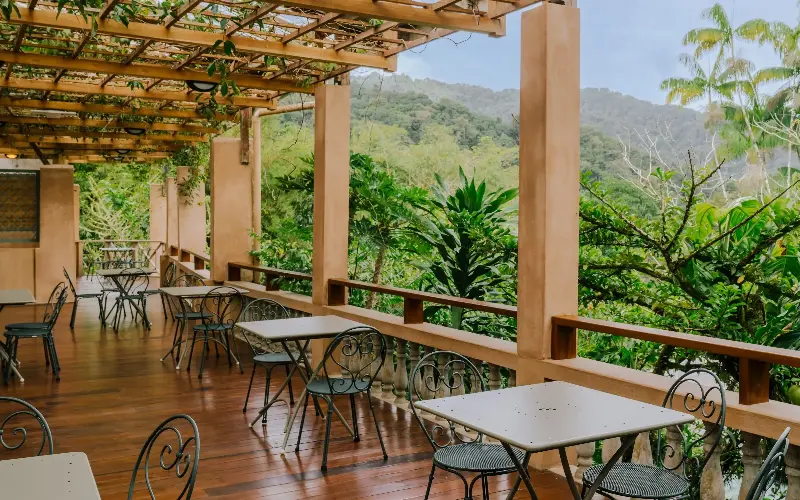
Walking onto the pretty veranda at Asa Wright Nature Centre in the Arima Valley in the Northern Range felt like being in a Disney film as tiny hummingbirds fluttered their green-tinged wings at a dizzying speed – up to 80 times a second – below. Trinidad has more than 18 species of these winged wonders, the smallest bird species in the world, which explains why the indigenous people named Trinidad the “Land of the Hummingbird”.
When Hadco Experiences re-launched the lodge in 2023, staff created a feeding station beneath the veranda. Guests can photograph and marvel at some of the 180 species of bird that thrive here, from bright purple honeycreepers to coppery crested oropendolas, pecking at juicy wedges of fresh papaya, banana and watermelon. A delight was never knowing what I was going to see each time I peered over, and a well-informed staff member was usually around to clarify.
The setting is paradisiacal; a tangle of centuries-old rainforest – much like Costa Rica, often shrouded in mist – and layers of greenery. The centre was opened in 1967 by Icelandic conservationist Asa Wright, to preserve and protect the rainforest and its inhabitants. Today, the restaurant, lounge and gift shop are housed in a former coffee plantation, a Victorian-era space with long, light-giving windows and well-worn polished floorboards, sensitively modernised with attractive rattan furniture, beautiful wildlife photography and soft green tongue-and-groove.
Freshly renovated rooms have large walk-in showers and well-placed windows framing the wildlife-rich gardens. Bird spotters don’t need flat-screen TVs and towel art on beds, just opportunities for sighting thrillingly named creatures such as gold-chested channel-billed toucans and black-throated mangos, a rainbow-hued hummingbird species.
I loved waking each morning to the dew-drenched views as well as discovering what the charismatic chef Jackie and her team were dishing up each day. A delectable array of typical Trini dishes showcased the island’s bountiful organic ingredients, from creamy corn soup to curry prawns and fragrant rice, followed up with sweet island treats (golden brown chunks of sticky cassava pone and creamy sweet sorrel cheesecake).
Nature-inspired activities included guided morning walks through the rainforest, stopping along the way as Mukesh – who has been at Asa Wright for 34 years – pointed out a (non-venomous) coiled slender rainbow boa constrictor shimmering in the sun or a male bearded bellbird, famous for its tendril-like throat hair and loud mating call, a strangely unalluring clanging metal-on-metal sound. Nearby, we passed a deep red flower native to Trinidad known locally as “hot lips”.
The cherry on the wildlife cake was seeing the world’s most accessible colony of oilbirds. Much like bats, these owl-like creatures are nocturnal, fruit-eating and sit tucked high in the gloom of the cave. Their name refers to the gruesome practice of boiling them for lamp and cooking oil long ago, so who can blame them? We didn’t stay long, and only guests staying more than three days can enter the cave, to limit footfall.
There’s no swimming pool at the hotel, but a dip in the bamboo-fringed natural pool fed by a waterfall was more refreshing. After-dinner entertainment came in the form of night hikes led by knowledgeable staff, revealing huntsman spiders gobbling worms and the less icky sight of canoodling stick insects caught out in the bright torch beam.
I couldn’t be in the Caribbean and not go to the coast. Fortunately, Hadco Experiences also rescued a neglected hotel on the northeastern coast. The two-hour drive wound round at times nausea-inducing bends to reach Mt Plaisir Estate Hotel, an attractive low-rise wooden eco-lodge in Grande Riviere, a remote fishing village whose history is intertwined with a certain endangered reptile.
Grande Riviere is the densest leatherback nesting ground in the world and Hadco works with Len Peters – chairman of the Grande Riviere Nature Tour Guide Association – to preserve them. Len grew up with turtle meat on the table but, once he realised how in danger the turtles were, he began patrolling the beach at night, risking threats with machetes. His mission was to help people “realise that the species was worth more to the community alive than dead,” as he puts it. A community conservation programme now brings eco-conscious visitors to the area each year.
My beach-facing room – big, bright and with a spacious balcony – provided a ringside view not just of the beach but of the turtle nesting. But I wanted to get up close, so one night after dinner, I met Len and his friendly team on the beach. I was mesmerised watching tank-like turtles dig deep into the soft, damp sand with their flippers. Trance-like during the process, they “lay” – actually shoot out – between 60 and 100 ping pong ball-like eggs. Each female was gently measured and checked for tags. Watching the process up close felt momentous.
From March to August, around 40,000 turtles nest here and locals patrol the one kilometre beach in case the autumn hatchlings need help – if their shells break too soon, they run the risk of being eaten by birds. Hadco has also installed red lights around the village – to stop the turtles from following discombobulating bright lights – and houses researchers who test different oxygen levels to support the health of eggs and hatchlings. Other sustainable initiatives at the hotel include low-pressure shower heads, composting waste and the use of solar power.
Having seen the eggs buried in the sand, I’m longing to return and watch them hatch.
Jo Fernández travelled as a guest of Hadco Experiences, which offers doubles at both lodges from £285, including full board and guided hikes.