



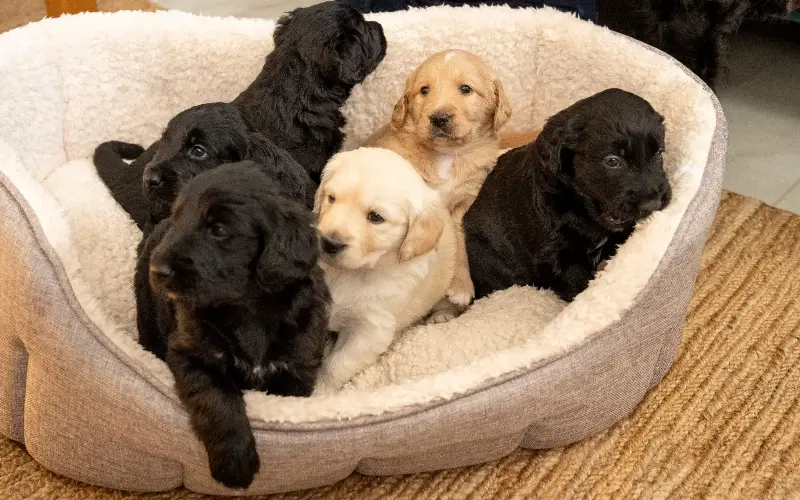
Labradoodle assistance dogs have been bred to help people with physical disabilities and allergies for the first time.
The dogs – a cross between a labrador and a poodle – are more likely to be hypoallergenic than traditional assistance dogs such as labradors and golden retrievers.
These traditional household breeds are the most common assistance dogs because of their size, temperament and ease of training but their coats cause strong allergic reactions for one in eight people.
Experts at Canine Partners, a Leicestershire-based charity that trains dogs to aid physically disabled people in everyday life, first experimented with breeding allergy-free dogs in 2021.
The first puppies from the labradoodle breeding scheme are now beginning to work with their partners in a watershed moment for the charity, for which The Telegraph is raising money as part of its Christmas appeal.
Liz Lacey, Canine Partners breeding manager, told The Telegraph: “We were struggling to source dogs that were suitable for some of our partners that couldn’t have a labrador or a golden retriever because of a health condition or an allergy.
“The need for it really was down to requirements and not to just breed something novel.”
Labradoodles were created in Australia in the 1980s to combine a poodle’s hypoallergenicity with the reliability of a labrador, and unleashed a series of poodle cross-breeds.
Genetic variety in labradoodle puppies means only some are hypoallergenic, while not all of them are easy to train.
But the unpredictability of how the labradoodle puppies will turn out has been a headache for breeders who prefer knowing what they will look and behave like, as much as possible.
Ms Lacey decided to produce the charity’s own labradoodles for the first time in 2021 and Rosa, a five-year-old black dog, has now given birth to 20 puppies in three litters.
Rosa was obtained from Guide Dogs as a puppy and entered into the Canine Partners training programme. Despite being a stellar pupil, it was taken off active duty and transitioned into a brood animal as the ideal labradoodle mother.
Its first litter of eight was born in 2023 and produced male stud Stanley, who is now a working canine partner.
The puppies are completing their training and being matched with their possible partners, with whom they will work and live for a decade.
‘It opens up the world to you’
Harvey is one of Rosa’s first litter and is set to take the reins from Denny, a 10-year-old black goldendoodle (a cross between a golden retriever and a poodle) that assists Joanne, a 51-year-old living in Shropshire.
Joanne, who has dystonia and severe allergies to dogs, has had two poodle-crosses from Canine Partners since she first met the charity in 2006.
She had to wait nearly three years for her first dog because no allergy-free animals were available, and the charity had to buy doodles in as puppies from other charities or external breeders and hope they would pass training.
Denny, a big, curly black goldendoodle, took over from Kaiser and is now approaching retirement. It will be formally adopted by Joanne’s mother while she and Harvey start their own journey together.
“I had to wait longer than most people because they didn’t have many doodles back then,” Joanne told The Telegraph.
“They’re different from labradors because they are so clever and need to channel that. It was such exciting news when they said they were starting breeding labradoodles.
“I think it is amazing that Canine Partners is mitigating this response so you can have an assistance dog if you do have allergies. You may need to wait a bit longer but it opens up a new world to you. It really is worth the wait.”
After a roller-skating accident at 15 led to a fractured elbow, Joanne developed severe muscle spasms and was diagnosed with post-traumatic dystonia which has required more than 100 surgeries to date. With limited mobility to her left side, face and right hand, she relies on her dogs to help open doors, pick up her crutches, answer the phone and even to do laundry.
Harvey will be her third dog from the charity.
“It’s amazing, but when I went to meet Harvey I did feel a bit like I was having an affair!” Joanne said.
“I can’t stand people doing things for me, because I feel disabled but I don’t see myself as disabled. When you have a dog doing it for you because they want to, then suddenly you are not dependent on people as well as getting unconditional love and support.”
The partnership is one of the 300 facilitated by Canine Partners.
Ms Lacey told The Telegraph that Rosa has now had three litters of eight, four and eight, with the latest born in October 2025.
Five of the eight puppies from the first litter are now working as assistance dogs, with one also representing a visually impaired charity.
Ms Lacey said Rosa’s second litter of four is now in training with Canine Partners, adding that “they’re looking good”. The third litter is still spending time with Rosa at the home of Nicola and Andrew Brown, the dog-breeding volunteer home where Rosa lives as a pet.
The Browns cared for the puppies and Rosa during pregnancy, whelping and the first eight weeks of their life, before they went to live with the foster parents to raise them for two years until the dogs are fully trained and partnered up.
Ms Brown told The Telegraph: “You know that every dog you help bring into the world is going to go on and change somebody’s life.
“Rosa lives with us as a pet, first and foremost, and we always talk about the Canine Partner dogs changing other people’s lives in the future, but when Rosa came to us she helped change my life too.”
Rosa may have a fourth and final litter in 2026, depending on its health, and will then retire to a life of luxury with the Browns alongside Monty, a 14-year-old grey and white sheepdog.
“We will adopt her when we can, officially, and she can put her paws up, live a normal life and become part of us,” Ms Brown said. “We wouldn’t want to let her go, she will be here forever.”
But without homes to raise them, the charity cannot help people on their waiting list.
“Across the charity we really do need more dog breeding and puppy training volunteers,” Ms Lacey said.
“We can’t grow the breeding programme unless we get more volunteers. It is a crucial part in the first stage for the puppies.”