



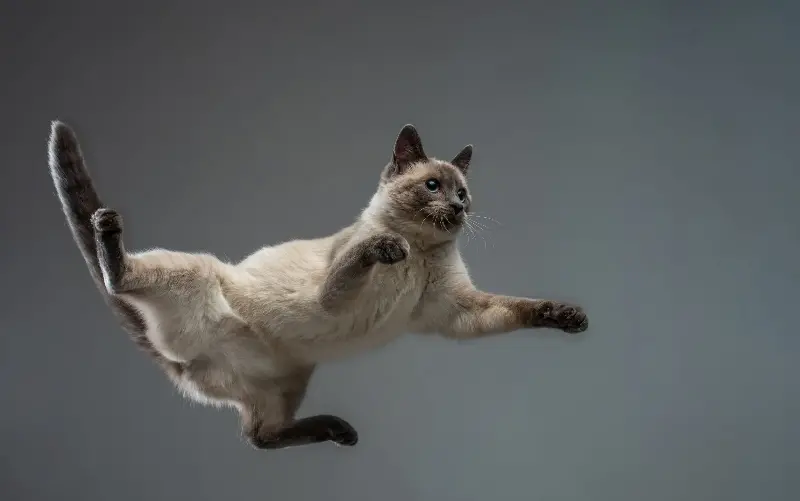
Why do cats always land on their feet? It’s one of science’s most enduring mysteries in the realm of pets.
The first paper on the subject was written in 1700, but despite centuries of competing theories, feline researchers have failed to arrive at a satisfactory explanation for the creatures’ acrobatic prowess.
Now, Japanese scientists may have finally put the age-old debate to bed in a new study that suggests the answer may lie in the animals’ spines.
Researchers at Yamaguchi University found that the cats first twisted the front half of their bodies, with the rear part following a fraction of a second later.
The findings, published in the journal The Anatomical Record, may not only help to explain this curious trick but could also help vets to treat spinal injuries, researchers have said.
Dr Greg Gbur, a physicist and author of the book Falling Felines and Fundamental Physics, who was not part of the research team, said the study was one of the first to look at the flexibility of cats’ spines in detail and could “certainly help understand the limits of their mobility and how to treat it”, particularly in older animals.
He added that the findings could also be useful for designing robots to prevent them from getting damaged when they fall.
“When scientists are trying to make robots more autonomous and operate across different terrains, ensuring they fall correctly, say, for a rescue situation, could be very useful,” he said.
Science of spines
To understand how cats were able to stick to their landings so flawlessly, the Japanese scientists first studied the spines of five cat cadavers. Separating the spine into two parts, they found that the front portion, the thoracic spine, is remarkably flexible, enabling them to twist through more than 45 degrees with minimal resistance.
Meanwhile, the back portion, known as the lumbar spine, is much stiffer and heavier, acting as a stabiliser.
Using high-speed cameras to film two healthy cats as they dropped onto a cushion, the team tracked the movement of their shoulders and hips.
They found that as the cats plummeted, they used the flexibility of their thoracic spine to rotate their heads and front legs toward the ground first. Their heavier lower spines then whipped around a fraction of a second later, allowing them to right themselves without spinning out of control.
The results appear to favour what is known as the “tuck and turn” theory, a model which sees the cats tuck their front legs close to their bodies, enabling them to rotate their top half more quickly before their back legs follow, righting them as they land.
Scientists have long been divided between this school of thought or the rival “bend and twist theory”. Those in this camp believe felines curl up into a “V” shape before twisting their upper and lower spines in opposite directions like a pepper grinder, meaning that when they straighten out again, they are the right way up.
Dr Gbur said the results of this new study suggested that the “tuck and turn” method was more important than people had appreciated”.
“The paper shows that a cat’s upper spine is extremely flexible, which shows that cats are really built for that tuck and turn twisting motion.”
However, he said that in all likelihood, cats used a combination of both methods, depending on the circumstances.
He said: “It’s always been a challenging problem for physicists because we are trained to look for the simplest solution to the problem, whereas nature looks for the most effective, which may involve more than one mechanism or technique.”