



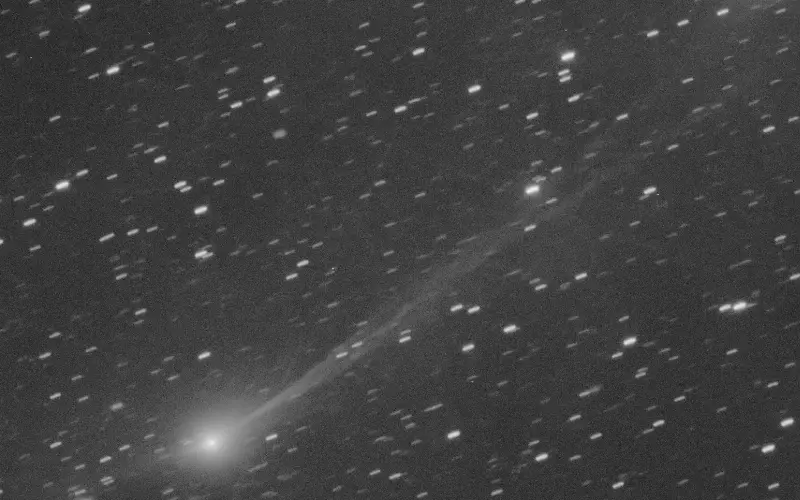
An interstellar comet will make its closest approach to Earth on Friday, with amateur astronomers advised to look out for the green visitor.
It is just the third time that a space rock from outside the Solar System has been identified and experts are hoping it might offer clues about alien star systems.
Although 3I/Atlas will pass Earth at a distance of 170 million miles, posing no risk, space agencies across the globe are using the fly-by to carry out a planetary defence exercise involving 21 countries.
Nasa and Esa are among those monitoring the object, modelling impact probabilities and testing emergency coordination and citizen communications.
At the moment, 3I/Atlas lies in the constellation Leo, and although it cannot be seen by the naked eye, amateurs with modest telescopes should be able to pick it up. It will look like a green smudge on the night sky.
“Around the time of closest approach, it will appear just beneath the Lion’s belly [an area in the constellation],” said Dr Mark Norris, senior lecturer in astronomy at the University of Lancashire.
“It won’t climb high enough in the sky to observe until roughly midnight, reaching its highest point around 5am on Dec 19.
“It is currently about a hundred times fainter than what the human eye can detect, and it’s continuing to fade as it moves away from the Sun. That said, it’s still very much within reach of astronomy enthusiasts.”
The comet was discovered by amateur astronomers at the Asteroid Terrestrial-impact Last Alert System (Atlas) – a network of four telescopes in Hawaii, Chile and South Africa – which was set up to give an early warning of dangerous asteroids.
Astronomers realised that the object was unusual because of its strange hyperbolic trajectory through the Solar System. The curve of its orbit is so flat and far away from being a circle that it must have come from interstellar space.
Current estimates show that it will get about 40 per cent further from the Sun than the Earth is, before heading back out into the galaxy.
It has been gradually growing brighter as it approaches Earth, making it easier to see from the ground.
The planetary defence exercise, which is being coordinated by the the International Asteroid Warning Network (IAWN) is only the eighth time a global drill has taken place.
An IAWN spokesman said: “While it poses no threat, comet 3I/Atlas presents a great opportunity for the IAWN community to perform an observing exercise due to its prolonged observability from Earth and high interest to the scientific community.”
Experts said the exercise would focus on improving capabilities for measuring the positions of comets, which are tricky to pinpoint because they often appear as ‘fuzzy, extended objects’ in a telescope’s field of view.
Only two other interstellar objects have been spotted in our Solar System previously.
The first, called Oumuamua (pronounced oh MOO-uh MOO-uh) was a bizarre cigar-shape rock, which passed through the Solar System in 2017 and appeared to be accelerating away from the Sun, suggesting it had an internal power source.
Some speculated it might be an alien spacecraft, but scientists later found its course was being altered by the tiny push created as hydrogen gas spurted out of its icy surface, acting like a thruster.
The second was 2I/Borisov, a comet which was spotted in 2019 and thought to have originated near to a red dwarf star.
Experts believe that passing interstellar comets may be the best way to learn more about conditions outside of the Solar System.
It took the Voyager spacecraft decades to reach interstellar space and it would take tens of thousands of years to reach nearby stars but scientists are hoping to develop new technology to sample the next interstellar object.