



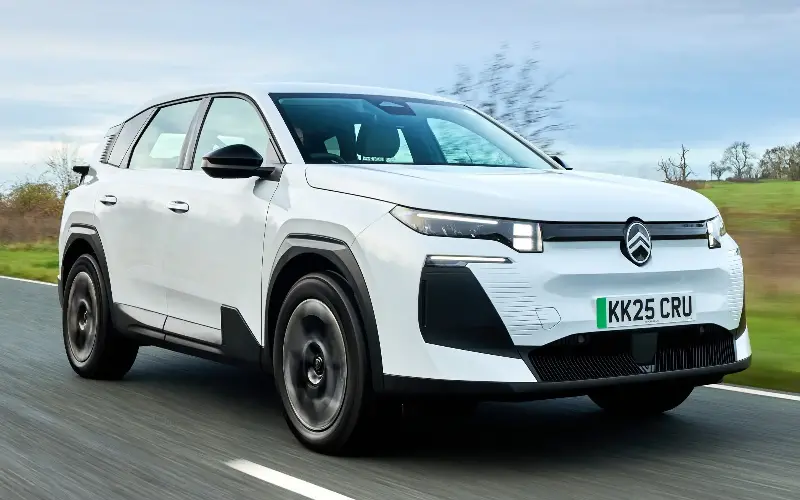
This new Citroën ë-C5 Aircross is a large, family-friendly SUV that’s capable of a real-world 300 miles in Long Range form. Nothing too unusual about that, but it’s also eligible for the full £3,750 government plug-in car grant, which reduces the cost to just under £33,000.
In terms of range, on a “miles per pound” basis nothing else comes close – not even Chinese rivals promising lots of car for little cash. Their list prices may be lower, but none come closer to the ë-C5 Aircross in terms of mileage on a full charge. Nor, indeed, can Tesla, which charges £5,000 more for about 25 miles less in a Model 3.
Pros
- Impressive range for the price
- Slick, well-resolved interior
- Roomy interior with a huge boot
Cons
- Not as comfortable as the old C5 Aircross
- Higher-end versions look pricey
- So-so energy efficiency
The price is right?
There is a catch, however. Your £32,995 buys an entry-level ë-C5 Aircross You! so you’ll have to pay £700 extra for an efficiency-improving heat pump (which you should). You also don’t get heated seats or lumbar adjustment, nor can they be added as optional extras – you have to upgrade to the Plus version for a reversing camera.
Doing so will add £4,600-odd to the bill. And the top-spec Max’s list price is above the £42,000 cap for the grant, making it ineligible. That means moving from Plus to Max will add £6,390, bringing the total to a decidedly less cost-effective £43,695.
There’s always the Comfort Range battery option, which loses about 70 miles of real-world range and therefore trims those prices further – but not by much, as it’s only eligible for £1,500 of government assistance. In short, the ë-C5 Aircross’s cracking value only applies if you choose the right version.
The official WLTP range is 421 miles (320 in the Comfort Range model), while charging speeds peak at 160kW and average a very respectable 130kW, meaning it will take 33 minutes to add about 180 miles of range at a sufficiently fast charger. Its efficiency of 3.5 miles per kWh is decidedly average, however.
Inside job
It’s roomy, though. The boot offers 651 litres of luggage volume, making it one of the most sizeable of any EV, while the false floor can be set at different heights, increasing flexibility. However, the old C5 Aircross’s three individual rear seats that folded and slid independently have been replaced by a more conventional bench. This does at least offer a 40/20/40 split-folding seat back. In the Plus and Max versions, tilting backrests can liberate more boot space at the expense of rear passenger comfort.
There’s plenty of passenger space, too, with acres of leg room and a square door aperture that makes clambering aboard – or securing your offspring in child seats – pretty easy.
The biggest changes are in the front, however. The slightly plasticky finish of the previous model has given way to a much plusher feel, with a tactile, fabric-trimmed dash and a huge central touchscreen.
This controls most of the car’s functions, including the climate control, which does not augur well. However, because the screen’s size permits an always-on climate control quadrant that allows quick and easy access, it’s not the bad news you might at first imagine.
Screen sense
What’s more, Citroën has resisted the temptation to cram as many functions onto the screen as possible, which means each on-screen button is large and easy to prod with the briefest of glances. In practice, this set-up is barely any more distracting than a traditional set of physical switches.
In front of the driver, a second screen serves as an instrument binnacle, which is clear and easy to read. A nice “surprise and delight” touch is that its backdrop is a skyline that switches from a fluffy blue sky with clouds to dusk and night-time, in line with the time of day.
It’s not all sweetness and light, though. The seat squabs are quite short and don’t have enough pitch adjustment, so taller drivers might feel the backs of their knees aren’t well enough supported.
The seats aren’t quite as squidgy or as welcoming as the ë-C5 Aircross’s stablemates, either, although they are supportive in all the right places so a lengthy drive shouldn’t result in backache.
On the road
It feels as though Citroën has sacrificed some of the old model’s comfort. The suspension no longer has a flouncy, laid-back way of flowing over bumps. In electric form, meanwhile, the weight of the batteries seems to compress it more than in the petrol-hybrid model, so there’s even less give. As a result, the ë-C5 Aircross deals less effectively with potholes.
Thankfully, this behaviour evens out at motorway speeds, making this an adept cruiser, for the most part. There’s plenty of urge from the electric motor even at higher speeds, wind and road noise are well damped and only concrete sections with expansion joints make themselves felt.
There’s also plenty of lateral grip and good body control, too, so if you enter a corner a little too rapidly the ë-C5 Aircross will forgive you and help you recover. But it doesn’t relish rapid changes in direction, the steering is quite light and numb while the front end lacks the sort of bite of, say, a Kia EV6.
The new model doesn’t lean over as much as the old, but its predecessor’s behaviour was a corollary of its delightful ride quality. The new one feels more “normal”, which may suit more buyers, but it also means this car feels more like every other electric SUV, lacking the sort of comfort that defined it as a Citroën.
The Telegraph verdict
While it may have lost some of its distinctiveness, this is still a car that’s easy to live with, smartly finished inside and inoffensive to drive. If you require an EV that offers lots of space, range and warranty for the money, it will be a tempting alternative to the Chinese hordes.
Just keep in mind that you have to be careful with the specification, because in higher-spec forms the ë-C5 Aircross’s value proposition starts to falter. In this entry-level form, however, it looks like a bit of a bargain.
The facts
On test: Citroën ë-C5 Aircross You! Long Range
Body style: five-door SUV
On sale: now
How much? £36,685* on the road (range from £34,065*)
How fast? 106mph, 0-62mph in 8.8sec
How economical? 3.5mpkWh (WLTP Combined)
Electric powertrain: AC permanent magnet synchronous motor with 96.9kWh (usable) battery
Electric range: 421 miles (WLTP Combined)
Maximum power/torque: 227bhp/253lb ft
CO2 emissions: 0g/km (tailpipe), 22g/km (well-to-wheel)
VED: £10 first year, then £200
Warranty: 3 years/60,000 miles, with service-activated extensions up to 8 years/100,000 miles
Spare wheel as standard: no (not available)
The rivals
Geely EX5 SE
215bhp, 267 miles, £31,990* on the road
This new arrival is the same size as the ë-C5 Aircross but can’t go anywhere near as far on a full charge – and, once the various grants are factored in, it’s barely any cheaper.
Volkswagen ID.4 Pro Essential
282bhp, 351 miles, £36,995* on the road
The closest the ID.4 can get to the Citroën is this fairly basic version. Less range for more money and a cheap-feeling interior make it a tough sell as an alternative.
*Prices before UK electric car grant and/or manufacturer incentives deducted