



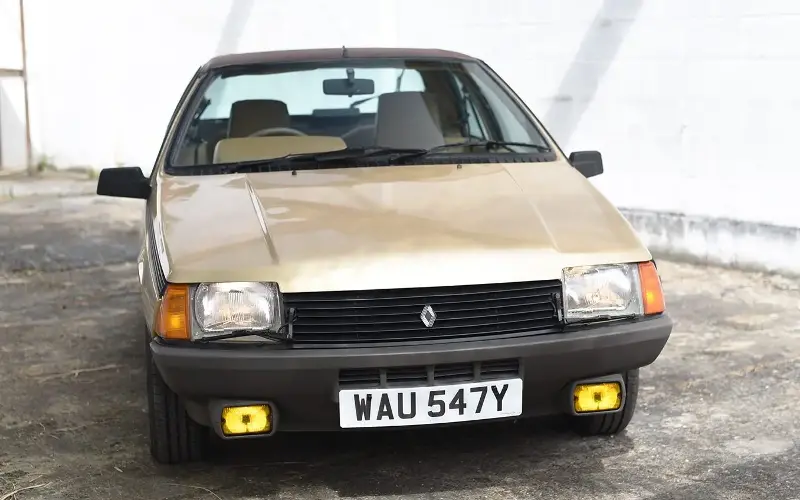
Some cars look as though they belong on-screen. Ian Brooks’s 1982 Renault Fuego GTS Automatic would have been the ideal vehicle for this week’s villain in an early edition of Bergerac. Its lines were entirely in keeping with the series’ pretensions to glamour; any Fuego would have looked splendid in a low-speed chase with the hero’s Triumph Roadster.
Today, it still looks splendid but is also extremely rare; in the UK, a mere 29 of all types are believed to remain on the road, this being the sole GTS Automatic.
Renault began work on the replacement for the 15 and 17 coupés in January 1976. The Fuego (Spanish for “fire”) featured distinctive bodywork by renowned French designer Robert Opron with much of the running gear of the forthcoming 18 saloon. It debuted at the 1980 Geneva motor show, and Renault boasted that it was not a coupé but an “Open Plan Saloon”, whatever that may mean. It was also keen to point out that the Fuego was rather more than a new body on the 18’s floorpan.
The Fuego’s looks were a major sales asset, delivering a beguiling combination of a 1980s sci-fi drama spacecraft with faint overtones of the Porsche 924 at the rear. Brooks says he is especially keen on such detailing as “the French yellow front fog lights, that huge all-glass tailgate and the front seats”. By August 1980, Fuego sales accounted for 3 per cent of the entire French car market.
Renault devised the Fuego with an eye to US sales. Car and Driver magazine thought: “Those crazy Frenchmen are about to do good by us.” UK sales began in December 1980, with Renault aiming to sell 1,200 by the end of that year and a further 12,000 in 1981. This newspaper wrote: “We used to joke about the ‘funny’ styling of many French cars, despite their practical merits. There won’t be many sniggers about Renault’s newest offering.”
Your dealer could point out that the Fuego was one of the first mass-produced four-seat coupés to be designed in a wind tunnel, with a 0.347 drag coefficient: “less wind resistance than the Scirocco, Manta and Capri”. The GTS had electric front windows and adjustable steering, while the Fuego was also the first UK-market Renault with a name, rather than a number, since Dauphine and Caravelle sales had ended in 1968.
Renault GB initially offered the 1.4-litre TL, the 1,650cc-engined TS, GTS and GTS Automatic as well as the TX and GTX, which had the 2.0-litre engine from the 20 TS. The GTS Automatic cost £7,027 in 1982; front-wheel-drive alternatives were the Volkswagen Scirocco GL Automatic at £6,801 and the Honda Prelude Executive at £6,800.
If front-wheel drive were not one of your main criteria for a reasonably priced coupé, there was also the Mazda 2000 SDX for £6,399, the Opel Manta Berlinetta SR 3-Door Automatic for £6,452 or the Toyota Celica 2.0 Liftback for £7,324. That left the Fuego’s main competitor in this country; Motor believed the new Renault coupé was a worthy opponent for the long-running Capri.
A similarly impressed Telegraph journalist reckoned that “Renault should have a winner, competing against the Ford Capri”, which in 1980 dominated the UK sales charts for mass-market coupés. Two years later, the Capri Mk3, in 2.0S Automatic form, cost £6,867 and, compared with the Fuego, had the virtues of familiarity and reassuringly conventional rear-wheel-drive engineering.
A Fuego enthusiast might contend, however, that by 1982 its Ford rival was already in its twilight: The Mk3 lineup had been reduced since its 1978 launch, while its lines seemed redolent of the mid-1970s being merely an update of the 1974 Mk2. The Fuego possessed a sophisticated “Euro-chic” air that seemed far removed from the Capri’s distinctly blue-collar image.
Renault continued developing the Fuego range, introducing the Turbo in 1984, the year before French production ended after 226,583 units. An Argentine-built version remained available until as recently as 1992.
Brooks says he has owned his Fuego “for a few years now”. He points out while the performance from its 1.6-litre engine is not blisteringly fast, his Renault is extremely comfortable, not to mention genuinely stylish.
Plus, the Renault Fuego really should have made regular appearances in Bergerac.
We use the fascinating https://www.howmanyleft.co.uk for figures of surviving examples but some cars present more of a challenge than others, so the figures are rarely authoritative. Some pre-1974 records were lost before the DVLA centralised the process, while some cars have their model type misnamed on the V5 registration documents. A further issue is the omission of the exact model name or generation, or distinction between saloon and estate body styles.