



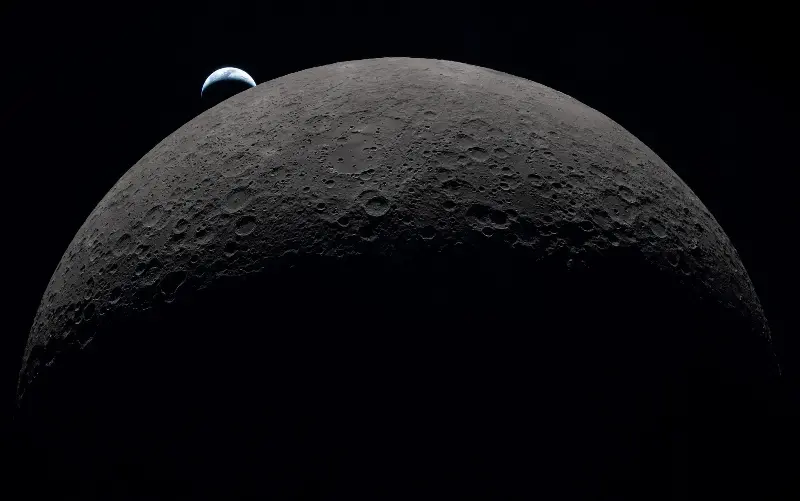
Nasa’s Moon mission astronauts have travelled further from Earth than any humans in history – but the most dangerous part of their journey is yet to come.
The Orion capsule is due to re-enter Earth’s atmosphere using a trajectory that has never been tested and a heat shield that has previously failed. If all goes to plan, it will splash down in the sea off California at 17.07 EDT (22.07 BST) on Friday.
Re-entry will not be a good moment for anything to go wrong for the four Artemis II astronauts as they near the end of their 10-day, 700,000-mile journey around the Moon and back.
The 15ft-by-9ft capsule will smash, bottom first, into the atmosphere at almost 25,000mph, meaning the astronauts will be travelling at seven miles per second. Flying that fast through gas causes extreme friction and pressure, and the air around Orion will heat up to more than 2,760C.
All that will protect the astronauts from the inferno is a 3in-thick heat shield made of silica fibres and epoxy resin, housed in a fibreglass honeycomb mesh. The material is designed to disintegrate, atom by atom, in a controlled way that carries heat away from Orion.
Unfortunately, when the capsule was tested without a crew during the Artemis I mission in 2022, the disintegration was haphazard, with chunks flying off unexpectedly at more than 100 locations. Large bolts in the heat shield partially melted.
A Nasa investigation found that gases, which should have vented, built up inside the material, resulting in cracking that caused “charred material to break off”, leaving a trail of debris.
Amit Kshatriya, deputy associate administrator of Nasa’s Moon to Mars programme, admitted it had not expected “pieces to be liberated from the vehicle”. The heat shield material – called Avcoat – has been redesigned to be more permeable and allow the gas to escape rather than build up and create pressure and faults.
However, the upgraded heat shield was not fitted in time for the Artemis II mission, so astronauts Christina Koch, Jeremy Hansen, Reid Wiseman and Victor Glover are relying on the old version.
In fact, the shield on Orion is less permeable than the one that failed on Artemis I.
Nasa said an extensive investigation had proved that the current heat shield could keep the crew safe, while data from inside the Orion test flight showed that temperatures would have remained comfortable for the crew even with the missing chunks.
In an effort to further mitigate the risk, Nasa has changed the craft’s planned trajectory of re-entry to Earth. The goal is to subject Orion to less time in the fiery heat of the atmosphere.
During Artemis I, Orion made a “skip entry”, dipping briefly into the upper part of Earth’s atmosphere before slipping back out. This helped Mission Control calculate where it would land more accurately and reduced the G-force astronauts experienced.
It was hoped that skipping the craft on the atmosphere – like a stone on a lake – would mean that rather than one blast of intense heat, it would experience two at lower temperatures.
For Artemis II, with lives at stake, Nasa has abandoned the skipping plans entirely, and the astronauts will face the full force of re-entry in one go. Orion will be descending faster and steeper to minimise the time exposed to the most extreme temperatures.
Jared Isaacman, the Nasa administrator, said he had “full confidence” in the heat shield. Mr Wiseman, the Artemis II commander, said the crew were “thankful for the openness of Nasa to weigh all options and make decisions in the best interest of human spaceflight”.
However, the new trajectory has never been tried with the capsule. Nasa is relying instead on computer modelling, rather than a successful test flight, to show that it will work.
In 2022, Jeremy VanderKam, the deputy manager for Orion’s heat shield, admitted that test facilities could not reach the combination of “heat flux, pressure and shear stresses” spacecraft encounter during re-entry.
He said: “We’re always having to wait for the flight test to get the final certification that our system is good to go.”
Last year, a report by the Nasa Office of Inspector General (OIG) warned: “The unexpected behaviour of the Avcoat creates a risk that the heat shield may not sufficiently protect the capsule’s systems and crew from the extreme heat of re-entry on future missions.”
Charles Camarda, a heat shield expert, former Space Shuttle astronaut and ex-director of engineering at the Johnson Space Centre, has claimed that Nasa was using the same “flawed thinking” and “crude analysis” that led to the Challenger and Columbia space shuttle disasters, which killed the crews.
He wrote in a letter in January: “The modified entry trajectory for Artemis II ... is not sufficient to assure risk is mitigated.”
Once the crew makes it into the Earth’s atmosphere, 11 parachutes and drogues must deploy in a precise order to slow and stabilise the capsule to a speed of less than 20mph.
Nasa OIG was also concerned that flying pieces of heat shield could strike the top of the capsule, potentially damaging the parachutes. Without all the parachutes working, the crew cannot land safely.
It will be a harrowing 16 minutes from the time the astronauts re-enter Earth’s atmosphere to the moment they splash down – hopefully in the Pacific off the California coast near San Diego.
In 2023, shortly after selection, Mr Glover, Orion’s pilot, told The Telegraph that the part of the mission he was most looking forward to was hitting the ocean.
He said: “People assume I’m being facetious when I say I’m looking forward to splashdown, but it’s not because I’m in a rush for the mission to be over. If that’s not successful, then we don’t enable future things.
“All those objectives come to a halt until we figure out what went wrong. And so splashdown means, one, our families can relax and exhale, but it also means that we’re at least in the process of handing off the stick of this relay race.”
Let us hope Nasa does not drop the baton during re-entry.