



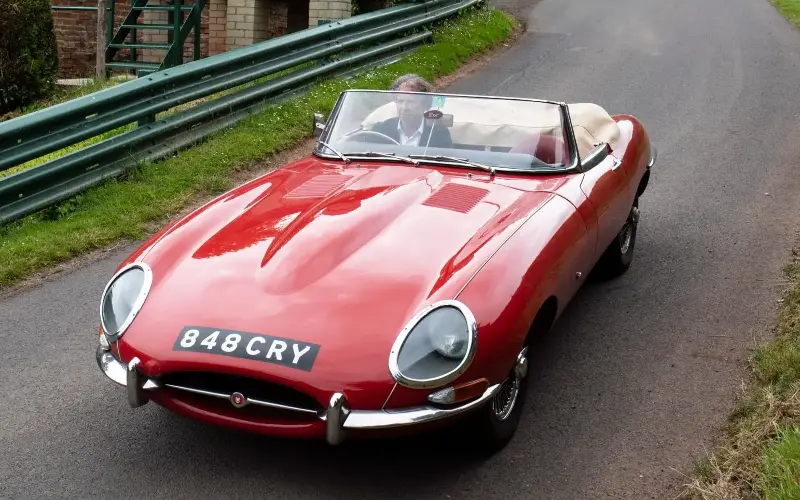
Join me, if you will, for a stroll through time to the garage of memories at the end of the garden, where the pungent odour of motor oil mixes with mouldering grass cuttings.
In here you might find your father’s MGB roadster from 1968 – the one in Old English White with chrome bumpers, wire-spoke wheels and the black leather interior that reeked of Rothmans.
The canvas roof always leaked, but it was a joy to be in – even if its restrained good looks and rather limited power made it the sports car equivalent of a Rich Tea Biscuit.
Perhaps, however, the English sports car of yesteryear in your garage is the peerless Austin Healey 4000 from the 1960s – an aesthetic masterpiece, though not if it’s been rolled through a hedge (which is what my father did to his mother’s Healey after a binge at the George and Dragon in Epping).
Or how about the angular 1970s Triumph TR7? My Uncle William had one in burnt gold – which my cousin Andy used to rearrange a lamppost. William had it rebuilt. But you would.
Whichever old English sports car inhabits your own showroom of nostalgia, whether it’s one of the above or a grunty TVR Griffith or a lithe Lotus Esprit – like Roger Moore had in For Yours Eyes Only, or Julia Roberts floored in Pretty Woman – it’s a sad fact that while a few are still on the roads today, the companies that made them have either vanished or changed beyond recognition.
MG was mauled badly before being sold to the Chinese – who moved production to China in 2016. Triumph disappeared into the catastrophe of the demise of British Leyland. Lotus is owned by Geely, another Chinese giant, which announced it was cutting a third of the workforce – 550 jobs – at its HQ and factory in Norfolk last year. TVR exists and there is news of a new model… again.
Last time I heard Morgan, the venerable maker of wooden-framed sports cars from Malvern was thriving, albeit in the hands of a Continental industrial conglomerate, and then there’s Jaguar, which had the F-Type until it ceased production in 2024, though it was hardly the “spiritual successor” of the E-Type – a serious contender for the title of most beautiful sports car of all time. Aston Martin, the modern Bond’s wheels of choice, trundles on but is seemingly mired in commercial woes.
So it’s heartening that in these dark days, where good news is about as rare as a Resident Doctor on duty in England, that lovers of English sports cars have something to celebrate.
Because a new sports car start-up – Longbow – has unveiled a spankingly beautiful all-electric open-top “Speedster” model, which will do 0-60 in 3.5 seconds and allegedly go 275 miles on battery power. While the £84,995-Speedster is a rich-man’s toy – there’s no roof or windscreen – and is available only in a limited 150-model run (most of which are already sold), next year Longbow plans to begin making a Roadster model – a two-seater with a roof that will be priced at £64,000 and do 280 miles.
What’s more, they hope to make 5,000 of them a year with an entirely British supply chain, except for batteries which aren’t yet made here – but when they are, they will be.
If it all transpires, this will create and secure several thousand British jobs in the automotive sector. And it’s just the start: the firm would like to expand into bigger cars.
While I don’t think they have received a single handout from the Government, they do stand to benefit from Rachel Reeves’s economic policies because there are now quite a lot of unemployed automotive workers out there looking for new jobs.
England, says Longbow’s co-founder Mark Tapscott, who is ex-Tesla and BYD, is still the best place in the world to make a light-weight sports car, and what could be better if you’re embracing an electric future where every gram counts? Astonishingly, the Roadster weighs just 995 kilos, so about half of a Tesla Y or, funnily enough, about the same as my dad’s little old MGB.
Which is technologically impressive, and should give us all hope. Because while 5,000 cars a year – assuming they achieve it – is small beer compared with giants like Tesla, it’s a step in the right direction – and one that builds on a great English tradition of lightweight sports cars.
Not just that, it proves that despite the gloom, despite the burden of Labour’s taxes, regulation and energy costs, we can still do it. And, thank Heaven for that, because there’s no better way to explore the English countryside than behind the wheel of an English sports car. It’s what the Sussex Downs, the rolling hills of Hampshire and the Lake District were invented for.