



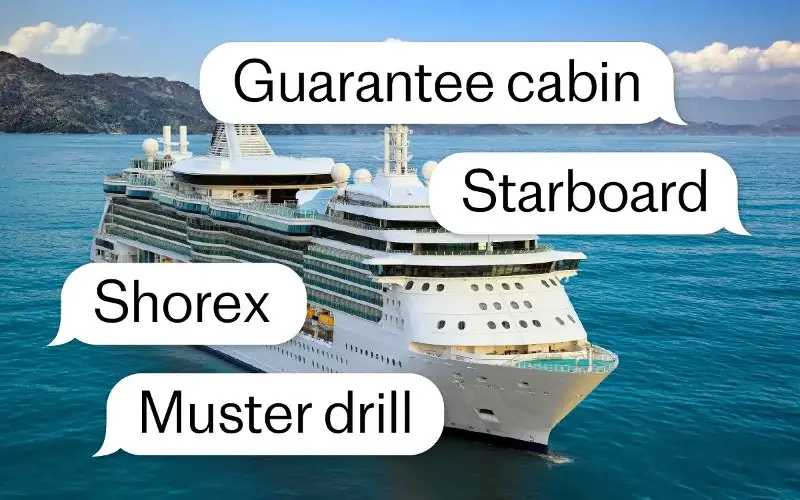
You never quite realise how fluent you are in terrestrial life until you step aboard a cruise ship. Anywhere else, “room” means room, “boarding” means getting on, and “smart casual” means not looking as though you’ve slept in a hedge the night before.
At sea, however, familiar words sprout entirely new meanings. Suddenly, you haven’t just booked a holiday – you’ve enrolled in a floating world with its own customs, dialect and pecking order; it’s a place where even left and right are quietly retired in favour of port and starboard.
Cruise lines’ websites and brochures are masterclasses in euphemism – pages full of “inviting public spaces”, “enrichment opportunities”, and “dynamic entertainment”. Indeed, this jargon is the Esperanto of leisure travel – needlessly elaborate, mildly absurd, and impossible to resist. Once it gets under your skin, you’ll find yourself saying things like “see you midships after muster” or “we’re docked starboard-side-to”, then pause mid-sentence to pity your former self.
And that’s the charm of cruising: an entire lexicon devoted to leisure. For the uninitiated, here’s a survival guide to ensure you don’t mistake – as many have before you – a “port day” for a wine festival. By journey’s end, you’ll be fluent.
Embarkation: A state of organised chaos
Technically, embarkation means getting on the ship. In reality, it’s the world’s most genteel cattle drive. Thousands of people descend upon a single terminal, clutching passports, print-outs, and a misplaced understanding of the function of a queue.
Lines like Princess Cruises now use staggered boarding and digital check-ins. But that doesn’t prevent the curious urge – of, well, everyone, actually – to arrive three hours early and attempt to sneak on board ahead of their allotted boarding group.
Guarantee cabin: A roll of the dice
A “guarantee cabin” is one of cruising’s great linguistic sleights of hand. It doesn’t guarantee you a room of your choice; it guarantees you a room. It’s a booking category beloved by optimists and gamblers. You pay less and hope for an upgrade. Sometimes you strike gold with a balcony. Other times, you find yourself beneath the anchor chain, below the nightclub.
If you like surprises, you’re going to love this. If, however, you err on the side of control freak, my suggestion is: just don’t. Select your cabin. Know the layout of the ship. And read the small print – a “partial ocean view” on some ships has been known to mean a pin-prick of a porthole behind an on-deck lifeboat.
Muster drill: Your first lesson in ship speak
Before you can sail away from the mayhem on land, you must muster. A muster drill – the compulsory safety briefing – is where you learn your muster station and are reminded that “fore” is the front, “aft” is the back, and midship is generally the most stable place to stand if the ship hits a storm.
These days, the drill is usually streamlined: watch a short video on your phone, tap a button, and stroll to your station to confirm your presence. It’s safety, yes, but also your very first lesson in cruise navigation.
Shorex and tender ports: Leaving the ship
Shore excursions – shorex, if you’re feeling fluent – span everything from rainforest treks and vineyard tastings to panoramic drives where your only exertion is adjusting the air-con nozzle above your head. You can, of course, strike out on your own, but booking through the ship comes with the single greatest perk in travel: the unshakeable guarantee that the vessel absolutely will not sail away without you.
River cruise ships tend to dock right in the heart of the action. Enormous ocean liners often can’t, since ports are either too shallow or too small. Here, passengers are ferried ashore by small boats known as tenders. Tender boats are much more comfortable than the inflatables of old. But in popular ports where 3,000 passengers decide they’ve had enough of Dubrovnik’s mid-summer heat and converge at the pier at 4pm sharp, the wait can test even the most patient of cruisers.
500 people, the smell of diesel strong enough to pickle an olive and someone insisting they’ve dropped their lanyard: that’s a tender port. Burnishing in the sun waiting to board, you begin to realise why so many lines – from Cunard to MSC Cruises – now offer priority disembarkation packages. And why you absolutely should have splashed out on one.
Sea day: 24 hours of sanctioned idleness
To landlubbers, a sea day suggests calm reflection, ocean vistas, and afternoon tea. To the seasoned cruiser, it means full sensory overload: trivia in the theatre, line-dancing in the atrium, and a queue for the buffet that would make US immigration proud.
Royal Caribbean fills its sea days with surf simulators and escape rooms while Viking opts for quiet lectures and Nordic saunas. Either way, it’s the day you realise the only thing that punctuates time is food. Pack trousers with elasticated waistbands.
All-inclusive: Always check the small print
Cruise brochures use “all-inclusive” with the same creative latitude as estate agents use “bijou.” Yes, your meals are included, but so are 48 separate ways to pay extra for them. Speciality dining, premium coffee, bottled water and room service are all “enhancements” billed separately unless you’re on a true luxury lines such as Seabourn or Regent Seven Seas Cruises, where “inclusive” actually includes most things.
Even “drink packages” come with sub-clauses worthy of a mortgage contract. You’ll quickly learn that “premium spirits” excludes the only one you really want, and that “unlimited” often caps out at 15 drinks a day – which sounds fine until the first sea-day brunch.
Formal night: Dress to impress
A relic from the golden age of cruising, when film stars crossed the Atlantic, a formal night (or Gala night), is when passengers are encouraged to dress to impress. On Cunard’s Queen Mary 2 – the only ship sailing that I believe can legitimately call itself a liner – that still means tuxedos and gowns.
On Virgin Voyages, the concept has been replaced by Scarlet Night, a surreal fancy-dress party in which everyone wears red – meaning they either blend in with the ship’s interior or look as though they have just been mauled.
The unspoken rule? Pack for both ends of the spectrum. You’ll either feel absurdly overdressed or hopelessly informal – occasionally within the same hour. If in doubt, carry a flute of Champagne at all times; it renders anything you’re wearing immediately appropriate.
Disembarkation: The final call
Disembarkation is cruise-speak for getting off the ship, but in practice, it feels closer to an eviction. The announcement arrives early, the corridors fill with luggage, and someone inevitably blocks the lift with a mobility scooter. Many lines give you a disembarkation time, but, as with embarkation, it’s not always adhered to as people rush to nab taxis and hunt for their luggage.
Yet the time you finally reach the terminal, you’ll be fluent in cruise-speak: nodding sagely at mentions of tender ports, debating the merits of aft balconies as if you’d designed the ship yourself, and replacing left and right with port and starboard.
About our expert
Murray Garrard
Murray Garrard got his sea legs young, when he took a topper off a beach in South Devon and charted a course for the South Atlantic, only to capsize yards from the shore. Not put off, since then he has spent as much time on – and indeed in – the sea as possible, sailing on every ocean and every type of ship, and has travelled to over 180 countries.