



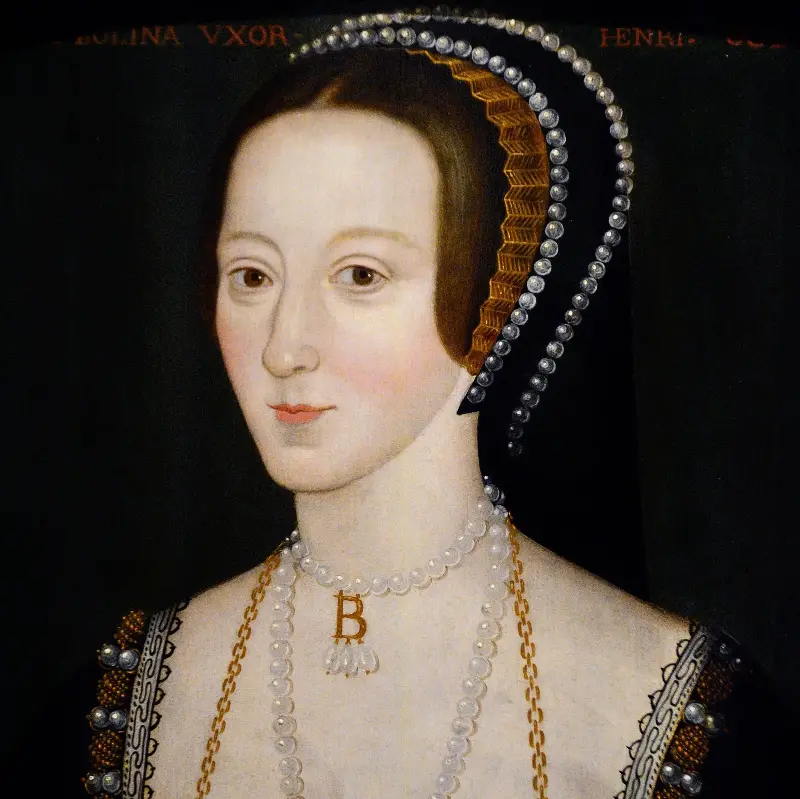
Anne Boleyn’s portrait actually depicts her daughter, Elizabeth I, a Tudor historian has claimed.
Owen Emmerson, the co-curator of a new exhibition, said the painting of Henry VIII’s second wife showed her upper body but her daughter’s face.
The portrait, which is held by the National Portrait Gallery, was painted at the end of the 16th century – towards the end of Elizabeth I’s reign and half a century after Boleyn was beheaded.
Mr Emmerson said the image was deliberately made to resemble Elizabeth I to add legitimacy to her rule.
“It’s one artist doing a series of portraits of monarchs and putting on the face of the reigning queen, Elizabeth, to show a legitimate and God-ordained line of succession,” he said.
The historian said Boleyn’s features in the painting – the angular look, pale skin and brown hair – were similar to that of a portrait of Elizabeth I in the Compton Verney Collection in Warwickshire.
He said it also resembled a portrait of Mary I owned by the Weiss Gallery in Mayfair and a privately owned image of Edward IV.
His theory has been supported by other experts.
Lawrence Hendra, a research director at the Philip Mould gallery and an Antiques Roadshow adviser, said the portraits were “probably [from] a workshop from the end of the 16th century, going into the early 17th, which appears to have a niche producing posthumous portraits of English kings and queens”.
Boleyn was Queen from 1533 until her execution in 1536, and many original portraits of her were destroyed after her death for fear of upsetting the King.
In 2016, facial recognition experts concluded that several supposed portraits of Boleyn in the National Portrait Gallery – including the one highlighted by Dr Emmerson – may not be her.
They made the finding by comparing the portraits to a contemporaneous miniature of Boleyn from the British Museum, which was the only undisputed likeness of Henry VIII’s second wife at the time.
However, a portrait of Boleyn by Hans Holbein the Younger, painted in 1532 or 1533, has since been ratified by Kate Heard, the senior curator of the Royal Collection, which currently holds the image.
It shows Boleyn with auburn or red hair, in contrast to the dark brown or black hair she is often portrayed with.
Mr Emmerson said he was also convinced that Boleyn carried the MC1R “ginger gene”.
“It’s the primary determinant for red hair. After all, Henry VIII had red hair, as did their daughter, Elizabeth,” he said.
His new book Capturing the Queen: The Image of Anne Boleyn is co-authored with Kate McCaffrey, the assistant curator at Hever Castle.
Its release coincides with an exhibition of the same name at Hever Castle in Kent, Boleyn’s family home.
The National Portrait Gallery said: “We take great interest in new research involving portraits from our collection and look forward to discussing this further with Hever Castle.”