



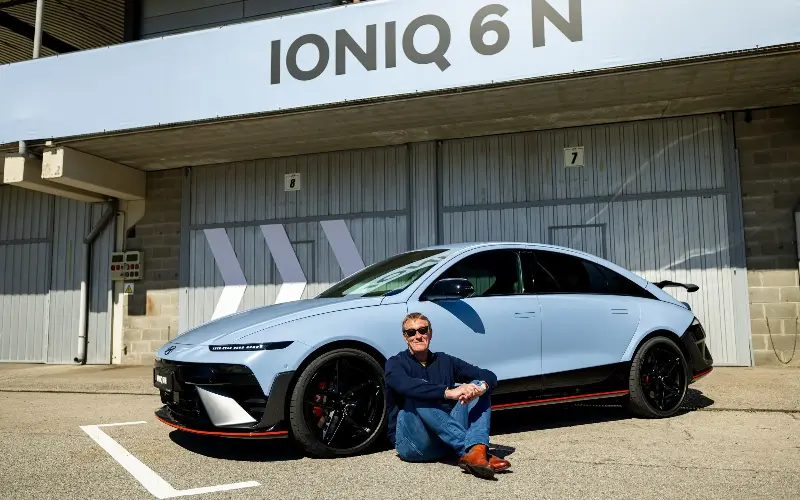
I almost bought an N-badged Hyundai, denoting the South Korean firm’s sporting brand (think of N like BMW’s M or Mercedes’ AMG). It was the astonishing i30 N hot hatchback and I was looking forward to ownership. There are various reasons why I didn’t buy it: one was the colour, a medical-scrubs light blue, but another was the helium-inhaled-pitch of over-excited owners, draped in N-blue windcheaters, gathered at automotive conventions around the world. No harm in this of course, I simply didn’t want to join their number.
I don’t suppose it will be any different with the Ioniq 6 N, the newest, hottest battery car on the block, or so they will have us think.
The preceding (and highly acclaimed) Ioniq 5 N, with its fake “gears” and simulated engine noises, has influenced the research and development departments of almost every European manufacturer, each desperate to make their battery cars more appealing to driving enthusiasts.
A fastback five-door saloon with a cute rear end and a questionable-taste boot spoiler, the 6N costs a basic £65,800 plus grey paint and sunroof (£1,250 each). I rather like the standard Ioniq 6, and this N version is being sold as a sort of dialled-back, more grown-up version of the Ioniq 5 N.
Under the skin
A 84kWh gross lithium-ion battery feeds a twin-motor 4x4 drivetrain, punching out a total of 641bhp and 568lb ft of torque (at least when using the “N Grin” overboost button, which provides 10 seconds of extra urge). In continuous form, the motors provide a steady 601bhp and 546lb ft, giving a 160mph top speed with 0-62mph in 3.2 seconds. With that sort of oomph, you shouldn’t expect the most fantastic efficiency. The 6 N’s 3.45-miles-per-kWh claim is somewhat fanciful, as I managed only 2.48m/kWh on a brisk but not super-fast route, which gives a range of 208 miles against a claim of 291 miles.
Suspension is a MacPherson strut front and a multi-link rear, as well as an electronically controlled limited-slip differential at the back. That makes it mechanically similar to the wilder 5 N, although there are different suspension bushes and geometry, with a stiffer bodyshell and mounting points. It sits on 20in wheels and tyres, which is one inch smaller than the 5 N, and as well as the spoiler, there are swollen wheel arches and a deep front splitter – like wearing a lounge suit with trainers and a baseball cap, then.
If the coupé-style shape dictates size (it’s 4,935mm long, with a 2,965mm wheelbase), then the battery dictates weight, and at 2.2 tonnes, it’s heavy for something which would pitch itself against BMW’s revered M3.
Inside information
The bucket seats are pretty much what you get with the 5 N, but they are mounted lower and are pleasingly supportive. Rear-seat passengers also get heavily sculpted seats, with plenty of legroom but poor headroom. The boot capacity is 371 litres, which is hardly fantastic in the class.
The fascia is much as the standard Ioniq 6, with a long glass screen containing the instrument binnacle and the touchscreen. The steering wheel has a normal complement of controls, plus the colourful N Grin boost switch (giving the full 641bhp for 10sec) and two N buttons to unleash the more sporting driver modes or a custom set-up.
Each driver mode has a different fascia layout and appearance; at the top end you get the fake engine noise and “rev counter” display. After giving us separate heater controls for many years, Hyundai now includes them as permanent tiles at the bottom of the touchscreen. It now puts the window switches on the centre console, too; it’s cheaper to execute and makes the wiring run easier, but why?
On the road
As I shut the door and settled into the driver’s seat, the car played a rock-style guitar chord at me, just like my washing machine. It’s a South Korean thing.
Similarly, the myriad choices of driver modes accessed through the steering wheel and touchscreen. It’s hard to imagine this as a getaway car, with the wheelman still organising his active sound, drift and torque distribution settings just as the armed police tap on the window…
The response to the major controls is measured, at slow speeds and when pressing on. And it’s phenomenally fast, although the wellbeing of your innards means you wouldn’t want to do too many fast starts. But it’s a measure of the car’s fine engineering that it managed repeated laps of hard driving with no tail-off in performance. I preferred the artificial engine noise and gear changes (they are more closely stacked than in the 5 N) on the circuit, but peace and quiet on the road.
The steering is much improved over the 5 N, with a finer weighting and better response, although it lacks the intimate delicacy of, say, the seminal BMW M3.
The ride quality is far from a disaster either; on public roads the body control is excellent, the chassis responsive and progressive if you drive hard. At times, however, it relies rather too much on the mechanical grip of the tyres to rein in the tail-happy antics of the rear end.
The brakes, too, are first rate, with a progressive-feeling pedal and strong, intuitive stopping, which blends regeneration and friction linings seamlessly.
The Telegraph verdict
On long journeys, the 6 N is accomplished and refined, quiet and well balanced, but if you use the considerable performance, you’ll be stopping to charge every 180 miles for an hour and a half. And if you take it to a racing circuit, where the 6 N is a lot of tyre-smoking fun, you’ll wish that ultra-fast chargers were more numerous.
The 6 N is certainly as billed, a house-trained version of the 5 N, and at less than £70,000 it exists in a world of its own, cheaper than the immediate German opposition but less practical than the 5 N.
It’s a solid four-star car, although it makes me wonder what Hyundai’s N team will do with the smaller Ioniq 3 when it appears later this year…
The facts
On test: Hyundai Ioniq 6 N
Body style: performance EV saloon
On sale: this summer
How much? from £68,500
How fast? 160mph, 0-62mph in 3.2sec
How efficient? 3.45 miles per kWh WLTP, 2.48m/kWh on test
Powertrain: 84kWh gross (80kWh net) lithium-ion NMC battery, with 800v operating electronics and twin motors (front 222bhp, rear 378bhp) with step-down gear for each, four-wheel drive
Range: 291 miles maximum (WLTP), 208 miles on test
Charging: 350kW DC, 10-80 per cent in 18min, 50kW DC, 1hr 21min, 7.4kW AC household wallbox 0-100 per cent in about 12 hours
Maximum power/torque: 641bhp/568lb ft on “N Grin” overboost
CO2 emissions: 0g/km (tailpipe), 31.7g/km (CO2 equivalent well-to-wheel)
VED: £10 first year, then £200
Warranty: five years/unlimited mileage, eight years/100,000 miles on battery
The rivals
BMW M3 saloon, from £91,315
The cornerstone of BMW performance, with a deftness and pace that surpasses mere numbers. Pricey though, with a wallet-wilting options list. An i3 battery version arrives this year.
Porsche Taycan, from £88,200
Lovely to drive, interesting to look at and fairly efficient, but after the initial acclaim, the Taycan has become known for poor residual values and so-so reliability.