



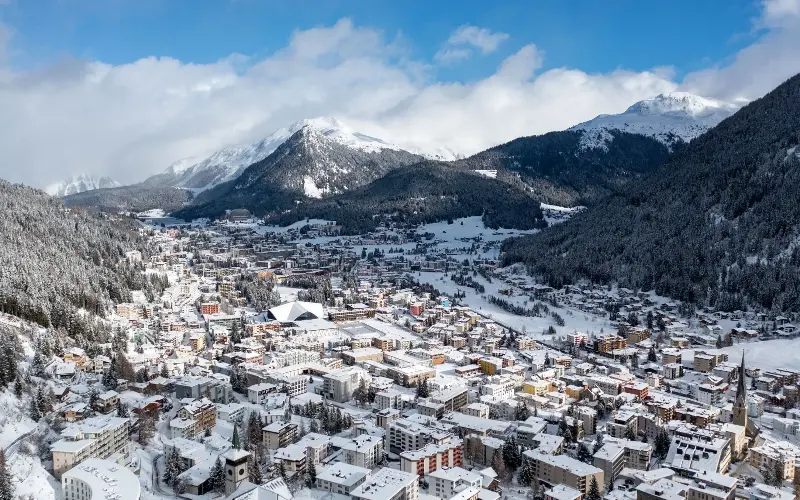
Davos is a small Swiss town with an international appeal that has always extended beyond the slopes. In Victorian times its worldwide reputation sprang from the tuberculosis sanatoriums that were built here in the belief that the crisp, clean mountain air could provide a cure or, at least, respite from the ravages of the disease. These days it’s the annual meeting place for the World Economic Forum.
Davos’s own slopes are linked to those of much smaller Klosters, and in total its ski area has six separate ski sectors with 300km of pistes and good terrain parks. The resort is ideal for intermediates, and there are also challenging black runs and off-piste opportunities for experts.
Stay on track with the essential facts from the resort below, and scroll down for our insider guide to a day on the pistes, expert ratings and advice. For further Davos inspiration, see our guides to the resort’s best restaurants and après ski.
In this guide:
Resort guide
Davos town is divided into two parts: Davos Platz and Davos Dorf. Platz is most convenient for the majority of hotels and shops, while Dorf is the best base for accessing the slopes. There’s an efficient ski bus service however, so getting from one to the other presents little problem during the day and early evening.
Davos wasn’t built as a ski resort and it’s no architectural beauty, but then skiers and snowboarders come here for the slopes, not to admire the solid and largely unenterprising blocks of hotels.
In the 1880s a local businessman bought a pair of the newfangled “Norwegian snowshoes”, as skis were known at the time. The sport captivated Sir Arthur Conan Doyle, whose wife was having treatment in Davos for TB. He shared his passion with the readers of Strand magazine and a whole new type of winter tourism was born. Conan Doyle described in detail his crossing of the Maienfelder Furgga Pass to Arosa – it’s even possible to follow in his tracks with a guide.
By far the largest of the ski area’s six sectors is the Parsenn, which has seen its mountain railway renovated for 2025/26. However, the others are all interesting, and particularly good to explore during busy high season weeks.
In 1946 the development of the wonder drug Streptomycin heralded the demise of the sanatoriums, but by then the Swiss ski industry was already starting to emerge as a suitable replacement for Davos’s economy. Since 1971 the World Economic Forum has been held here each winter, adding another financial string to the resort’s bow.
Switzerland in general (and Davos in particular) is not a destination for a snow-sports trip on the cheap. However, the resort does offer free access to local transport and a programme of complementary activities and attractions to holders of the free Davos-Klosters guest card, available via the tourist office.
There’s a solid range of quality leisure facilities, notably skating rinks and swimming pools, and after dark, plenty of bars and late night entertainment in town.
Piste guide
Beginners
For beginners, there are better resorts out there than Davos. Klosters’ Madrisa sector is novice-friendly, but far away, and the diffuse layout of Davos itself makes it extremely difficult for a party of mixed abilities to spend time together. The best bet is the Bolgen nursery slope at the bottom of Jakobshorn and at Bünda Davos Dorf. The magic carpets at Bolgen and Bünda are recent additions.
Intermediates
Davos’s ski area is linked to that of much smaller Klosters, and together the two resorts offer six separate ski sectors that are ideal for intermediates – Parsenn, Jakobshorn, Pischa, Madrisa, Rinerhorn and Schatzalp-Strela – with 300km of pistes and 56 lifts.
By far the largest of these is the Parsenn, but the others are all interesting. They can be particularly good during high season when the Parsenn tends to become overcrowded. Pischa is a dedicated freeride zone and outlying Rinerhorn is usually quiet even on the busiest weekends of the season.
Experts
Experts will enjoy challenging black runs down through the Meierhofer Tälli to the hamlet of Wolfgang as well as the more demanding itinerary routes down to Klosters, and off-piste opportunities abound, including following in the tracks of Sir Arthur Conan Doyle by crossing the Maienfelder Furgga Pass to Arosa with a guide.
Jakobshorn is a freestyle paradise, home to the large Jatzpark terrain park and superpipe, served by a fast access cable-car. Both this and the mountain station were recently renovated and refurbished, with easier access for people with disabilities and new solar panels for increased renewable energy. There’s also a challenging 2km piste that extends from the Jakobshorn summit down a wooded trail into the centre of Davos Platz.
However, the Parsenn is still the main course. The Parsennbahn funicular goes from Davos Dorf up to the 2,662m Weissfluhjoch, and is followed by a ride on a short cable car to the Weissfluhgipfel at 2,844m, the highest point in the ski area. From here a network of lifts spreads out across the mountains towards Klosters. Alternatively, there’s a 12km descent with a 2,000m vertical drop to the farming hamlets of either Küblis or Serneus on connected red runs. There is a train back to Davos from Küblis; from Serneus there’s a bus to Klosters, then a train to Davos.
Snowboarders
Davos is big on terrain parks. The Jakobshorn’s Jatzpark is much loved by freestylers and has a wide assortment of humps, boxes, kickers and rails. Both Madrisa and the Parsenn have boardercross courses and there’s also a small fun park at Rinerhorn.
Who should go?
Davos has an extensive network of linked intermediate pistes on offer in its six separate sectors of slopes. The resort is a great area for freeriders too when the snow is good, with long runs from the top of the mountains down to the valley, but its appeal to freestylers looking for terrain parks is equally compelling. Most of the accommodation in Davos is four- and five-star hotels and prices here are particularly high, even for Switzerland. But the service and quality is good and with plenty of choice for fine places to eat and stay.
Where to stay
Davos is a town of two parts; the majority of accommodation is in Davos Platz, while the slopes are more conveniently accessed from Davos Dorf. However, there’s an efficient ski bus between the two. Most of the accommodation in Davos comprises four- and five-star hotels, which are typically solid and largely uninspiring. But you can find authentic wooden Walserhaus (a traditional type of log cabin) and some family-run three-star guesthouses too. There are also serviced apartments as well as smart – and very pricey – rental chalets; one stand-out is the Alpine Inn, a historic building built as a sanatorium that has undergone an extensive renovation.
How to get there
Swiss resorts are generally more expensive than elsewhere in the Alps and Davos is no exception. This means fewer choices from the bigger UK ski operators, but Inghams (inghams.co.uk) offers one or two more affordable options, while Ski Solutions (skisolutions.com) has some four- and five-star hotels. Tailor-made packages to the resort are offered by the Switzerland Travel Centre (switzerlandtravelcentre.com) and Oxford Ski Company (oxfordski.com), while rental-only Ski in Luxury (skiinluxury.com) organises stays in two high-end catered chalets. Zurich airport is closest, and fast trains serve Landquart, for connections to Davos Platz, taking two hours and 30 minutes.
When to go
Winter opening is staggered over different areas, with Parsenn Davos and Parsenn Klosters fully open from November 28. The Jakobshorn area usually opens in the first week of December and other areas follow suit. The region generally gets plenty of snow, with most snowfall in early February. Events include the Cross Country World Cup (December); Backcountry Weeks Davos (January); Art on Ice and the Coverfestival Davos (both in March) for tribute bands playing in the ski arena.
Know before you go
Essential information
- British Embassy/Consulate in Berne: +41 (0)31 359 77 00
- Ambulance: dial 144
- Police: dial 117
- Fire: dial 118
- Tourist office: See davos.ch, the website for the Davos Klosters Tourist Board, for weather reports, lift status, webcams, traffic details and local event listings. Pick up maps, leaflets and other information from the offices in the centre of Davos and Klosters.
The basics
- Currency: Swiss franc (CHF)
- Telephone code: from abroad, dial 00 41, then leave off the zero at the start of the 10-figure number.
- Time difference: +1 hour