



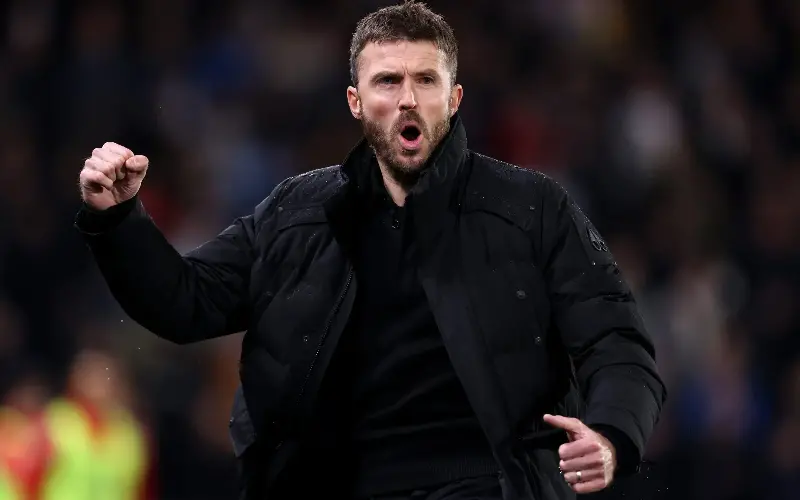
Michael Carrick has been announced as Manchester United head coach until the end of the season.
“Having the responsibility to lead Manchester United is an honour,” he said. “I know what it takes to succeed here; my focus is now on helping the players to reach the standards that we expect at this incredible club, which we know that this group is more than capable of producing.
“I have worked with a number of the players already and have obviously continued to watch the team closely in recent years, I have total belief in their talents, dedication and ability to be successful here. There is still a lot to fight for this season, we are ready to pull everyone together and give the fans the performances that their loyal support deserves.”
How Carrick’s time at Boro unravelled
Michael Carrick’s football intelligence was never in question during his 2½-year reign at Middlesbrough and while he will have much to prove as interim manager of Manchester United, being sacked by the Championship club does not mean he is destined to fail.
There was much to be positive about during his time on Teesside and he was liked and respected by chairman Steve Gibson, who was genuinely sad when they parted ways.
Carrick’s refusal to criticise his team in public or hide behind excuses when some of his best players were sold, or loan deals expired, was impressive for a young manager in his first job.
Given the power of sporting director Jason Wilcox at Old Trafford, it is worth highlighting that the former United midfielder worked well with the club’s hierarchy, particularly Gibson. His approach to recruitment has been described as “collaborative”.
Even during his disappointing final season – Carrick was sacked in June 2025 after the team had finished 10th at the end of a campaign where everyone had publicly admitted promotion was the target – relationships did not sour. Indeed, Gibson always believed that, given the right club and players, Carrick would prove himself to be an excellent manager.
According to those who worked closely with him during that time, Carrick did not display any signs of ego or entitlement. He was described by one key figure at Boro as “a man of integrity and honesty, who always told you the truth.”
He understood the budget limitations at the Riverside and, tellingly, never talked about his achievements as a player. Those who played for him insisted there was no harking back to prior achievements, no crowing about his success or moaning about their limitations compared with his own.
That is a common flaw in elite players who move into management, but Carrick understood the level he was at and repeatedly told the media – and those he worked with – that his career as a player was “irrelevant” to those he now managed and coached.
If there was one criticism that grew louder as things fizzled out in his final season, Carrick was perhaps too closed, too guarded. There were very few flashes of personality, humour or light-heartedness.
The working environment was too serious, to the point where people stopped enjoying it. In the end, as often happens, the players grew tired of his voice and bored of his methods. Things became stale and Carrick could not freshen things up.
The loss of first-team coach Aaron Danks, who left for Bayern Munich in 2024, was also a massive blow. Danks, working alongside Jonathan Woodgate, was an excellent coach and an experienced one. He led every training session. His replacement, Michael’s brother Graeme, who had been an academy coach at Newcastle United, did not go down well.
Those who know Carrick socially argue this is not a true reflection of the man he is, but perhaps, after so long in the Manchester United and England bubble, he did not think he could drop his guard or let people in from outside of his inner circle.
“He is very laid back,” one former colleague said. “As a manager he is exactly like he was as a player – very calm, methodical and detailed. He behaves how you would expect someone who played the game like he did.
“He is very approachable, easy for the players to talk to. He is not someone who lets his emotions get the better of him, good or bad. That could be a good thing going into Manchester United at the moment.”
There were, however, grumblings about his attitude towards the media. Carrick’s press conferences could be prickly affairs.
His refusal to give anything away became tiresome, his stubbornness and unwillingness to engage on topics gradually turned into a problem. There were times when he could appear condescending towards reporters who, at a club like Middlesbrough, were largely made up of people who had grown up supporting the club or at least wanted them to do well.
He ended up creating animosity where there did not need to be any. He will have to learn from that at a club like Manchester United, where every media conference is a major event and he will be bombarded with questions – often difficult and combative – before and after every game.
Perhaps his apparent ambivalence to media voices will serve him well, but you feel he will need to show a bit more charisma and personality at United.
However, Carrick’s time at Middlesbrough, with the benefit of hindsight, largely reflects well on him. When the 44-year-old was sacked after two years and seven months, he was the fourth-longest-serving manager in the Championship. Impressive longevity for a rookie.
Carrick’s early impact on Teesside was hugely impressive. Inheriting a team who were sliding towards relegation under Chris Wilder, sitting 21st with 17 points from 16 games, they surged up the table. That will inevitably encourage United to believe he can do something similar in his interim role.
In Carrick’s first season, Middlesbrough ended the season in fourth place, losing to Coventry in the play-off semi-finals. The turnaround was stunning and players and staff alike enthused about his coaching methods, man management and tactical acumen.
For three to four months, Boro played the best football in the division. Leaning heavily on a possession-based style, borrowing heavily from the Pep Guardiola school, Boro passed teams to death. With a strike force of Chuba Akpom (sold to Ajax for £12m that summer) and Cameron Archer (on loan from Aston Villa), they were potent in attack and capable of beating anyone.
When they won away at second-placed Sheffield United in February 2023, Boro appeared to be closing in on automatic promotion. The style of football was pleasing on the eye and there was a confidence and a swagger about much of what they did. That was down to Carrick, but they lost momentum late on, resting players after securing a play-off place and failing to spark in defeat by Coventry.
At the end of that season, Boro’s team were broken up by player sales and the end of loans. After a poor start in the next campaign, in which they failed to win any of their opening seven games, Boro rallied, eventually finishing eighth. It was a disappointment, but progress into the semi-finals of the Carabao Cup showed a manager who could adapt his methods and be effective against stronger opponents.
It was only in his final season that things began to unravel. Supporters began to grumble about a team that passed for the sake of it, looking to score the perfect goal. In turn, there was a softness and a vulnerability at the heart of the team. Boro constantly threw away leads and Carrick’s game management was criticised.
Having been backed in the transfer market, Gibson pulled the trigger. Carrick had run out of steam and ideas.
He has been waiting patiently for another opportunity to step back in management, reluctant to choose the wrong team or situation.
There has been plenty of interest from Championship clubs, but the former England midfielder will now get the ultimate chance to prove he can succeed in the dugout with a far more talented group of players at his disposal.
Carrick’s in-tray: Restore confidence, find cutting edge and be less predictable
Telegraph Sport sifts through some of the main challenges facing Manchester United’s new interim head coach
Qualify for the Champions League
United set a minimum target of a top-six finish last summer but they are chasing Champions League qualification now and remain well-placed to achieve it, despite winning just two of their last eight Premier League games.
More than anything, Carrick needs to win games and build some momentum – something that routinely eluded Ruben Amorim, who won just nine league matches in his last 10 months in charge and only twice won successive matches during his tenure. That was in October, when United beat Sunderland, Liverpool and Brighton back-to-back and Carrick, coincidentally, popped up on Match of the Day to praise the connections and fluidity in midfield that would soon break down again. If United get anything like the bounce Middlesbrough enjoyed when he took over in October 2022, they should finish in the top five.
Improve cutting edge
United are third for goals scored in the league this season but the campaign has been one long tale of missed chances and a significant reason why they have surrendered so many winning positions.
They have created the fourth most big chances in the competition (60) but missed the third most (40) and only four teams have a poorer shot conversion rate. No side has mustered more shots or shots on target in the division than United but they are underperforming their expected goals (xG) by 2.34. Carrick will hope he can get Benjamin Sesko, Bryan Mbeumo, Matheus Cunha, Mason Mount, Amad Diallo and Bruno Fernandes scoring.
Cut out soft goals
One goal never looked like being enough to win under Amorim. United have committed the second fewest errors leading to goals and the third fewest errors leading to shots in the top flight this season but they have managed just two clean sheets. They have a very soft underbelly and have been susceptible to opponents making fast breaks and exploiting the defensive shortcomings in midfield.
Restore confidence
Darren Fletcher admitted United’s players were in a “fragile” state and short of confidence. It is evident in how badly the team tend to respond to setbacks in games and their struggles to manage and control matches. Carrick needs to lift the spirits of most individuals in the team, get more out of them and improve the overall mood.
Make United less predictable
United’s hierarchy were left aghast when Marco Silva explained how his side exploited Amorim’s 3-4-2-1 in August. United are expected to move to a 4-2-3-1 system under Carrick but it is important the team becomes less predictable and harder for opponents to read. They must also find a way of countering teams who sit back and play a low block.
Reinvigorate Mainoo
Kobbie Mainoo started one game under Amorim this season and wanted a loan move before the Portuguese’s dismissal. The 20-year-old is well known to Steve Holland, Carrick’s No 2, from their time together with England.
Carrick and Holland must find a way to get the best out of a disillusioned midfielder who has been frozen out for much of the campaign. With the World Cup finals taking place at the end of the season, United will hope have the prospect of forcing his way back into the international reckoning serves as an extra source of motivation for Mainoo.