



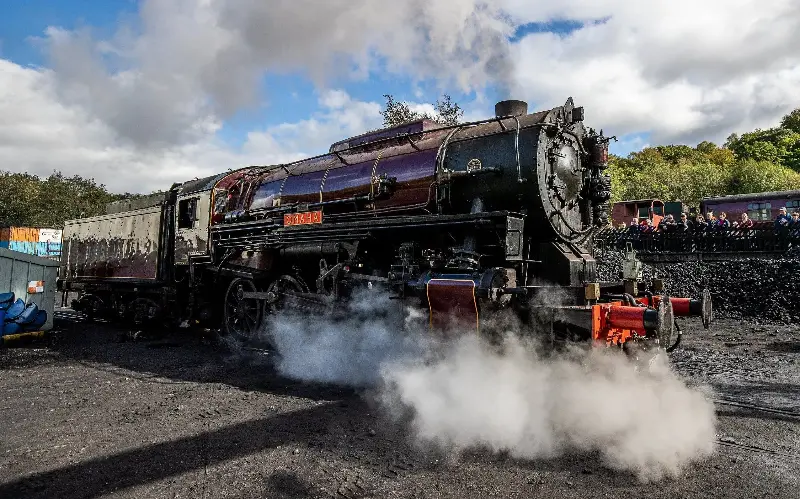
One of the largest heritage railways in the UK has stopped using coal in one of its steam engines to lower the risk of wildfires during heatwaves.
The North Yorkshire Moors Railway (NYMR) has converted one of its steam locomotives to run on diesel so it can continue running trains during hot and dry weather.
Burning cinders ejected from the NYMR’s 1943-built S160 steam engine risk setting off wildfires in the North York Moors National Park, through which the preserved railway runs.
The engine, No 2253 “Omaha”, now has a 10,000-gallon diesel tank instead of its eight-ton coal tender, and achieves a fuel economy of eight gallons to the mile.
It is the first standard-gauge steam locomotive to be modified for an alternative fuel since British Rail ended scheduled steam services in the 1960s.
Although the cost of diesel is “now about double what our coal bill would be”, the NYMR sees this as better than having to cancel its planned services during heatwaves.
There have been two heatwaves in the UK this year, and parts of the country are in the midst of a third. Record-breaking temperatures reached 37.7C in June.
Paul Middleton, the NYMR’s director of mechanical engineering, said it loses 25 per cent of its income when it is deemed unsafe for coal-burning engines to operate.
He described the modifications as a “game-changer”, and said the measures would future-proof the railway because the countryside along the rail route is “very prone to lineside fires”.
As a result of changing Omaha from coal to diesel power, Mr Middleton said: “We can run it when every other steam locomotive in the UK is parked up.
“Our railway runs 24 miles mostly through moorland. There’s a key section in the middle where we run through nine miles of a site of special scientific interest and the nature of that, with a lot of heather, a lot of peatland and bracken, means we are very prone to lineside fires,” he told The Telegraph.
“Throw in the mix that the line is very steep so the locomotives have to work hard for a living, and it is very difficult to make a coal-burning engine not chuck sparks out.
“The long periods of dry weather mean we have to look for other options, and I came to the conclusion the only way to cure this problem is to burn oil because there aren’t any spark emissions,” he explained.
‘Common sense’ decision
In the long term, Mr Middleton plans to run the locomotive on cold-pressed rapeseed oil rather than red diesel, although he foresees potential problems with the taxman.
“I’ve got a challenge with how the government will tax it because HMRC doesn’t know what to do when you burn it,” he said.
“Cold-pressed rapeseed oil is sustainable and renewable and it is from the UK, so I can finally get my locomotives back on a UK-sourced fuel, which is really important,” the engineering director said.
Converting Omaha to diesel prompted an unlikely partnership between the NYMR and US Sugar, American industrial conglomerate that operates a similar 106-year-old diesel-fired steam locomotive.
Scott Ogle, general superintendent of US Sugar’s rail division, said: “It is a common sense way to ensure these machines are going to be around for future generations.”
Davidson Ward of FMW Solutions, which designed the oil-burning equipment now fitted to Omaha, added: “We heard about the NYMR’s problems with fires and suggested oil-firing. Paul came over to Florida for a week and we let him fire the steam locomotive under my guidance and the proof is in the pudding.”
Mr Middleton concluded: “We’ve got to grab things by the horns and make some changes. I’m not going to sit around and wait for someone else to find a solution, I’m going to get on with it.”
An American design, the S160 class of steam locomotive was used by the US army transportation corps during the Second World War and ended up operating all over the world.
Coal for steam locomotives is regularly imported from as far afield as Colombia and Kazakhstan.
Met Office forecasters say there will be a third summer heatwave later this week, with temperatures climbing as high as 35C in some areas of southern England by Friday.
Some “tropical nights”, where temperatures do not drop below 20C overnight, are also expected.