



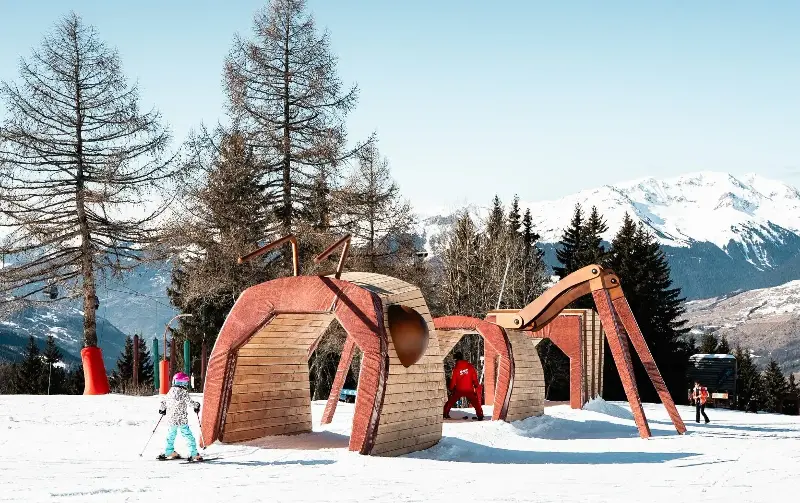
Les Arcs is one of the French traffic-free, purpose-built resorts built in the 1960s and 1970s, when large apartment blocks were in vogue – its jagged architecture was the work of pioneering French designer Charlotte Perriand. However, the resort divides opinions. Some claim it to be a contemporary masterpiece, while others prefer the traditional chocolate-box charm found in the likes of Austria and Switzerland.
Les Arcs’ slopes are remarkably varied, with plenty to suit all standards from beginner to expert, including some seriously steep ungroomed black runs and plenty of easy cruising. Its ski area is linked to neighbouring La Plagne to form the huge Paradiski area.
Stay on track with the essential facts from the resort below, and scroll down for our insider guide to a day on the pistes, expert ratings and advice. For further Les Arcs inspiration, see our guides to the resort’s best restaurants and après ski.
In this guide:
Resort guide
Les Arcs’ original resort village is Arc 1600, set at the top of the funicular up from the valley town of Bourg-Saint-Maurice, where the first hotel was built in 1968. Then came Arc 1800 a few kilometres across the mountain (and now the biggest village) and Arc 2000, 20 minutes away (12km) from 1600 by shuttle bus.
More recent development has been in more sympathetic low-rise chalet style, including Arc 1950, built in the early 2000s by Canadian developer Intrawest. It’s just below Arc 2000 and is connected by a short gondola that runs until late at night.
The Les Arcs ski area is served by a generally slick lift system, and snow reliability is good, with lots of snow-sure runs over 2,000m and plenty of snowmaking. The views over the valley to the resort of La Rosière and to Mont Blanc are stunning.
The link to La Plagne is via the two-way double-decker Vanoise Express cable car from Plan Peisey, high above the intervening valley. The joint Paradiski area has a total of 425km of pistes, putting it up there with the biggest ski areas in the world.
The numbers in the names of Les Arcs’ resort villages aren’t to be taken too seriously. Arc 2000 was named in the 1960s to symbolise the future and the far-off new millennium. The village is actually at an altitude of over 2,100m.
Arcs 1600, 1950 and 2000 are fairly compact and good for families. Arc 1800 is more spread out, with a number of the newer apartments being up the hill away from the centre. All of Les Arcs’ villages have a decent selection of bars and restaurants, plus they are all (if not quite all the accommodation) ski-in/ski-out, and it’s fairly easy to get between them on skis.
Après ski in general is fairly quiet; Arc 1800 is the liveliest, with a couple of nightclubs and some places hosting regular live music. As well as the village’s free events programme, bars here take it in turns to organise nightly concerts.
For drinks on the mountain, there’s a fun ice bar and grotto with sculptures in Igloo Village near Arc 2000 that’s open until 5pm. The area above Arc 1800 has a fun ski slope for kids and a toboggan run that are floodlit until early evening.
On the opposite side of the ski area, near the link to La Plagne, Plan Peisey and Vallandry have been built in low-rise chalet style above the traditional village of Peisey, which is linked to the newer development by a bucket gondola lift. Both villages have a handful of bars, restaurants and shops.
Piste guide
The local Les Arcs ski area has plenty to keep most people of any standard happy for a week, with 200km of nicely varied pistes above and below the treeline and lots of off-piste options.
The resort operates an innovative lift pass system to broaden its appeal to skiers and snowboarders of all levels. There’s a choice of paying €348 for a six-day Classic Pass, covering Les Arcs and Peisey-Vallandry only; €389 for a six-day Essential Pass, with full access to the Paradiski area; and €463 for a Premium Pass, which offers the Paradiski area as well as first tracks, priority lane for the Aiguille Rouge lift, access to the resort pool, zip line and toboggan runs.
Winter 2024/25 saw the relaunch of Transarc, the connection between the Arc 1800 resort and the peaks. The gondola was updated with seats, a faster ascent (reduced from 20 to 13 minutes) and lower electricity consumption.
Beginner
Each of Les Arcs’ resort villages has its own local slopes linked to the others, a beginner area and easy blue slopes for progression. Les Arcs has reclassified 10 of its easiest slopes, which are now marked green and ideal for beginners wanting to level the nursery field.
A lot of the blues are on the narrow side or are narrow traverses across the mountain, so it helps to know the best places to go. The best easy blues are the quiet slopes served by the St Jacques chairlift from Arc 2000 – ideal for beginners taking their first runs after the nursery.
Les Arcs has two beginners’ progression areas – one in Arc 1800 and one in Peisey-Vallandry. These offer three zones aimed at the first few days on the slopes, focusing separately on “first slides”, “first turns” and “first descents”. The beginners’ zone in Peisey-Vallandry is at the top of the Vallandry cable car, which has a big picnic area and the Museum of Mountain Animals.
Intermediate
The Pré Saint Esprit, one of the longest chairlifts in France, starts below Arc 1950 and finishes well above Arc 2000. This lift serves the gentle and wide Vallée de l’Arc blue run. Furnished with snowmaking, it makes for a lovely easy slide down from 1950.
The other best gentle, wide blues for easy cruising are Mont Blanc above Arc 1600 and Renard above Peisey-Vallandry. Mont Blanc is reached from the Mont Blanc chair and is a little out of the way, so it’s often delightfully quiet. Renard is a lovely long blue that goes from top to bottom of the Derby chair.
Most of Les Arcs’ red runs are distinctly steeper than the blues but are at the easier end of the red scale, so they’re good for fast cruising. The ones through the trees above Peisey-Vallandry – Aigle, Morey and Myrtilles – are relatively quiet, wide and delightful in all conditions, but especially when it’s snowing and visibility is poor on the treeless slopes higher up.
The long red run down to the tiny village of Villaroger at the opposite end of the ski area to Peisey-Vallandy is also a lovely quiet cruise. It is well worth doing despite the three slow chairlifts needed to get back up.
The red run from the resort’s high point of Aiguille Rouge (3,225m) is a narrow track for much of its length but has several worthwhile wider pitches. At the summit, there’s a panoramic walkway accessible to both skiers and non-skiers to admire the views.
Expert
For experts, the steepest black runs are above Arc 2000, most served by the Varet gondola. The majority aren’t groomed (the resort calls these “Nature runs”) and there can be huge moguls, but the snow there is generally in good condition because of the shady aspect.
Those who are keen to cover as much ground as possible will want to take the double-decker Vanoise Express cable car over to La Plagne for a day or two during their stay.
Off piste
Some of the best off piste is on the open slopes reached from both the Aiguille Rouge cable car and the Varet gondola, which has a café, sun terrace and zip line at its summit. It’s also possible to go over the back from the Aiguille Rouge on secluded slopes towards Villaroger, a descent of almost 2,000m. The routes from the Grand Col and Col de la Chal are also recommended.
Snowboarding
The terrain park on the slopes between Arcs 1600 and 1800 is top-notch, with separate lines clearly marked for different ability levels of freestylers, plus an airbag for a soft landing while practising jumps.
Who should go?
There is plenty to suit all abilities in Les Arcs, with varied pistes that range from easy cruising to steep black runs. Experts will particularly enjoy the area; most of its black runs are never groomed and become huge mogul fields, plus there’s lots of accessible off piste, with steep pitches on the front of the Aiguille Rouge and secluded runs off the back. The purpose-built nature of the resort means most accommodation is ski-in/ski-out, and the connection to Bourg St Maurice makes it one of the most popular resorts with skiers who enjoy travelling by train to the Alps.
Where to stay
Accommodation is spread out between the separate villages, each with its own bars, shops and restaurants, and nursery slopes. These are connected by pistes and free shuttle buses. Hotels exist but apartments are the most common form of accommodation, varying widely in style and comfort. Arc 1800 is more spread out, with some apartments located up the hill away from the centre. It is the liveliest, with a couple of nightclubs and bars hosting regular live music. Plan Peisey and Vallandry have been built in low-rise chalet style above the traditional old mountain village of Peisey.
How to get there
Several UK tour operators have catered chalets and apartments, including Ski Beat (skibeat.co.uk) and Ski World (skiworld.co.uk). There are few hotels; Club Med (clubmed.co.uk) offers Les Arcs Panorama at the top of Arc 1600, and Crystal (crystalski.co.uk) offers Les Arcs’ only five-star property – the ski-in/ski-out Taj-I Mah in Arc 2000.
Train travel is easy, arriving via Bourg St Maurice with transfers by funicular to Arc 1600 (seven minutes), and free buses on to the higher resorts. Travelski Express (uk.travelski.com) and Inghams (inghams.co.uk) offer train-based packages from the UK.
When to go
Les Arcs’ ski season starts in mid-December and runs until the end of April. The glacier and high elevation ensures reliable snow, with plenty of runs over 2,000m and a highly efficient snowmaking to top up the pistes overnight. Reliable snowfall means the purpose-built accommodation is largely ski-in/ski-out even in spring. The main winter event is the Electronic Peak Festival, which takes place in March, and Arc 1950 is also known for its Film Festival in December.
Know before you go
Essential information
- British Embassy/Consulate: 00 33 1 44 51 31 00; gov.uk
- Ambulance (samu): dial 15
- Police: dial 17
- Fire (pompiers): dial 18
- Emergency services from mobile phone: dial 112
- Tourist office: See lesarcs.com, the website for Les Arcs Tourist Board, for weather reports, lift status, webcams, traffic details and local event listings. Pick up maps, leaflets and other information from the offices, based in each of the four villages.
The basics
- Currency: Euro
- Telephone code: from abroad, dial 00 33, then leave off the zero at the start of the 10-figure number.
- Time difference: +1 hour
Local laws & etiquette
- When greeting people, formal titles (Monsieur, Madame and Mademoiselle) are used much more in French than in English.
- The laws of vouvoiement (which version of “you” to use) take years to master. If in doubt – except when talking to children or animals – always use the formal vous form (second person plural) rather than the more casual tu.
- When driving, it’s compulsory to keep fluorescent bibs and a hazard triangle in the car in case of breakdown. Since 2021, it’s also compulsory to have snow chains in your car or winter tyres from the beginning of November until March.