



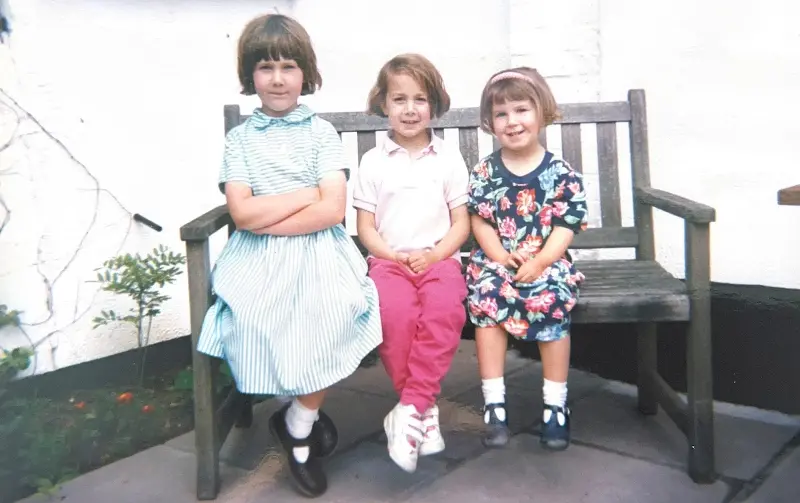
What do Princess Charlotte, Britney Spears and Tony Blair have in common? Okay, they are not normally grouped together, but besides being world-famous for a variety of reasons, they are all middle children. However, among the general population in the UK, families of three children may be facing extinction. With a birth rate of 1.41 children per woman in England and Wales in 2024, the lowest for the third year in a row, soon there might not be any left. And while the declining birth rate may be understandable given the cost of living, the loss of the competitive, rebellious, risk-taking middle child will be a great blow to mankind.
Why are middle children so special? Simply put, in a family of three children, a middle sibling has their unique experience of familial dynamics. In popular culture, they tend to be portrayed as either extremely talented and outspoken (as for example, the ferociously clever Lisa in The Simpsons) or continuously underestimated (think Downton Abbey’s Edith Crawley). The idea of the overshadowed, forgotten and forlorn middle child was suggested in the early 1900s by psychotherapist Alfred Adler. This idea has given rise to “middle child syndrome”, although not (yet) a recognised condition.
Growing up, I was the oldest of three sisters. My middle sister, Jessie, younger by 18 months, was a determined, athletic rule-breaker. While she was graceful, socially adept and fearless, by contrast, I was a rhythmless, rule-loving bookworm who disliked going outdoors. Our youngest sister, Eleanor, 31, was often the peacemaker and occasionally the rope in our literal tug-of-war.
Being one of three was formative; I always had two people in my corner if under attack from the outside world. My debating skills were top-notch because of all the arguing, and everything had to be split into thirds, stretching our parents’ tolerance to the limits.
How did being a middle-child shape my sister Jessie? Now 33, Jessie asserts that as she was neither the baby nor the older, more responsible one, she instead became fiercely independent early on. “I think I was stronger as a result, but I don’t know if that’s because I’m the sort of person who wanted to know how to do my own thing, rather than being reliant on following my older sister or being looked after by my parents.
“I wanted to be different and set myself apart, I was a tomboy and wanted to be the opposite of my older sister.” Today, she’s very independent – she’s the one moved furthest away, but she admits to feeling “extremely protective” of us siblings.
For most of our childhood, Eleanor, our youngest sister, wanted to emulate Jessie, while I wanted to compete with her. Although we’re best friends now, we wouldn’t have said the same growing up.
“I find it bizarre that the middle child might be known as the peacekeeper,” says Jessie. “My older sister was clever, and our parents were very proud of her, while Elle was the baby, and so I was just wild, but I don’t know whether that’s my character or because I wanted attention.
“If Alexandra had friends over, I’d do things like jump from the high platform of my treehouse to get them to notice me, hoping I didn’t break my arm.” Jessie says she’s not sure if she believes in middle child syndrome. Readers are free to come to their own conclusions after reading the following: “My biggest childhood success was when I convinced both Alexandra and Elle to run away with me,” says Jessie. “It was so hard to get Alexandra to follow me, but this time they were both on board. We packed up some sandwiches and took our piggy banks and marched off, although we didn’t get very far.”
The legacy of birth order
Counsellor Georgina Sturmer, who offers online relationship guidance, says: “There are so many stereotypes which relate to birth order, including the middle child who gets a bit squashed and left to their own devices, whether that’s to their detriment or benefit.” Sturmer, a younger sister herself, believes there are “many factors” which have an impact on how children develop, different even between siblings in the same family.
Sturmer says: “The way we behave as adults is built on what we learn as children. We are given a place in our family by society, so when we are told that the middle child is independent and self-sufficient, we can’t help but live up to it.
“The middle child will learn they are praised for looking after themselves, and it becomes a self-fulfilling prophecy.
“There is a really complex set of factors influencing character, and birth order is one of them, but more significant must be the attachment dynamics within our families and how responsive our parents are to what’s happening.
“If we are told to not make a fuss, that might translate to an adult who on the outside is good at getting on with it, but that doesn’t necessarily mean they are looking after themselves. The way we are treated in our families does impact how we behave, but birth order is one of many factors.”
What about the theory that smaller families – with just a singleton or two children – are quieter, more harmonious domestic units? Sturmer says: “There’s no set formula for how well everyone will get along. Every set of family dynamics is composed from a different and very individual recipe of factors.”
In speaking to four adult middle children for this article (read their thoughts below) and quizzing my own sisters, I’ve learnt that while three may feel like a crowd at times, those in the middle work hard for recognition, while sometimes being the glue which holds the family together. Maybe that’s why the ones in the middle are seen as somewhat fiery, but always fiercely loyal.
And in a scenario my sister would have loved growing up, I’ve given her the final say.
Jessie says: “I think it’s really sad that middle children are dying out… It’s inevitable because people can’t afford large families, but a two-child family is very different from one with three-plus children. My sisters are now definitely my best friends.”
Four grown-up middle-children have their say
The determined one
Martyn Sign, 43, a mechanical engineer, lives in the New Forest and is the middle of three brothers.
“I would say middle child syndrome exists; there is a pecking order. However, while I think being a middle child has an effect, it also comes down to parenting. I was always striving for perfection but felt I never quite knew what was good enough.
“It’s left me with a determination to be the best at whatever I do. While I’m an extrovert, my older brother Graeme, 45, is quiet and introverted, and my younger brother Alain, 40, is a mixture of us both. While we don’t live in each other’s pockets, now we are always there for each other. Are we good at sharing? When it comes to food – and other things – it all has to be equal. And we all still eat fast, because if you don’t eat fast, your food goes.”
The easy one
Louisa Hussey, 46, a menopause trainer and therapist from south Manchester, has an older sister, Gabrielle, 48, and twin younger sisters, Madeleine and Elizabeth, both 41.
“I always felt identified with being the one in the middle, I wasn’t the oldest, responsible one and I wasn’t the baby needing attention. After the twins were born I wasn’t allowed to be carried any more. We are all very close now, and speak regularly, but I remember my older sister always having to be sensible and the little ones always being naughty, while I would be the easy one, not giving my parents any trouble... I’m freaked out by the idea that the middle child might be dying out.”
The independent one
Chartered accountant Catherine Picton-Turbervill, 31, of London, is the middle sister of two brothers, Ed, 32, and James, 29.
“I look back with very positive, fond memories of my childhood. I loved my brothers and got on very well. Obviously we had disagreements, as any siblings would, but on the whole we really did get on. My brothers are much more similar than I am. They are creative, and I’m more numbers-based. [Growing up] I was quite conscious of not being the same as them, and as a result I was very independent. I wanted to be successful, getting a good job and working hard, to prove I could do it…
“Thinking of middle children becoming extinct makes me very sad. If I am ever lucky enough to have a family of my own, I would love to have three children with a daughter in the middle because I had such a lovely experience. Contrary to the stereotype of the squashed middle child who gets forgotten about, I feel I got the attention I needed, but as the second child I was always in the middle seat in the car; I was never in the window seats!”
The rebellious one
Rachel Coles, 31, a marketing chief executive from Brentwood, Essex, has an older brother, Sam, 32, and a younger sister, Naomi, 27.
“Growing up, I was the definition of the middle child, the one who was up to no good. My first memory of my little sister is the day she was born. I had asked for a sister all the way through the pregnancy, and when she arrived, I said I wanted a little brother!
“The worst thing was having to split everything in three, I used to think I could have had a bigger slice of cake if my mum hadn’t had my sister. Now I’m the peacemaker between my brother and sister, but as children, I caused a lot of arguments.
“I think being a middle child makes you more independent. We are typically the rebellious ones, not scared of pushing the boundaries, but we are good people, just misunderstood. I always remind my siblings, ‘I was once the youngest’.”