



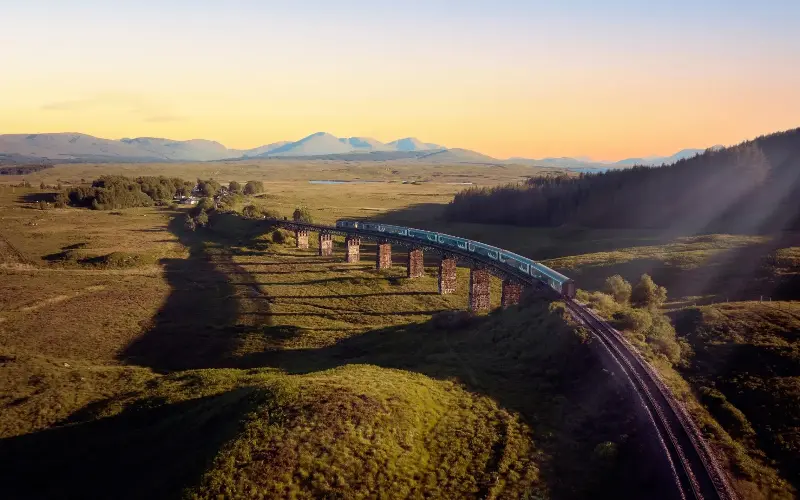
I do love a good sleeper train – especially when it comes laced with history, drama and a wee dram of malt whisky. That and more is the promise of the Caledonian Sleeper, a service that in one form or another has been transporting passengers between London and Scotland since 1873.
In its illustrious history, the train – one of just two sleeper services in the UK – has gone through numerous incarnations, both public and private.
I travelled on it in 2016 when it was a pretty tired old thing desperately in need of a facelift. That facelift came in 2019, with the introduction of gleaming new carriages, more stylish accommodation, better drinks and meals, extended en-suite facilities and even – in top-tier compartments – double beds.
So, 10 years on, would my second experience of the Caledonian Sleeper live up to expectations? On the whole, the answer was yes – but there was one major disappointment.
The routes
There are two Caledonian Sleeper routes – the “Lowland”, connecting London with Glasgow and Edinburgh; and the “Highland”, between London and Aberdeen, Inverness and Fort William, with stops including Dundee, Aviemore, Gleneagles and – since January 2026 – Birmingham. I wanted the full experience, so opted for the longer journeys between London and Aberdeen on the way up and Fort William and London on the return.
The cabin options
The revamped cabins are certainly easier on the eye than the rather drab ones I remembered: a pleasing palette of white, grey and brown is complemented by subtle traces of tartan. They are, of course, compact, but the beds are comfortable enough if you, like me, are of average height and build and enjoy the sensation of being rocked to sleep by a train in motion.
Classic cabins come with upper and lower bunks, a sink, limited storage space, and access to a shared WC down the corridor. Club cabins have an en-suite WC/shower room. Caledonian Double en-suites contain a modest-sized double bed.
There are two wheelchair-accessible rooms. Interconnecting doors between classic rooms are popular with families and groups of friends. All rooms – entered using hotel-style key cards – come with an amenity kit including an eye mask and earplugs, charging points for phones, and, in the higher-grade compartments, Arran Sense of Scotland toiletries.
For budget travellers, there is a seat-only option.
Food and drink
I enjoyed one of the best meals of my life. It wasn’t the splendour of the food – nice, though the smoked salmon followed by haggis, neeps and tatties was – but rather the sensational accompanying views as the train headed south from Fort William, passing mountains, lochs and glens. Wine, whisky and conversation flowed.
The Club Car itself is a contemporary space consisting of several bays with seats around tables and individual swivel chairs – smart but informal. Less obvious dishes include cream of mushroom and miso soup and lentil ragu with potato rosti.
Breakfast ranges from a full Scottish (including haggis, black pudding and toasted tattie scone) to a continental variation involving fresh fruit and Greek-style yogurt. The food is not gourmet, and the portions are not huge, but dining on a train is always a treat – on this one, doubly so.
Showers and WCs
I initially felt uncomfortable about the proximity of the loo and shower in my very compact en-suite bathroom (shouldn’t those two things be a bit further apart?). But I took the plunge anyway; it’s a perfectly functioning shower, if not overly powerful, and the water drains away quickly.
Access to lounges
While there’s nothing too fancy about the Caledonian Sleeper station lounges to which passengers in the higher-grade cabins have access, it’s always nice to be away from the concourse crowds, and at London Euston, I took the opportunity to try (for the first time) that legendary Scottish beverage, Irn-Bru. It’s clearly an acquired taste. Otherwise, there were complimentary shortbread biscuits, tea and coffee and alcoholic drinks to purchase.
The dedicated lounges are at Euston, Fort William and Inverness, the first two offering shower facilities. On return to Euston, I enjoyed a post-journey chat in the lounge with a friendly couple from Dundee who, having made the most of the Club Car facilities the night before, fancied freshening up ahead of a night or two on the town in London.
Service
The news that my train to Aberdeen had been forced to return to London Euston in the night because of severe damage to overhead wires north of the border was not exactly what I wanted to hear at 5am. But the carriage attendant delivered it with just the right tone of apology and sympathy – and, crucially, talked me through Plan B – the 06.15 from nearby King’s Cross, which would get me to Aberdeen (via Edinburgh) in time for a late lunch. It’s easy for staff to be upbeat and charming when all’s going well – as I saw on the return journey from Fort William – but that tricky 5am knock required real professionalism and tact.
Caledonian Sleeper can’t be blamed for these technical problems, of course, but it did rather spoil what should have been my first morning in Scotland. On the glass half-full side, I enjoyed the wonderfully scenic stretch of track between Newcastle and Edinburgh in daylight.
The staff on the train wear their Scottish-themed uniforms with pride. They know that for many passengers – a large number of whom come from abroad – this is a bucket-list journey and they are keen to ensure it lives up to expectation; they will even – for those who have the stomach for it – provide an explanation of what exactly haggis is.
Insider tips
Make a beeline for the Club Car, as it fills up very quickly. Club and Caledonian Double passengers have priority, but space is limited so it’s best to get in early.
If you want to do the journey by night one way and day the other – as I ended up doing – think about whether you want the Highland scenery in the early morning or over a lengthy, lingering sunset.
Journeying towards the Highlands, face forwards; journeying away, face backwards. All trains can be jerky; for the smoothest ride, pick a room in the centre of a carriage.
Best time of year to go?
I wanted to make the most of the fabulous Highland vistas, so I travelled close to the summer solstice (June 21), when sunrise is around 5am and sunset well after 10pm. But all seasons have their magic, and the sight from a cosy cabin window of misty moors on a frosty, wintry morning would also warm the cockles. Fares also tend to be cheaper in the colder months.
Is it worth the money?
Travelling on the Caledonian Sleeper, particularly in the better class of cabin, is not cheap (see below), and there are passengers who feel that for such a high price, it should be properly luxurious. To be fair to the Caledonian Sleeper, it doesn’t bill itself as that, nor are its prices anywhere near those charged by real luxury trains such as the Venice Simplon-Orient-Express and The Royal Scotsman. But the Caledonian Sleeper – a Scottish Government-owned enterprise – offers a unique, iconic experience, and travelling this way does save the cost of a hotel room. I experienced it in all its variations, good and bad. Would I do it again? Absolutely.
Departure days/times
Both variations of the Caledonian Sleeper operate every night of the week except Saturdays. The Lowland train leaves London Euston at 23.45 (23.30 on Sundays), arriving in Glasgow/Edinburgh at 07.30. For the reverse journey, departure from Glasgow and Edinburgh is at 23.40 (23.15 on Sundays) with arrival at Euston at 07.15.
The Highland train leaves London Euston at 21.15 (21.00 on Sundays), arriving (after splitting into three sections) at Aberdeen at 07.50, Inverness at 08.45 and Fort William at 10.00. For the reverse journey, departure from Fort William is at 19.50 (19.00 on Sundays), Inverness at 20.45 (20.25 on Sundays) and Aberdeen at 20.26 (21.43 on Fridays and 20.36 on Sundays), with arrival at Euston at 08.00.
Departures heading north from Birmingham are at 22.42 (22.35 on Sundays); arrival in Birmingham on the southbound service is at 06.20.
See Caledonian Sleeper for a full list of stopping points.
The price – and how to save money
One-way prices are as follows: Classic Solo: £210-£305; Classic Twin: £290-£405; Club Solo: £270-£420; Club Twin: £360-£520; Caledonian Double Solo: £410-£475; Caledonian Double Twin: £495-£570. Accessible rooms cost: £210-£305 (solo) and £290-£405 (twin). Seats are £54-£100.
For lowest prices, book early (tickets go on sale 12 months in advance), avoid peak days such as Sundays and Fridays, travel in off-peak months such as February and November and check special offers for families.
How and where to book
Tickets can be booked at Caledonian Sleeper or by phone on 0330 060 0500. Rail specialists, which include travel on the Caledonian Sleeper as part of a mini-break to Scotland, include Byway and Railbookers.