



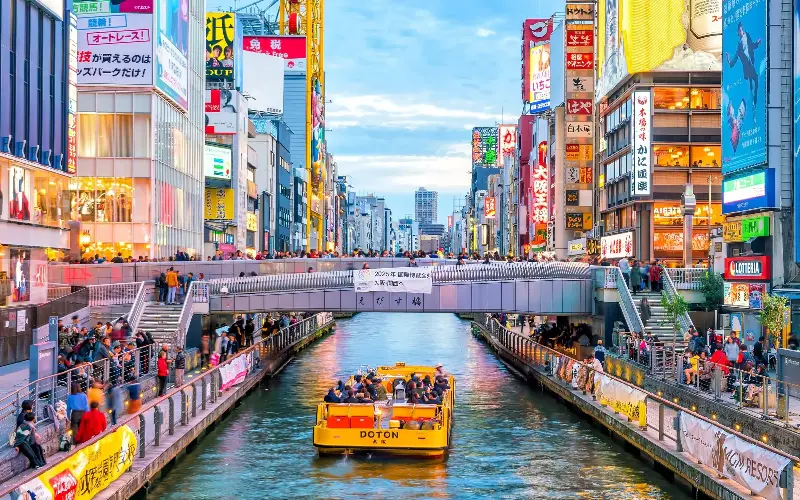
As any local will tell you, Osaka is proudly different. Japan’s third biggest city has a reputation for being fun-loving and energetic, with a colourful dialect that distinguishes it from Tokyo and locals who love a good deal almost as much as a good meal.
Where nearby Kyoto has its historic sites and traditional experiences, Osaka delivers a vibrant burst of modernity with white-knuckle rides at Universal Studios Japan and the kinetic, neon-lit streets of its Dotonbori entertainment district. Throw in the country’s most addictive comfort food and kaleidoscopic nights of karaoke with strangers, whisky tastings, or drinking in death metal hangouts, and you’ll soon see why Osaka is so easy to love.
For more Osaka inspiration, see our guides to the city’s best hotels, restaurants, bars and things to do.
In this guide:
How to spend the perfect weekend in Osaka
Day one: morning
Begin by working your way through some of Osaka’s top attractions. A good starting point is Osaka-jo, a towering 16th-century castle restored to its Edo-period resplendence in the 1990s. The keep delivers sweeping city views and is home to displays of samurai weaponry and armour. After a tour, stop off at the teahouse in the garden for matcha and sweets. Across the castle grounds, the Osaka Museum of History shines a light on the story of the city itself, covering Osaka from the 8th to early 20th century.
To keep the morning focused on the past, hop on the Osaka Loop Line from Osakajo-koen to Tennoji, then stroll up to Shitennoji, one of Japan’s oldest temples – on the 21st and 22nd of the month, the flea market here is a lively place for finding antiques or secondhand bargains.
Afternoon
From Shitennoji, walk through leafy Tennoji Park to Shinsekai, an offbeat district with retro billboards, tiny streets and hundreds of places to grab a bite to eat – the deep-fried skewers of panko-coated meat, seafood and vegetables at Kushikatsu Daruma are one of Osaka’s low-cost culinary specialities. Afterwards, browse the cluttered aisles of Don Quijote, where the eclectic stock includes everything from Pokemon underwear to sake-flavoured Kit-Kats.
After all that walking, unwind with a few hours at Spa World. It has traditional Japanese onsen (hot spring baths), Turkish baths, saunas, swimming pools with slides, and plenty to do once you’ve dried off – karaoke included.
Late
For a night out, head northward to Dotonbori to experience the crowds, neon billboards and energy of Osaka’s busiest entertainment district. There are endless places to eat around here, but for a unique contrast, turn onto the stone-paved, lantern-lit alleyway of Hozenji Yokocho, where you can enjoy some respite from the clamour with savoury okonomiyaki pancakes at Yakizen.
For post-dinner bar hopping in and around Dotonbori, start with some retro gaming and video game-inspired cocktails at Space Station Osaka, then hit Moonshine Karaoke Bar for a singalong with strangers, before winding down at uber-fashionable Subterra. If you get peckish afterwards, Takotako King does an excellent version of Osaka’s most cherished street food, takoyaki – chopped and battered octopus cooked into balls in special molds and then smothered in rich umami sauce, mayo and bonito flakes.
Day two: morning
If you want a big day out, devote all morning and afternoon to Universal Studios Japan and its immersive Harry Potter and Nintendo themed worlds – there are a huge mix of rides to keep both small kids and thrill seekers thoroughly entertained. If not, head north to the Cup Noodles Museum in Ikeda for one of Osaka’s most distinctive experiences – you can spend a couple of hours here designing, making and packaging your own one-of-a-kind cup noodle.
Afternoon
Back in the heart of the city, browse the seafood and produce stalls at Kuromon Market, where you can also grab fried noodles and gyoza dumplings for lunch at Miyoshi Kuromon. From there, walk north to Shinsaibashi-suji. One of the liveliest shopping streets in Osaka, this covered arcade has brand name stores like Gucci, Onistuka Tiger and Calvin Klein, but also shops selling everyday essentials and secondhand fashion. It’s a real mishmash.
For something off the beaten path, make a beeline to Nakazakicho, a low-key neighbourhood close to the busy streets of Umeda that in recent years has taken on a bohemian vibe with its vintage clothing shops, galleries, and independent cafes – Yatt is a stylish spot to stop off for a flat white or matcha latte.
Night
Head to Umeda for the night views from the Kuchu Teien Observatory on the 40th floor of the Umeda Sky Building. The 1920s-themed basement of the building has a collection of restaurants for any budget – including decent sushi, okonomiyaki and ramen – but nearby there are plenty of places to splurge on an unforgettable meal. Numata, for example, has earned two Michelin stars for its tempura, while a few metro stops away Hajime’s innovative haute cuisine has garnered three Michelin stars.
Finish the evening off with a nightcap at CRAFTROOM, around the corner from Numata. Take a counter seat to watch the bartenders mix up creative reimaginations of classic cocktails – and non-alcoholic concoctions too.
When to go
Spring and autumn both have great temperatures for being out and about, although cherry blossom season (late March to early April) and the Golden Week holidays (late April to early May) can see a spike in room rates. Mid-June to mid-September will be hot and humid – especially July and August – so plan on doing a little less if you go then. You might encounter a typhoon or three during the peak season in August and September. As for winter, apart from the year-end holidays and an influx of visitors during Lunar New Year, December to March is the quieter off-season, and (everywhere but the snowy north) the weather is usually mild enough to enjoy the outdoors.
Where to stay
Luxury living
Art Deco New York meets clean-lined Japanese design at the Waldorf Astoria Osaka, which has planted a flag as the best hotel in the city. In-demand architect André Fu’s latest project brings high glamour to Tokyo’s looser counterpart, most notably in the glassy central lounge, which seems destined to be the setting for celebrations and big business deals.
Designer digs
Zentis is a sleek hotel housed in a 16-storey tower in downtown Osaka – and the Japanese city’s very first Design Hotels member. It is home to 212 mid-range guestrooms, a signature restaurant, outdoor terraces and playfully natural and contemporary interiors by London-based studio Tara Bernerd.
Budget bolthole
WAQOO Shitaderamachi combines the charm of a historic inn with the boutique comforts of a modern Japanese hotel. Designed in shukubo (temple-lodging) style, the space mirrors the tranquility of nearby Shitennoji, and the approximately 80 other shrines in the area. Doubles from £82.
How to get there and how to get around
There are currently no direct flights between the UK and Osaka (Kansai International Airport), but there are options for connecting flights via Tokyo, Helsinki, Hong Kong and Seoul. If visiting Tokyo first, bullet trains (shinkansen) run from Tokyo to Osaka multiple times per hour. In Osaka, the Osaka Metro and a combination of rail lines will get you anywhere you want to go.
Know before you go
Tourist office: en.osaka-info.jp
Currency: yen (¥)
Telephone code from abroad: +81
Time difference: GMT +9
Travel time from London: at least 16 hours by plane (no direct flights)
Accessibility
Osaka Metro has elevators, ramps and multi-function restrooms, and staff can assist wheelchair users when it comes to getting on and off carriages at platforms with gaps. The Japan Accessible Tourism Centre has handy info on transport and attractions.
About our expert
Rob Goss
Rob has lived in Japan for almost 25 years and has been writing about the country and its culture for almost as long. He currently lives in east Tokyo, navigating the first steps of empty nest syndrome with his Osakan wife and a shiba called Henry.