



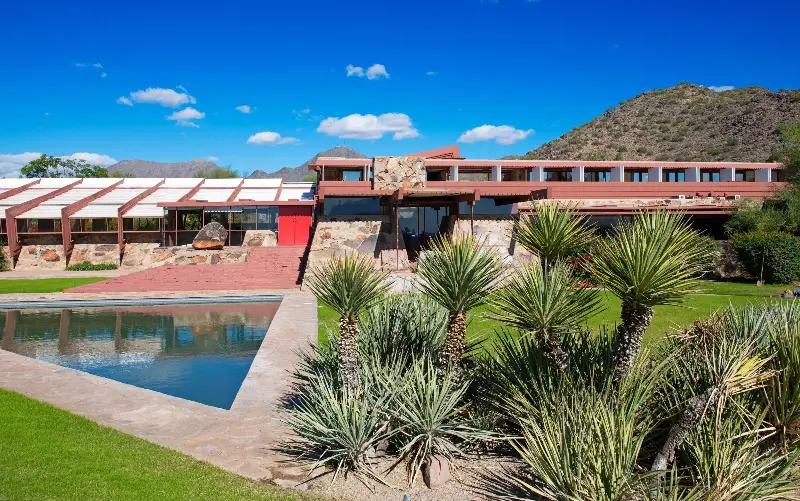
I first learnt the true power of Frank Lloyd Wright on a dusty Arizona afternoon, shortly before sunset. Driving from Scottsdale up to Taliesin West, the architect’s desert compound in the foothills of the McDowell Mountains, I had little idea what to expect. What I found was an unexpected meditation on happiness.
The first time you visit, Taliesin West sneaks up on you. The low-lying complex is hidden on the uphill drive, melting into the rust-coloured mountains as a textbook example of Wright’s “organic architecture” philosophy. It integrates into the landscape, with walls constructed from desert rocks and a peaked red roof echoing the ridge line above it.
When Wright – generally considered the greatest American architect of the 20th century – first purchased this land in 1937, he telegrammed his assistants to hurry to Scottsdale with two things: shovels and violins. Wright had cultural as well as architectural ideas to explore here, and he intended to do so joyfully.
That creative spirit lives on at Taliesin West, I learnt, as I was shown around the compound by Henry Hendrix of the Frank Lloyd Wright Foundation.
“As both a studio and a laboratory, Taliesin West was intentionally rough-hewn and experimental,” says Hendrix, leading me through the entrance and into the Garden Room, Wright’s luminous personal lounge with its expansive windows and skylights. “The buildings were designed not to dominate the desert, but to work in harmony with it. Open passages, terraces and carefully placed structures allow light, air and even wildlife movement to remain part of the experience.”
That blurring of lines between indoors and outdoors is a common theme throughout Taliesin West, making the whole place feel like a working compromise between human architecture and the untamed wilderness. It’s particularly apparent in the massive Drafting Studio, where Wright and his apprentices worked diligently beneath triangular beams and translucent canvas panels, sketching their ambitious ideas – including his groundbreaking design for the Guggenheim in New York – while desert light shifted across their desks.
“At its core, Taliesin West is a place dedicated to creativity,” says Hendrix, as we explore its squat passageways, avant-garde rooms and dramatic sunlit courtyards together. “It shows that environment matters: spaces designed to inspire reflection, collaboration and connection to nature can encourage more innovative thinking.”
One of Wright’s favourite innovations used here is “compression and release”: tight hallways with low-angled ceilings hiding expansive rooms beyond. As you move out of the narrow, awkward space and into the sweeping, light-filled interior, you instantly feel happier.
From ingenious geometric furniture to acrylic roof systems working as giant light diffusers, the design tricks here are manifold, and all geared to making happier, more creative spaces for happier, more creative people. Put simply, Wright was a master at harnessing the emotional and psychological effects of well-designed rooms.
“Taliesin West reflects the idea that people thrive when their lives are in harmony with their surroundings,” says Hendrix, as we finish our tour on the property’s dramatic Prow, a triangular vantage point extending over the desert. “Wright believed that architecture should support human wellbeing by creating spaces that feel not only connected to the outside world, but also purposeful in function and beautiful in experience.”
So what can we learn from this extraordinary desert outpost that can make us happier and more creative in our own lives?
“The campus suggests that happiness is often found in simplicity, intentional living and a stronger relationship with the natural world,” says Hendrix. “By reducing friction between people and their environment, architecture can contribute to a greater sense of balance, satisfaction and peace.”
I don’t have a violin at home, but I do have a shovel. And one of the first things I did on my return from Taliesin West was replant the neglected flowerbed outside my study window to bring a piece of the natural world into my working life. After that, I started following Wright’s rule of indirect lighting, adding lamps and sconces to my home, and avoiding overhead lights.
Finally, last month, I went the whole hog and built a covered back porch: a transitional space between indoors and outdoors, which immediately became the most popular part of the house for the whole family.
Throughout his stellar, seven-decade-long career, Frank Lloyd Wright was a famously complicated and contradictory figure. Yet the masterpiece he built in the Arizona desert endures because it taps into timeless human desires, from beauty and creativity to connection and peace.
The Wright-inspired changes I’ve made in my own home might be tiny by comparison, but they’ve created an undeniably happier, more productive environment. And that, after all, is the fundamental point of Taliesin West. Not that it teaches happiness outright, but that it gently introduces visitors to the conditions in which happiness has room to grow.
The Wright Aesthetic
Five more inspirational Frank Lloyd Wright-designed masterpieces to visit across the United States.
1. Fallingwater, Mill Run, Pennsylvania
An undisputed masterpiece, this unique home is built directly over a cascading waterfall, in lush woodland about 60 miles south-east of Pittsburgh. Like Taliesin West, it is a Unesco World Heritage site and a prime example of Wright’s “organic architecture” philosophy, merging man-made structure with the natural world.
2. Taliesin, Spring Green, Wisconsin
The original house to bear the name (which means “shining brow” in Welsh), Wright’s summer compound sits on a sprawling 800-acre estate in south-west Wisconsin. It features buildings spanning nearly every decade of the architect’s career, giving visitors a comprehensive overview of his stylistic evolution.
3. Hollyhock House, Los Angeles, California
The 1921 Hollyhock House is a fantastic example of Wright’s pre-Columbian era, when he was heavily influenced by Aztec and Mayan history. The house, originally designed for oil heiress and socialite Aline Barnsdall, features Mayan-revival roof décor, an ornamental moat and “inverted” windows, invisible from the outside.
4. The Rosenbaum House, Florence, Alabama
Constructed in a classic L-shape with built-in furniture, this is considered the purest incarnation of Wright’s “Usonian” style: a simple, utilitarian design conceived as affordable and practical for middle-class Americans.
5. Frederick C. Robie House. Chicago, Illinois
The Robie House is considered the ultimate example of Wright’s “Prairie Style” works, consciously designed to mimic the great plains of the Midwest with its cantilevered roof, sweeping horizontal lines and airy open-plan layout. It is located on the University of Chicago campus – one of several FLW sites in the city.
Essentials
Fly to Phoenix, Arizona, with British Airways or American Airlines. Taliesin West is a half-hour drive from the airport. Experiences at Taliesin West include behind-the-scenes tours, lectures, films, sunset desert hikes and art, textiles and photography workshops in the desert laboratory. Book tickets, tours and experiences at all sites in advance.