



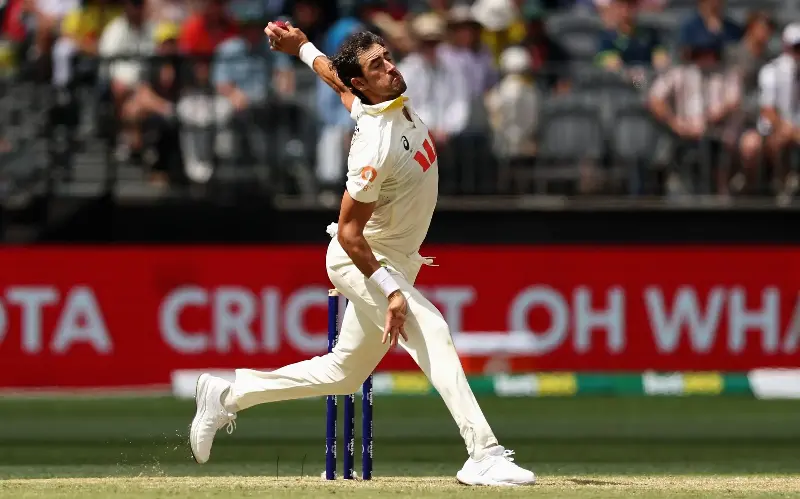
With the wicket of Harry Brook at the Gabba on Thursday, Mitchell Starc became the leading left-arm wicket-taker in the history of Test fast bowling. Yet by my reckoning the Australian cannot yet be regarded as the greatest left armer.
10. Sir Garfield Sobers (West Indies)
235 wickets @ 34.03 (not all as a left-arm seamer)
Swinging the new ball was something he only did part-time, as he also bowled orthodox left-arm spin and wrist-spin - oh yes, and he batted a bit too (Sir Donald Bradman said that a Sobers double-century was the best innings he had seen). But nobody has run in more gracefully than Sobers, collar turned up, a combination of languid and leonine grace. His record as a pace bowler is unfortunately unknowable - but he swung the new ball awesomely when he wanted to.
9. Bill Voce (England)
98 wickets @ 27.88 (not all as a left-arm seamer)
Built exactly like a traditional fast bowler used to be, broad of beam, after Fred Trueman’s heart – and also from a mining background. He began as a brisk left-arm spinner, and had a great Test on Trinidad’s mat so, like Sobers, his record purely as a pace bowler is unknowable. As the 1930s went on he became not only a supporting act for Harold Larwood but could lead England’s attack on his own, taking 26 wickets at 21 on England’s 1936-7 tour of Australia.
8. Neil Wagner (New Zealand)
260 wickets @ 27.57
No subtleties here, although he could pitch it up and swing a new ball if he had to, as in England. Wagner steamed in and bashed out a hard length and loads of bouncers when the pitch had gone to sleep, as they often do in New Zealand (and they are not helping spinners either). Wagner thereby made himself an indispensable support for the more subtle new-ball pair of Trent Boult and Tim Southee. Round or over the wicket, he roughed batsmen up in long spells at full steam.
7. Alan Davidson (Australia)
186 wickets @ 20.53
Much like Voce in style and method, if perhaps half a yard slower, he was a formidable presence bustling in to bowl over the wicket in traditional left-armer’s style. He had a particular penchant for dismissing Colin Cowdrey, taking his wicket nine times. Like Voce again and Sobers, he could also bowl left-arm orthodox spin when required, usually in Asia.
6. Chaminda Vaas (Sri Lanka)
355 wickets @ 29.58
No more than medium-pace, and he did not swing the new ball either, not into right-handed batsmen in the orthodox fashion. Yet he was one superb operator on dry pitches, especially in Sri Lanka, when he angled the ball across right-handers and had them nicking off as the ball nipped away. As for left-handed batsmen, he had Chris Gayle on toast, dismissing him five times for a duck.
5. Trent Boult (New Zealand)
317 wickets @ 27.49
Very whippy and nippy, fast-medium rather than fast, his forte was bowling full and swinging the new ball back into right-handers, as England can vouch after a day/night Test in Auckland when Boult took the lead in bowling them out for 58. Boult then took six wickets in 11 overs of embarrassment. He retired from Tests a shade too early, in order to maximise earnings on the T20 circuit.
4. Zaheer Khan (India)
311 wickets @ 32.94
Immensely skilful. In addition to the traditional task of swinging a new ball into right-handers, he learned how to reverse-swing an old ball away from right-handers when going round the wicket: thus he surprised England with a new style of delivery in the Trent Bridge Test of 2007, having played for Worcestershire the previous season. He also tipped India’s way the high-scoring World Cup final of 2011 in Mumbai with his first three overs against Sri Lanka.
3. Mitchell Starc (Australia)
415 wickets @ 26.51 (when Brook was dismissed)
He now tops the wicket-taking list of left-arm pace bowlers in Tests, and his consistency around the world has been admirable, but he does not quite topple the two men ahead of him and go to the top of these charts. He cannot make the ball kick and snort from the pitch quite like Mitchell Johnson in his prime, or reverse an old ball from round the wicket quite like Wasim Akram. It has been an advantage that he has played so many pink-ball Tests and taken one-fifth of his wickets therein.
2. Mitchell Johnson (Australia)
313 wickets @ 28.4
Starc has been more consistent through his career but no left-arm pace bowler – no bowler, period? – has been such a danger to batsmen as Johnson was against England in 2013-14 and in Australia’s subsequent Test series in South Africa. An attacker of bodies and stumps. He took 37 at 13.9 against England then 22 in three Tests in South Africa. Sometimes he could swing it conventionally but, basically, just imagine a javelin coming up under your ribs.
1. Wasim Akram (Pakistan)
414 wickets @ 23.62
Simply the best, because he was uncoached and taught himself all the tricks. Having grown up on the baked mud tracks of the Maidan in Lahore, he knew what could be done with a ragged old ball: ie. how to reverse-swing it both ways. To graft on top of those skills, it was relatively easy to learn how to swing a new ball conventionally with Lancashire. Over the wicket and round the wicket, old ball and new, Akram came in off his own unique run-up and covered all the angles.