



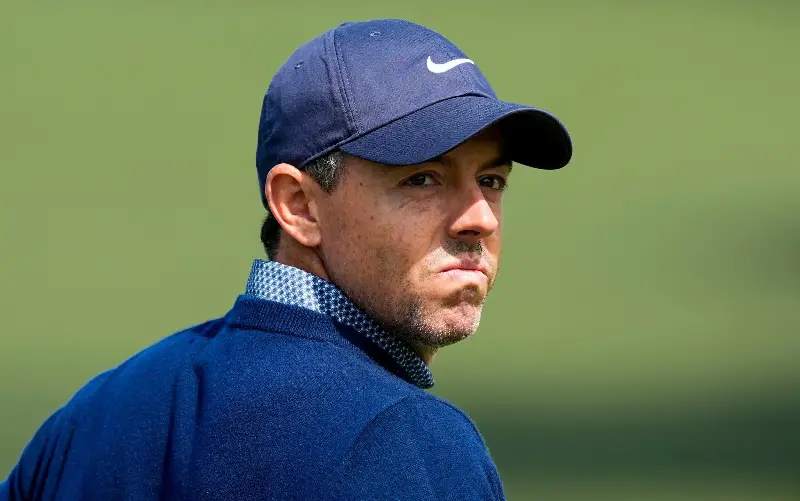
The only worry when Rory McIlroy won the Masters was that his yearning was sated, that he would struggle to find a fresh dream to chase. He admitted as much himself, explaining how he felt “directionless” after fulfilling the quest of a lifetime. “I climbed my Everest in April, and I think after you do something like that, you’ve got to make your way back down, look for another mountain to climb.” Sooner than most had expected, he has trained his eyes on golf’s next Himalayan summit, opening his title defence here with a round of such serene self-assurance that he could yet accomplish a feat even rarer than the career grand slam.
Six male players in history have completed the set of all four majors. But only three – Jack Nicklaus, Sir Nick Faldo and Tiger Woods – have grasped back-to-back Green Jackets. On the evidence of a superlative first-round 67, McIlroy is hell-bent on becoming the fourth. Having argued that this course fit his eye better than any other, he duly proved it with an impeccable demonstration of scrambling, repeatedly rescuing his score after spraying his drives deep into the pine straw.
At his 18th Masters, McIlroy has acquired the virtue of patience. He embraced a waiting game en route to glory last year, refusing to panic even when he shot two double-bogeys in his opening round. While others charged up the leaderboard, McIlroy stayed in his own bubble, eventually reeling off a 10-under-par run across 14 holes to create a platform for victory. He tapped back into that mindset here, even as his driver malfunctioned. When his tee-shot at the 13th fanned right, into the shadows of the trees, he responded with a nonchalant shrug, squeezing a low running escape shot between the trunks to set up a birdie. With his swashbuckling game, he has memorised every square inch of this fabled property. Now, crucially, he knows how to turn that local knowledge to his advantage. “There’s a certain freedom now,” he said. “If I hit it in the trees, OK, I’ve seen it all.”
His return to these fairways was genuine appointment viewing, to the extent that even Rafael Nadal, a scratch golfer himself, was glimpsed beneath the giant oak tree beside the clubhouse. And McIlroy did not disappoint, shrugging off his habitual slow starts with a performance of exquisite poise. Recording his finest Masters Thursday since 2011, he has reason to hope for a happier outcome than 15 years ago, where he tossed away a four-shot lead with a Sunday 80. He was anything but immaculate here but still sailed to five-under par, undaunted by his errant form off the tee and liberated by the overwhelming satisfaction of conquering a tournament that had thwarted him for too long.
The psychological effect of calling himself a Masters champion is profound. He acknowledged before this round that he barely cared if the event did not start, knowing that his most precious achievement could never be taken away. But at 36, he cannot spend the rest of his life in a state of self-congratulation. As a personality hardwired to keep testing himself, he needs renewed impetus, and the incentive of consecutive Masters triumphs has provided it. It is perhaps the ultimate alpha flex in sport, being able to sit in the Butler Cabin without even needing the previous year’s winner to drape another jacket over your shoulders. It is, however, devilishly difficult to do.
The duties of a defending champion are extensive during Masters week, from preparing the elaborate Tuesday night dinner to delivering a speech to fellow winners about the state of the game. Those in this position can often find themselves looking backwards, not forwards. For McIlroy, whose win was arguably the most dramatic in history, this experience has been especially pronounced, with none of the 22 questions at his first press conference about his form. The impulse was to revel in the romance of 2025, not to explore the tantalising possibility for 2026. For the first time since he can remember, McIlroy is swinging without pressure on this stage, liberated from the intrigue about whether he can cross the finish line.
It seems ridiculous to describe McIlroy as a veteran in any setting. But the lessons he has absorbed from his exotic excursions at Augusta are priceless, enabling him to escape even wayward holes with minimal damage. While he was all over the place on his front nine, he still reached the turn in a two-under-par 34, with his body language unruffled. “I kept swinging away and thought that sooner or later, I would find it,” he said. “From the eighth hole, I felt I did.” For the others, McIlroy’s early surge is an ominous sight. A more effective frontrunner than a pursuer, he has set exactly the right tone in his search for more history. Until recently, the thought of never winning the Masters would torment him. Now, remarkably, he can dare to dream of an encore.