



The car industry’s attempts at electrification have resulted in a catalogue of terrible commercial decisions, the consequences of which continue to ripple from the boardroom to the factory floor.
Jaguar Land Rover (JLR) has racked up so many that one might think the once-venerable company would have learnt from them, but apparently not.
Instead, under Indian owners Tata Motors, JLR continues to lurch from one disaster of its own making to another, leaving it stuck in a doom loop from which escape seems unlikely.
After a disastrous hot-pink reinvention in an attempt to be more inclusive, JLR’s battle-weary ranks have suffered another setback with the news that management has secretly drawn up plans for 4,000 job cuts.
The revelation came just months after the company made a big song and dance about a £1.7bn cost-saving programme, suggesting the crisis engulfing JLR goes even deeper than previously thought.
Then again that’s not exactly a surprise. June’s big investor-strategy day, at which PB Balaji, JLR’s new boss, pledged to focus on “propulsion flexibility”, was yet more confused corporate waffle from an organisation that has turned vacuous jargon into an art form.
At times, the nonsense coming out of Solihull (JLR’s West Midlands office) has been so profoundly silly that one wonders whether even the poor souls tasked with articulating it to employees and customers understand what it means.
A company whose bold advertising once enticed motorists with the promise of driving a “12-cylinder animal” now trots out slogans such as “live vivid” and “copy nothing” as part of a credulous, unnecessary and self-destructive embrace of diversity.
Indeed, JLR has been so enthusiastic about adopting fashionable causes that it seems to have forgotten its primary function: making cars.
At times, it has been hard to escape the impression that this woke crusade has come at the expense of the day-to-day running of the business.
Perhaps it’s nothing more than a coincidence that JLR was the victim of a devastating cyber attack just months after it committed commercial harakiri with the launch of a “Barbie pink” car.
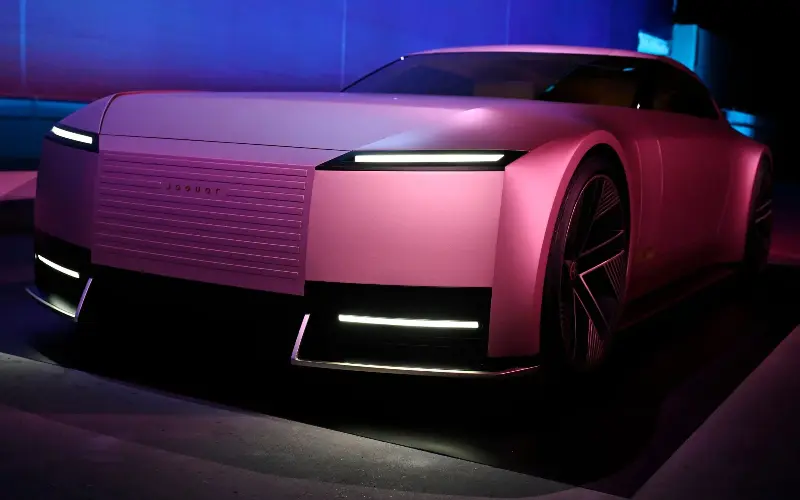
However, it is a simple fact that time spent needlessly obsessing about how to be progressive is time not spent on more important matters, such as ensuring customer data are safe from criminals.
The whole thing suggests a business that has completely lost its way as it tries to navigate a rapidly changing world of climate change, cheap Chinese cars, trade wars and an evolving customer base.
Balaji’s appointment, as the cyber attack was unfolding, was supposed to represent something of a back-to-basics moment for JLR after Adrian Mardell, his predecessor, had quit in the wake of the fallout from its preposterous rebrand.
Previously Tata’s finance chief, Balaji’s arrival was expected to usher in a new era of financial rigour amid pressure from the car manufacturer’s HQ to rein in costs.
Yet it came too late to halt a dramatic fall in sales in the wake of the cyber attack, which caused a ruinous one-month pause in production.
The carmaker announced in May that annual profits had been wiped out by a combination of the disruption from the attack, costly US tariffs and intensifying competition from China.
In what risked being the understatement of the decade, Balaji bemoaned “a challenging year” as turnover slumped by a fifth to just shy of £23bn and pre-tax profit crashed to just £14m from £2.5bn the year before, or in Balaji’s words: “multiple headwinds”.
Predictably, there was no mention of how damaging the company’s disappearance down a rabbit hole of virtue signalling had been.
The slump has continued into this financial year, with the carmaker’s first-quarter revenue falling 10pc from the same period the previous year, and profits plunging more than two thirds to £109m.
JLR is crying out for a genuine change of direction, but Balaji’s strategy “reset” risks being a case of “neither one nor the other” as it tries to be all things to all men (and women, of course).
Amid fears that the carmaker’s eager pursuit of all-out electrification would lead to the abandonment of its petrol and diesel engine roots, Balaji stressed there was “no way” JLR would phase out petrol vehicles because they remained popular in the US and the Middle East.
In fact, the carmaker was hoping to grow its US business “to the size of the entire JLR business as it exists today”, he said.
For a company that had previously promised to reach net zero carbon emissions across its business by 2039, the decision to ramp up sales in a market where motorists are markedly more reluctant to adopt electric models than in other countries sounded like a significant policy reversal.
Not so, said Balaji: JLR was adopting a model of “propulsion flexibility”, in which it would “give everything” to turbocharge sales to American “millionaires and billionaires”, but wasn’t “slowing down on any of our electrification plans”.

It plans to launch five electric vehicles in the next 18 months, after a product drought that stretches back four years. With its popular Range Rover, Defender and Discovery brands all available as mild hybrids, hybrids, plug-in hybrids and battery-electric models, it smacks of a business that no longer knows what it wants to be.
It will be fascinating to see how many people are willing to part with £154,000 for an all-electric Range Rover or £100,000 for a battery-powered Jaguar. The launch of the former has already been postponed once amid weaker-than-expected demand for electric cars.
Fierce competition from China raises questions about its petrol models too. Nicknamed the “Temu Range Rover”, Chery’s Jaecoo 7 has sold 91,000 models so far this year, compared with 41,000 Land Rovers. While the larger Jaecoo 8 costs around £45,000, an entry-level Range Rover starts at around £107,000.
With such a vast offering of cars and the gamut of engine types, no wonder the cost base needs radically shrinking. Yet instead of making tough decisions and drastically scaling back the model line-up, as other rivals have, Balaji and colleagues have taken the easy option: a voluntary redundancy programme expected to result in 4,000 job losses in the next two years.
In an industry facing an existential crisis, it is likely to be little more than a temporary reprieve.