



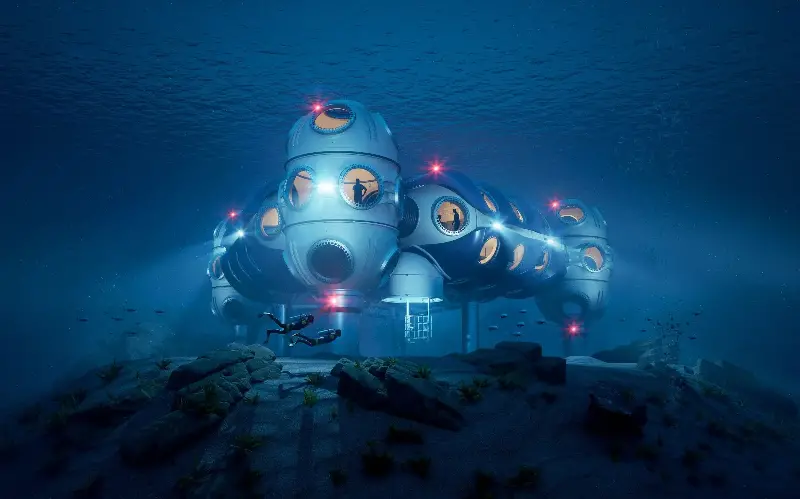
In a disused quarry that once supplied the limestone used to build the M5, a sub-aquatic future for human beings is under construction.
Tucked away on a quiet road near Chepstow, the DEEP Campus is the exploratory hub for a programme to enable divers to live comfortably beneath the ocean surface for a week at a time.
From later this year, dive teams will be training here for missions in the company’s subsea habitats, which will rest between 50 and 200 metres down in seas around the world.
Once fully operational, futuristic interconnected pods will combine comfortable, hotel-style living accommodation – including a functioning kitchen and bathroom – with research lab space.
The dream of existing under the sea, watching marine life pass by through a porthole while lying in bed, will be available to scientific dive teams currently restricted by the need to keep coming back to the surface.
But rather than just being a Jules Verne-inspired fantasy to allure the ultra-rich, DEEP’s directors have more profound aims.
By enabling human beings to exist like mythical mermaids, they foresee secondary benefits, including for patients suffering a range of medical conditions in hospitals on dry land.
Advances in marine biology as well as reef restoration in locations where coral is dying from global warming-induced bleaching are also anticipated.
Over the course of a five-day saturation mission, scientists will be able to dive for up to 30 hours, which would take them a month to accomplish under normal scuba diving restrictions.
For Dawn Kernagis, DEEP’s Head of Science, the ability to monitor changes to divers’ physiology in real-time by taking samples while they are stationed on the ocean bed is keenly anticipated.
In the same way that analysis of people living at high altitude and astronauts spending months on the International Space Station have proved a catalyst for wider health uses so too the subsea habitat research could have broader implications, Dr Kernagis believes.
“I’ve worked on other projects where we’ve collected blood and tissue samples from divers at depth, but then you’d have to bring those samples back to the surface before you could process them,” she explains. “You’re not actually seeing what’s happening to that sample at depth but the changes that happen to it associated with the decompression process.
“So, one of the things we’re really excited about is being able to integrate technology in the habitat, making it essentially an undersea lab. It’s really going to be a game-changer across a number of different disciplines.”
Studies of divers based underwater for a prolonged period are expected to deliver advances for patients going through hypobaric oxygen therapy, which involves breathing pure oxygen in a pressurised chamber.
Dr Kernagis says this could include people with ischemic injuries, in which tissue damage has been caused by reduced blood flow and oxygen deprivation, as well as carbon monoxide poisoning, severe wounds and radiation injuries.
It is also hoped that sampling conducted at depth will provide insight into the management of oxygen therapy for critically ill ICU patients.
Research on divers experiencing hypoxia or hyperoxia – too little and too much oxygen - has already improved knowledge about safe oxygen exposure levels in a clinical setting.
“There are so many shared lessons learned from humans in extreme environments that translate back to clinical populations,” adds Dr Kernagis, who previously worked on subsea missions off the coast of Florida for Nasa.
“Things that happen to the brain, the nervous system and the immune system for humans in environments like this can be applied to patients that are undergoing clinical procedures.
“This is a really good representative model for understanding otherwise healthy humans that are subject to a unique exposure. How do their bodies respond to that? How can we make sure that the human stays healthy with those changes? And when that change is reversed, what does that do to the body afterwards?”
The possibilities opened by DEEP’s habitats will build on findings from ongoing research into physical changes experienced by military submariners.
Its pilot Vanguard undersea habitat, which consists of a single living chamber for four people, is due for deployment later this year.
The vessel is tethered to a support buoy floating on the surface, which provides breathing gases, power, and communications to the crew down below.
Crews moor to the buoy, dive down to Vanguard and enter the habitat through a so-called moon pool. They swim into this acclimatisation space from beneath to get used to the pressure conditions, before opening up a door into the living area. Divers will exit the habitat through the same opening for daily missions.
During a boat tour of the DEEP facility, previously the National Diving and Activity Centre until it was bought out three years ago, the scale of the company’s ambition is made apparent.
Hemmed in by towering cliffs chiselled into the surrounding countryside by mechanical diggers decades ago, the man-made site is the deepest inland body of water in England. With a maximum depth of 80m, it is discreetly hidden away off a rural lane overlooking the Severn estuary.
At one end of the 700m-long lake is a prototype model for one of the flagship Sentinel undersea habitats, due for launch once Vanguard has gone through months of rigorous checks.
Clambering into this airy, spacious capsule and peering through one of its huge portholes gives a taste of how comfortable marine living could become.
After this year’s Vanguard launch, the plan is for many more to be rolled out, which will be permanently staffed by crews on rotas.
Many of the diving experts employed at the Gloucestershire base previously worked in the oil and gas industry. Dive manager Mark Hamilton, my guide for the day, worked for oil giants including BP, Shell and Chevron before joining DEEP.
According to Chief Executive Dennis Nelson, however, what this new global project aims to do is “democratise” undersea exploration, so the habitats will be as available to scientists wanting to understand the deep as commercial clients with the deepest pockets.
Until now, many people were excluded from the ocean depths because of the costs associated with dive support vessels. DEEP’s bold tagline is that it will “make humans aquatic”.
“Humankind has spent an incredible amount of time and attention focusing upwards to the skies, but never enough time looking down into the oceans,” says Mr Nelson. “The key driver for us is about enabling human beings to unpack that mystery.
“We have long been limited by our physiology and the economics of delivering access to the depths, by which I mean the blind spot zone between 50 and 200 metres deep, less than the height of many tall buildings around the world.
“There is so much to learn from that space and its continental shelf. Statistically, 70 per cent of the oceans are unexplored. We really should invest more effort to understand it and to access it better.”
This motivation sits in stark contrast to the OceanGate disaster in 2023. All five people on board the experimental Titan carbon-fibre submersible, including two multi-millionaires, died when it imploded from extreme pressure during a voyage to the Titanic wreck.
Whereas OceanGate’s founder Stockton Rush, who was also in the Titan, was criticised for overreaching, DEEP’s financial backers are determined to move gradually.
“We are at that intersection where there’s pioneering engineering and providing access to the awe of the oceans,” continues Mr Nelson. “One of our intentions is to have a permanent presence underwater.”
Beneath the main operations centre is the first saturation diving training facility in the northern hemisphere, which is also due to open in the coming months.
This unit, which is above the lake surface, will provide its occupants with the pressure conditions they would experience while eating, sleeping and working submerged.
Once they have entered the pressure chamber, divers will stay inside as they would in a subsea habitat. They will go directly into the lake below without returning to normal air pressure until the training period is complete.
DEEP is already talking with marine research teams and ecologists about exploration missions from its habitats.
The ability to restore and maintain reefs at a deeper level could be revolutionised by not having to scuba down from the surface. Marine biologists will also be far less restrained by oxygen tank capacity.
“It’s like the difference between Jane Goodall immersing herself right in the environment and studying the chimpanzees and the primate populations, versus somebody dropping down into the rainforest and getting a glimpse of them for an hour,” continues Dr Kernagis.
“Typically, undersea sampling methods are select to one location, one dive in a very specific time window. Living in an undersea habitat, you’re able to go down and collect data for these extended periods of time outside the habitat. You also really get to understand what happens in a 24-hour cycle, on a day-to-day basis.
“Divers will be able to use that extended bottom time to really amplify their data collection and observation of the surrounding ecosystem. Whether it’s marine science or marine engineering outside of the habitat, it’s really exciting to be able to extend the dive time opportunity.”
For now, DEEP is not advertising its habitats for holidays in the ocean.
But with life on terra firma feeling increasingly perilous, a cosy break 200m down in the murky depths is only likely to become a more attractive proposition.
Protect yourself and your family by learning more about Global Health Security