



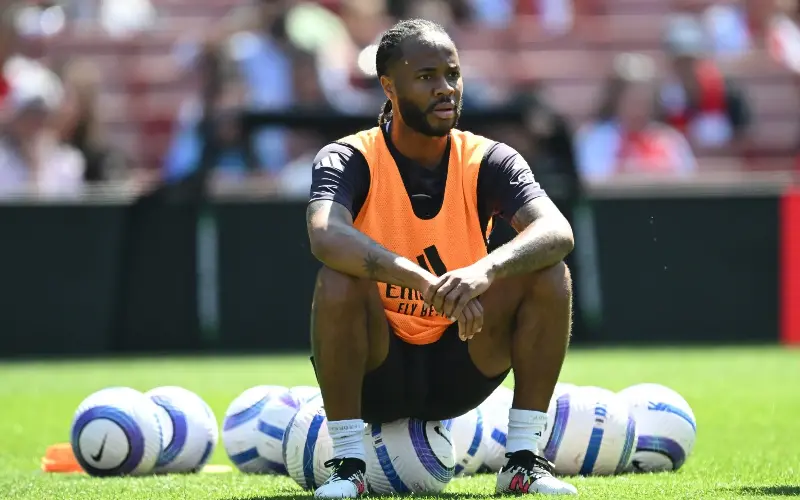
As a new chapter awaits Raheem Sterling. An unceremonious Chelsea exit should not overshadow the fantastic achievements of his story so far.
Sterling is blessed and cursed by the memories of him bursting onto the scene as a teenage superstar before peaking in his mid-twenties. He set the bar so high that this moment in his career inevitably feels like an anti-climax.
Sterling’s successes outweigh any recency bias amid headlines about Chelsea “bomb squads” and the termination of a reported £310,000-a-week salary.
By any measure, he is one of the best English players of his generation. When discussing his career, the focus should be on the thrill of his initial impact as a prodigy before maturing to fulfil his talent under Pep Guardiola at Manchester City.
He has won 10 major trophies, 82 England caps, scored 194 goals and was named the 2019 Football Writers’ Association Player of the Year.
It remains to be seen how long the queue for his services is. The most negative judgements are partly based on his worth given his salary during an ill-fated Stamford Bridge spell, but no player should be vilified because a club determined his value and then changed its mind two years later. Whatever Chelsea paid Sterling is a reflection of his status upon signing.
Had Sterling’s career ended with his Manchester City exit four years ago, he would have already achieved more by the age of 27 than most manage in a lifetime. At that point in his career, he might have imagined the upcoming 2026 World Cup to be his international swansong having collected 100 caps – a milestone which is now beyond him.
Instead, he looks like another example of a player who, while reaping substantial financial rewards for his talent, is a victim of a recurring football problem where those who shine brightest in their youth must wrestle with the perils of being overplayed, compromising their chance to prolong a career at Champions League and international level.
There are many qualities I have admired about Sterling since I first saw him shove Glen Johnson off the ball as a 17-year-old in an early training session at Melwood.
His skill, pace, strength and tenacity were obvious, but the most underrated of all assets in the modern game is stamina and durability. There are two types of professional footballers; those who need to be 100 per cent fit to play, and those who need to be 100 per cent injured to declare themselves unavailable.
To his immense credit, Sterling is the latter. Even though he has not played this season, his appearance record is extraordinary for a 31-year-old, especially someone who was a critical component of a high-intensity, dynamic forward line such as Guardiola’s. Longevity is generally measured in terms of age. Miles on the clock is a more accurate barometer of a player’s durability.
Sterling headed into this season having played a staggering 48,791 minutes. That amounts to around 39 games a year since his Premier League debut in 2012. There are footballers in their mid-thirties who have not spent so long on the pitch.
As a reference point, if Sterling were to maintain that rate and play as long as James Milner, he would have played 300 more games (27,000 more minutes) than the veteran Brighton midfielder’s current tally. It demonstrates how much football Sterling compressed into the early years of his career.
A study by the players’ union, Fifpro, highlighted that Sterling had played 50 games or more in seven of his first 11 seasons as a professional. Ryan Giggs played 50 games or more in six of his 24 seasons at Manchester United.
That volume is always going to catch up with a player, no matter how great and fit they are, especially now that the game is so much quicker and the elite coaches expect more from attacking players defensively.
It is five years since Sterling made his 500th senior appearance, while still at City. He is still waiting to hit the 600 mark in all club competitions.
The warnings are there for the current and next generation, hoping to extend their career into the late 30s. Unfortunately, teenage sensations – and their coaches – are not always great at thinking long-term. Barcelona’s 18-year-old sensation Lamine Yamal has already made 159 appearances for club and country (more than 11,600 minutes) since his debut three years ago. Football has a duty of care to prevent burn-out.
You feel your powers will last forever after making a senior debut fresh from the academy, and under-pressure managers are naturally inclined to squeeze every last drop from their best players.
Like another former team-mate of mine, Michael Owen, Sterling was one of Liverpool’s most valuable assets before his 18th birthday.
Aside from the Anfield link there are similarities between Sterling and Owen in that the longer their careers progressed, the less the appreciation for how good they were became.
Between 2018-2021, Sterling was second only to Harry Kane as England’s best player – an untouchable on Gareth Southgate’s team sheet when close to World Cup and Euro 2020 glory. In the second of those tournaments, Sterling was England’s most consistent and productive performer.
He recorded 110 goal involvements for Guardiola’s classic City side around that time – including 31 goals in 52 appearances in the 2019-20 season – while grabbing 14 goals in 25 England games across 2019, 2020 and 2021. For a brief spell, Sterling’s goal and assist rate under Guardiola was second only to when the City coach was in charge of Lionel Messi at Barcelona.
I wrote in this column in September 2019 that Sterling was a genuine Ballon d’Or contender, his 40 goals in his previous 70 games making him one of the era’s great wide strikers.
Despite these truly elite levels, there was a sense Sterling never quite won the love of others. I am not sure how high he would feature on an all-time list of the greatest England and Manchester City players. My suspicion is that he would rank lower than he should.
Some unwarranted criticism has shadowed him and may explain why few Chelsea fans were worried about his recent exile and why most are happy with his departure.
Underrating Sterling is not new. Review the coverage of the 2020 Euros and you will find a supporter clamour for him to be overlooked in the starting XI for Jack Grealish, which was bizarre given his form at the time and even more so in retrospect.
It is a matter for debate as to why that adoration was not always there. Mistakes were certainly made early in Sterling’s career, especially when he conducted some ill-advised interviews to push for his move from Liverpool. I was one of his biggest critics then. That was a distant memory by the time he was flourishing at City
I can speak honestly as a former team-mate that when it comes to his attitude to training and a desire to perform on the pitch, Sterling is up there with the most respected.
Wherever he goes and whatever he does from here, Sterling is searching for a new club armed with one of the most decorated CVs of any free agent in football history.
Hopefully, a fitting finale beckons.