



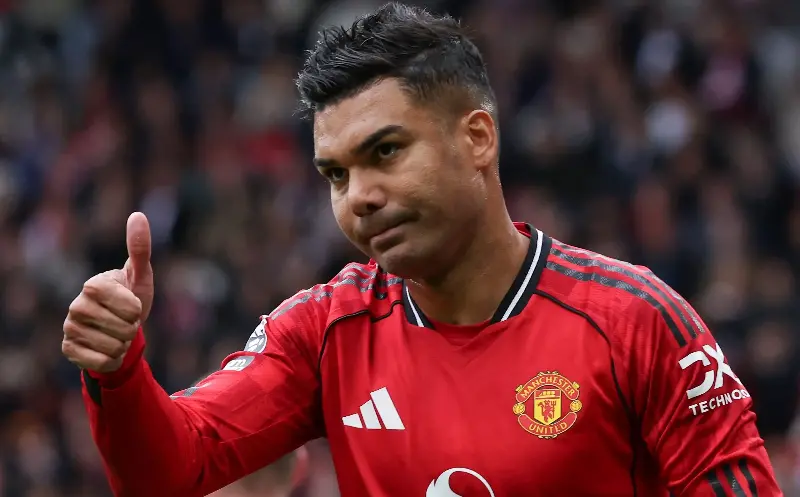
During my final year as a Liverpool player the consideration of whether to retire hinged on one, overriding question: would I ever be satisfied with my performance level again?
There was a piece of advice which I could never get out of my head before my final decision to quit top-level football. “Leave the football before the football leaves you.”
That phrase will be familiar to viewers of Monday Night Football, particularly supporters of Manchester United and the many hundreds of thousands of members of the Casemiro fan club.
It has become synonymous with a remark I made about the Brazilian legend after watching United suffer a 4-0 hammering to Crystal Palace in May 2024.
This brutal verdict on Casemiro’s display that night – and his contribution up until that point in his United career – has been thrown back at me with increasing regularity and even some amusement this season, particularly as he edges closer to his United exit.
Two years on, the Brazilian will be afforded the red-carpet treatment when making his final Old Trafford appearance for the club this weekend. He has played a pivotal role in the recent revival under Michael Carrick, helping to bring back Champions League football with his nine Premier League goals. Naturally, suggestions that Casemiro should have walked away from top-level football in 2024 have aged as badly as pre-season predictions that United would finish outside the top four.
In retrospect, do I regret my comments about such a legendary footballer? Yes and no.
It must be acknowledged that the implication that Casemiro was “finished” at the highest level was too harsh and premature. My argument was he would be better heading out to the MLS, or accepting offers from Saudi Arabia, because he would never get back to anywhere near his best to achieve the same heights of winning the Champions League or league titles at Old Trafford as he did so brilliantly at Real Madrid.
At the time, those observations were not controversial.
In 2024, Casemiro was unfit, lacked the physicality and athleticism to cope with quicker, sharper opponents, and was exposed when used in a deeper role, either in midfield or at centre-back as he was that night at Selhurst Park.
United had just suffered their 13th Premier League defeat of the season and dropped out of the European places under Erik ten Hag. Whatever my negative thoughts on the United players and the team were, they were nothing compared to the fury of the fans and the opinion of the manager.
Shortly after the Palace loss, Casemiro was not part of the FA Cup final squad which beat Manchester City at Wembley, while the United hierarchy was making it known that they would listen to offers to try to get him off their payroll. They could not shift him because of his £375,000-a-week salary.
Go back and listen to every respected pundit and reporter covering United during that period, and you will not find a well-informed piece on the club’s struggles without the Casemiro deal being referenced as a symbol of a failed, ill-judged and over-indulgent transfer policy.
My 2024 remarks were not personal. They were made about one of the best players of his generation with a feeling of reluctance and sadness, and were also based on what United needed to get back to a level where they are challenging for the league title and Champions League – something the club does not need reminding they are still some way from doing.
That particular fixture reminded me of seeing a world-class boxer well past his prime who was determined to keep getting into the ring, but was taking so many punches it made for uncomfortable viewing.
We have seen it before and there will be plenty more examples in the future: true greats of sport who extend their career at the top one or two years too long.
Casemiro was falling into that category. Amid the understandable reappraisal of his form this season, do not forget he was signed because he was one of the most effective defensive midfield shields of the past 20 years. That night he was torn to shreds by Michael Olise and Eberechi Eze – a shadow of the footballer who won five Champions Leagues and three La Liga’s at Real Madrid. It was not a one-off in a United shirt. Even though his output has massively improved since, we have never seen the Real Madrid version of Casemiro in English football.
This week, Casemiro suggested my remarks were “disrespectful”, and that is fair enough. Anything he says in response comes with the territory, although I would counter and say no disrespect was intended. Quite the contrary.
Because of his stellar career, it was natural to compare Casemiro to the extraordinarily high standards he set for himself.
Casemiro was no ordinary, struggling Premier League midfielder. At the Bernabéu, he was one of the greatest holding midfielders of the era and part of one of the finest midfields of his generation alongside Toni Kroos and Luka Modric. That was a trio that stood comparison with even the great Barcelona midfield of Xavi Hernández, Andrés Iniesta and Sergio Busquets.
He is ending his United spell playing a different role to that for which he made his name – a goalscoring midfielder who is particularly effective from set-pieces.
Everyone is entitled to reassess his broader contribution in a United shirt because the final memories of Casemiro at Old Trafford are more positive than the earliest ones. He’s vastly improved since 2024. But there is a reason why the United hierarchy are allowing him to leave on a free transfer at the end of the season, happy to search for his replacement rather than offer another year, even though he is contributing more aged 34 than he was aged 32.
And for all those arguing the criticism in 2024 was completely wrong, ask yourselves this: if United could go back in time, would they still have signed Casemiro?
They spent most of the summer of 2022 pursuing Frenkie de Jong, adamant they would no longer pay too much for high-salaried footballers in their 30s, but ended up bidding £70m and offering Casemiro a massive contract when it was obvious Real Madrid believed his best days were over.
Credit must be given to him for changing the perception of his United career as he prepares to say his goodbyes. Carrick also deserves praise for finding a role more suited to him and the team at this stage of his career in a way Ten Hag and Ruben Amorim failed to.
Casemiro is and will always be a Champions League and La Liga legend. When departing Old Trafford, he deserves the ovation he receives for a magnificent career.
But when the dust settles, no amount of rewriting history will change this fact: the next time a player of Casemiro’s age and status is available for the same salary and transfer fee, United will learn from experience and say, “thanks, but no thanks”.