



The British love a walk – it’s the nation’s favourite active pastime by a mile. We’ve been hiking in nature for pleasure since the 18th century, when the Romantics made it look so dreamy. In the 1930s, the Kinder Scout Mass Trespassers helped open the countryside up for all. More recently, Covid lockdowns reminded us how beneficial being outdoors can be for both our physical and mental health.
However, while any ramble will likely make you feel a bit better, some rambles are much better than others. Here are a few classic elements that make the very best British walks.
1. A hill to climb
The British basically invented recreational hill-walking in the 1700s. The urge to slog up a slope remains.
Head to: Conic Hill, Loch Lomond
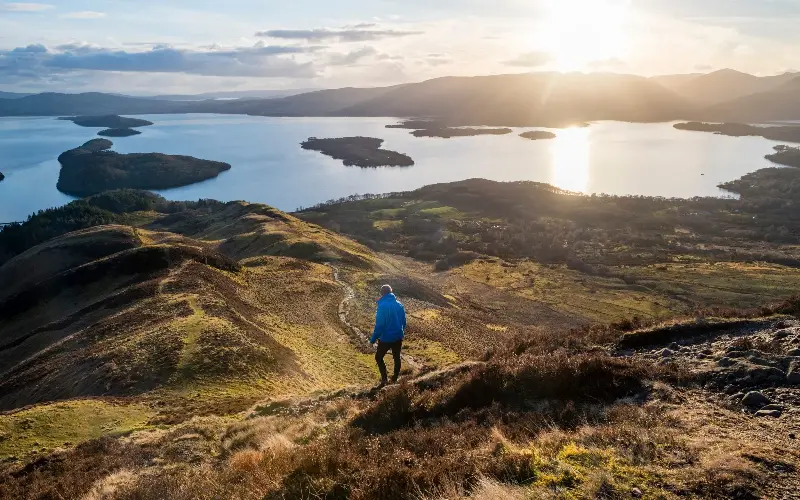
Small but mighty, Conic Hill is only 361m but offers arguably the biggest bang for the shortest exertion. It sits plum on the Highland Boundary Fault and affords breathtaking views down Loch Lomond and along the islands that dot the geological fissure to the Arrochar Alps and Ben Lomond beyond. The summit is a 2.5-mile return hike from the village of Balmaha. Map and directions.
Stay: Balmaha’s Oak Tree Inn has B&B doubles from £105pn.
2. A tinkling stream
Rivers add dabbling ducks, soothing sounds and a sense of calm to any stroll.
Head to: Tarr Steps, Somerset
Exmoor is riddled with idyllic waterways, but the crystal-clear babbling Barle, which meanders through the middle of the national park, is a particular beaut. A lovely option is a 7.5-mile loop taking in the village of Withypool, wooded riverbanks, Exmoor views and Tarr Steps, England’s longest clapper bridge, which may date to the Bronze Age and, according to legend, was built by the Devil himself. Map and directions.
Stay: Tarr Farm has B&B doubles from £190pn.
3. A woodland dell
Birdsong, bluebells, twisty trunks, autumn colours, fungi, shade, shelter – trees add something special to a walk in all seasons.
Head to: Padley Gorge, Derbyshire
Padley Gorge is on the eastern edge of the Peak District but looks straight from the pages of a fairy-tale. Here, wizened birch and sessile oaks rise above mossy, mushroomy rocks and the tumbling cascades of Burbage Brook. It’s easily accessed from Grindleford train station; a 4.5-mile loop includes a walk through the twisted trees with moor-top Surprise View, a superb lookout over the Hope Valley. Map and directions.
Stay: The Maynard has B&B doubles from £109pn.
4. A cracking pub
There’s nothing finer than combining two great British institutions: the country walk and the country pub.
Head to: Great Langdale, Cumbria
The Old Dungeon Ghyll Hotel Hikers’ Bar is the stuff of legend. Tucked amid England’s loftiest peaks – some attempt Scafell Pike from here – it was converted from a cowshed around 1950 and became a hub for eminent climbers. It’s just the spot for supping local ales, catching live music (every Wednesday), and swapping tales of days on the fells – perhaps a classic 8-mile loop of Crinkle Crags. Map and directions.
Stay: Old Dungeon Ghyll has B&B doubles from £140pn.
5. Drystone walls
Green and pleasant land meets agricultural artistry.
Head to: Swaledale, Yorkshire
Around 5,000 miles of drystone walls criss-cross the Yorkshire Dales. Many of these date to the 18th-century Enclosures Act; some are far older, but all give the region its distinctive James Herriotian charm. See some of the finest examples in Swaledale, where these boundary lines of limestone and gritstone weave across wildflower-rich hay meadows. Make a 7-mile loop from Muker, through the valley, stopping at Gunnerside’s community-owned Kings Head midway. Map and directions.
Stay: Frith Lodge in nearby Keld has B&B doubles from £140pn.
6. Some ancient history
A walk in ancient footsteps is the closest you’ll get to time travel.
Head to: White Horse Hill, Oxfordshire
It’s reckoned travellers have tramped the Ridgeway for at least 5,000 years, using trails up on the higher, safer chalk downs to move and trade between Wessex and East Anglia. Thus along it lies a lot of ancientness, including hill forts, tumuli and standing stones (notably the circles at Avebury). Get a taster on a 7-mile loop from Woolstone, which passes the 3,000-year-old Uffington White Horse. Map and directions.
Stay: Woolstone’s White Horse Inn has B&B doubles from £115pn.
7. A well-placed bench
It’s important to have somewhere to stop and contemplate the view.
Head to: Morwenstow, Cornwall
Built from driftwood by Reverend Hawker, poet-priest of Morwenstow in the mid-19th century, Hawker’s Hut isn’t simply a bench; it’s a mini hideaway by the sea. Fling open the doors to sit and look out at the wild North Cornwall coast. A 3-mile circular from the village is good; better is to pass the hut on the 15-mile rollercoaster from Hartland Quay to Bude, possibly the South West Coast Path’s most challenging but dramatic stretch. Map and directions.
Stay: The Bush Inn has B&B doubles from £130pn.
8. A top trig point
Installed by the Ordnance Survey from the 1930s to re-triangulate Britain, they’re now beacons for walkers.
Head to: Great Malvern, Worcestershire
At 425m, Worcestershire Beacon is the county’s highest point and the northern end of the Malverns, the mini-mountain range running along the Herefordshire border. As well as a trig point here, there’s a toposcope detailing all you can see: potentially 14 counties, including the Cotswolds and Wales. There are numerous paths – yomp up from Great Malvern, or plot a 9.5-mile adventure along the entire ridge. Map and directions.
Stay: The Cottage in the Wood has B&B doubles from £114pn.
9. A chocolate-box village
It’s nice to break up your ramblings with a little property porn.
Head to: Castle Combe, Wiltshire
Castle Combe might be the quintessential English village. Tucked into a wooded valley, it’s a picture-perfect cluster of old honey-stone cottages with a market cross, a comely bridge, a couple of pubs and a handsome church (founded in the 13th century). Embark on a green and leafy 7-mile loop, following the burbling By Brook through the valley to Long Dean, another teeny but ravishing Cotswolds idyll. Map and directions.
Stay: The Castle Inn has B&B doubles from £185pn.
10. Picturesque ruins
Since the 18th-century Romantics, we’ve all been suckers for rugged landscapes and overgrown ruins.
Head to: Tintern, Monmouthshire
The aesthetic ideal of the “picturesque” was popularised by William Gilpin in his 1782 work Observations on the River Wye, describing the kind of beauty that blurs boundaries between art and nature. Explore the theory with a 12.5-mile loop along the Wye from Chepstow to admire romantically roofless Tintern Abbey and follow in the wake of 18th-century Wye tourists through the picturesquely landscaped Piercefield estate. Map and directions.
Stay: Tintern’s Royal George has B&B doubles from £186pn.