



“At 60 miles an hour the loudest noise in this new Rolls-Royce comes from the electric clock,” David Ogilvy, the advertising tycoon, wrote in his 1958 advert for the Silver Cloud II.
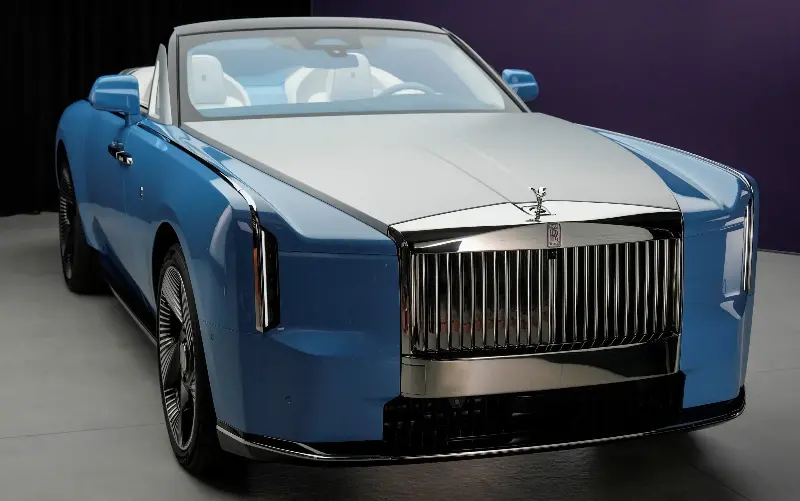
Now, Rolls-Royce has aimed to take an even greater step forward in cementing its reputation for quiet driving with an electric convertible that promises a “serene experience whether the soft top is raised or lowered”.
The BMW-owned company said it would create just 100 of the Project Nightingale cars, each tailored with bespoke features to reflect the “personal taste, character and vision” of the buyer.
The two-seater electric vehicle takes its name from the Nightingale Road factory in Derby, which was home to production of the Rolls-Royce motorcar from 1908 to 1939.
The Nightingale, which is the first of the carmaker’s Coachbuild Collection, is to be built at the Rolls-Royce headquarters in Goodwood, West Sussex, with deliveries starting in 2028.
Chris Brownridge, the chief executive of Rolls-Royce Motor Cars, said: “Some of the most discerning Rolls-Royce clients in the world asked us for our most ambitious work.
“We responded by bringing three things together that have never co-existed within our brand: the complete design freedom of coach-building, our powerful, near-silent all-electric powertrain, and a uniquely potent yet serene expression of open-top motoring – an experience that only this technology makes possible.
“Achieving this required the same audacious mindset that drove our co-founder, Sir Henry Royce, to create his radically different experimental ‘EX’ motor cars of the 1920s.
“Project Nightingale shares the spirit of those landmark projects and is the most extravagant expression of what Rolls-Royce is capable of today.”
At 5.76 metres, Project Nightingale is nearly the same length as the marque’s flagship four or five-seater saloon, Phantom.
Its long bonnet gives it a torpedo shape, drawing inspiration from Rolls-Royce’s experimental prototypes of the 1920s, known as EX models, and the Art Deco era.
Fitted with red-lettered badges that will also feature on the Nightingale, the EX models were made from powerful Phantom chassis cloaked in lightweight aluminium bodies that recorded a new top speed for the carmaker.
Royce was said to have been protective of the brand’s reputation for speed, once telling his colleague at the wheel of his Rolls-Royce to accelerate as a car was gaining from behind.
“A Rolls-Royce should never be overtaken,” he is said to have told his companion, eyeing the competitor in the rear-view mirror before adding: “Don’t worry. It’s one of ours.”
Royce put up his designers and engineers in a house on his estate on the French Riviera that he called Le Rossignol, French for “The Nightingale”.
The name was a direct nod to the factory in Derby, which the co-founder had designed down to the internal layout before his move to the south of France in 1911.
The Le Rossignol guest house became a crucible of innovation, while the hills of Le Canadel surrounding it became an unofficial test track for the latest designs.
A visiting engineer once recounted Royce inviting him to listen to records and, expecting music, was surprised when the Rolls-Royce founder put on a set of French-language lessons while saying: “No time for leisure. We must use every moment to learn.”
Rolls-Royce says the name Nightingale carries its founder’s legacy of “disciplined creation”.
For its latest invention, the company promises that the Nightingale’s fully electric property means it delivers “virtually no mechanical noise”, offering a “serene experience whether the soft top is raised or lowered”.
Last month, the car manufacturer scrapped its pledge to sell only pure-electric cars from 2030, saying it would continue to offer vehicles with combustion engines into the next decade.
The 120-year-old company outlined plans five years ago to go all-electric by 2030 but said it now “recognises some clients would rather have a V12 engine”.
Rolls-Royce is not bound by Britain’s zero-emission vehicle mandate, which requires a certain proportion of vehicles to be electric, since it sells fewer than 2,500 cars a year in the UK.
Under the ban brought in by Boris Johnson, the former prime minister, the company would have been forced to stop selling petrol cars in Britain by 2030, but this was pushed back by Rishi Sunak, his successor but one, to 2035.
Labour has vowed to bring back the 2030 ban but its plans exclude small-volume manufacturers.
Rolls-Royce sold 5,664 cars globally last year, but the company is currently undergoing a £300m expansion of its Goodwood manufacturing facilities to cope with growing demand.
The company does not publicly disclose the price of its cars, but said Project Nightingale would sit between its Private Commission and Coachbuild products, which have been estimated to cost more than £500,000 and £20m respectively.
Entry to the Coachbuild Collection programme is by invitation only.
Domagoj Dukec, the director of design at Rolls-Royce Motor Cars, said: “Project Nightingale is built on the design principles that define this marque at its most compelling – grand proportions, absolute surface discipline, and a clarity of line that rewards the closest attention.
“And yet, it takes them somewhere entirely new. For me, this landmark motor car feels both inevitable and completely unexpected, and it will shape everything that follows.”