



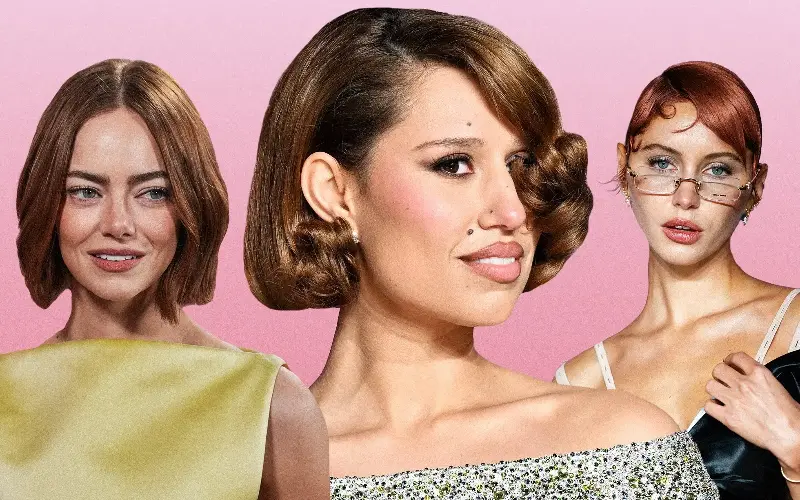
Forget blonde or brunette – warm, flattering hues of copper, auburn, russet and red are firmly in the spotlight right now.
At the Golden Globes earlier this week, Emma Stone walked the red carpet with her “bixie” haircut elegantly grown out into a bob, in a flattering shade of copper. Meanwhile, the actress Sadie Sink, who is on our screens in the latest series of Stranger Things, has enhanced her naturally red hair to a much richer rust tone. And we can’t fail to mention Julianne Moore, the ultimate poster girl for auburn hair, who has recently experimented with styling her mid-length hair into a whole manner of glossy looks.
The rest of us aren’t immune either. Flattering and fun, yet marked by a spirit of rebellion, copper hair has risen sharply in popularity. Google searches for “dark auburn hair” and “faded copper hair” are up more than 5,000 per cent in the past month alone. Catch an episode of Riot Women and you’ll spot flashes of Kitty Eckersley’s fiery mane; step out to the shops and copper sightings are inevitable.
Indeed, copper has become the colour of winter: last month, there was really only one statement hair colour punctuating the Fashion Awards. Billie Piper, Raye, Iris Law, Celia Imrie and Sandy Powell each showcased their own take on the shade, proving its breadth.
Part of the appeal lies not only in the richness copper brings to hair – and, by extension, to the complexion – but in what it represents. Long associated with dissidence, beauty and desire, some of history’s most memorable artworks (Botticelli’s Venus, for one) and figures, from Elizabeth I onwards, were famously red-headed. The punk era, too, saw shades of red reclaimed and worn with intent. Put simply, copper and its many cousins have always belonged to women who understand not just their style, but their point of view.
“I love copper,” says Nicole Kahlani, a colourist at Hershesons. “It’s a shade that grabs attention and stands out without being conformist – it transforms the ordinary into something extraordinary.”
She cites Vivienne Westwood as the ultimate rebellious redhead, her gothic-punk aesthetic a clear reference point for Iris Law’s recent colour switch ahead of the British Fashion Awards. “Karen Elson’s signature red is another perfect example,” Kahlani adds. “Copper embodies creativity and instantly makes a statement.”
Will copper suit you?
The beauty of copper lies in its adaptability. There is a shade for everyone. “Rosier coppers flatter cooler olive skin tones, while more orange-leaning hues – think Titian’s flame-haired heroines – tend to suit paler skin,” says John Clark, a colourist at the Nicola Clarke salon. “Even if you’re starting with very dark brunette or very light blonde hair, there’s an iteration of copper that will work, whether that’s peachy and pink-tinted, or a deep auburn or garnet.”
Those seeking something bolder might opt for a richer red undertone to create contrast, while anyone with pink undertones should avoid red-heavy copper hues. “They can, however, look beautiful on warmer olive skin,” notes Kahlani. A skilled colourist will help pinpoint the right shade, but bringing reference images is always useful for communicating the mood you’re after.
“While copper is incredibly versatile and complements many skin tones, pulling it off ultimately comes down to confidence,” Kahlani adds. “It’s a shade that attracts attention, so be ready for the spotlight.”
How to go copper
First, decide whether you’re committing long-term or simply dipping a toe into the trend. If it’s the latter, a semi-permanent gloss lasting six or seven washes can impart a coppery sheen on lighter hair, or a soft hazel glow on darker shades, says Clark.
Achieving true copper is easiest on lighter hair. “It can be as simple as toning,” says Kahlani, “which requires less commitment but fades more quickly.” Proceed with caution, though. “Blondes in particular can stain their hair with at-home tints,” Clark warns, making a professional appointment advisable.
For darker hair, the process is more involved, typically requiring lightening before copper dye is applied. Those with highlights or balayage can take a gentler approach, using semi-permanent copper hues over the top for a warm, multi-dimensional effect. And if your hair is virgin? “You can simply tint it to a copper tone,” says Kahlani. “It tends to last longer and is less damaging.”
As for cuts, copper proves just as adaptable. From Nineties pageboy bobs and Uma Thurman’s blunt fringe in Pulp Fiction to pixie cuts – think Linda Evangelista – it works across textures and lengths. Emma Stone’s easy shifts between auburn, bold copper, strawberry blonde and warm brunette only underscore its versatility.
How to look after copper hair
Copper shades are notoriously prone to fading, so a considered at-home routine is essential. Clark recommends asking your colourist to add a small amount of dye to your conditioner to top up colour between appointments, while Kahlani suggests spacing washes to around every four days. “Always use cooler water in the shower,” she adds, as heat accelerates colour loss.
Semi-permanent colour tints, such as Bleach London’s, help maintain richness, while colour-depositing conditioners like Davines’ Alchemic Red and masks such as Christophe Robin’s Shade Variation Mask make reliable weekly allies. “If you heat-style regularly, generous heat protection is essential,” says Kahlani. “Copper needs extra care, but the payoff is worth it.”