



A polar bear is lying asleep in what is, for him at least, a balmy -25C. He’s called Storm, he is huge, and thankfully behind glass. His 10-acre enclosure rises to a ridge on which other, smaller bears play.
The day is stunning, crisp snow under an ice-blue sky, but the zoo is empty. It’s just too cold and even Laura Cabak of the Assiniboine Park Conservancy is wincing as she speaks: “Nearly all our bears are orphans, found when they were under a year old, when they wouldn’t have survived. But Storm is different.”
Storm had wandered into Churchill, a town on the Hudson Bay to our north, and bitten a man on the bottom. He was sent to polar bear jail where it was decided he was still young enough to be rehabilitated.
He was shipped down to Winnipeg and into Assiniboine Park. I ask about the man who got bitten and Laura smiles: “Oh, he visits Storm quite often.”
Winnipeg is the coldest major city in North America, with a mean – in every sense – January temperature of -16.4C. My wife Camila and I step off the Canadian, the transcontinental train, to be met by a night wind off the prairies that sets about us with a knife.
As we stagger from the station to the old station hotel, the Fort Garry, a local greets us with, “Welcome to Winterpeg, Mani-snow-ba!”
Two sets of heavy doors open to an atrium where the receptionist tells us we are lucky we haven’t arrived during one of the “really cold weeks”. Temperatures can drop to -47C, not including wind chill. We are stuck though – the next westbound train isn’t for four days.
The Fort Garry is named after the trading camp that preceded Winnipeg at this ancient First Nations’ meeting place on the confluence of the Red and Assiniboine rivers. French trappers arrived on the northern great plains in the early 1700s, buying furs from the Anishinaabe (Ojibwe), Ininew (Cree) and the Dakota, all of whom navigated the rivers in their canoes.
In 1763, when France ceded Canada to the British, the traders were already embedded, many having married locally. This gave birth to a new people, the Métis, who still hold great sway to this day.
We discover this history in the city’s superb museums. The Manitoba museum tells the story through a series of vast dioramas. It also has a recreation of the Nonsuch, an English trading ketch that sailed into the Hudson Bay in 1668, leading to the establishment of the Hudson Bay Company.
Winnipeg’s art gallery is even better, holding the finest collection of Inuit art anywhere, in a vast chamber lit by January’s arctic light. It was worth the whole trip alone.
Smoked fish and snow mazes
We begin to explore a city that’s been allowed to sprawl, in a rental car with snow tyres. “It’s like Miami but 60 degrees colder,” says Camila as we head for breakfast at the Promenade Brasserie.
There, owner Jay Lekopoy hands me “fry bread smoked trout”, his version of bagel and lox. It’s based on what his Métis grandmother used to cook. “She would have fish smoking out the back when I was growing up, and we’d cook bannock [flatbread] over the fire.”
On the outskirts of the city we meet Angie Masse who, with her husband Clint, builds the world’s largest snow maze on their farm each year. She sports a Scandi accent, floppy eared hat and the all round vibe of a character from the Coen Brothers’ Fargo. “There was already a snow maze in Thunder Bay,” she tells us. “So we thought we should have the world’s largest.”
Camila and I disappear within its eight foot walls, immediately lost. There are snow houses filled with snow sculptures by local artists. When we finally find our way out, we head for the barn and lashings of hot chocolate.
Come evening, we head to Raw: Almond, a three-week, chef-driven festival that takes place in a designer built hut on the frozen Assiniboine river. There, joining 24 locals, we try the food of Justin Champagne, the chef from Perch in Ottawa, who is part of a rotating slate of chefs from across North America.
He serves golden eagle sablefish and agnolotti, and lamb seared on a furnace in the snow out back. Two local osteopaths, Caroline Feasby and Davis Bricker, sit next to us. “You decided to come in January?” Caroline asks, amazed. “This is when we try to get away!”
But we’re subject to the dawning realisation that Winnipeggers have made a decision to do the cold months well. Their winter may be a monster, but cold weather monsters are warm and fuzzy when you embrace them. “When there is a day with hardly any wind, we take advantage by getting outside,” Caroline tells us.
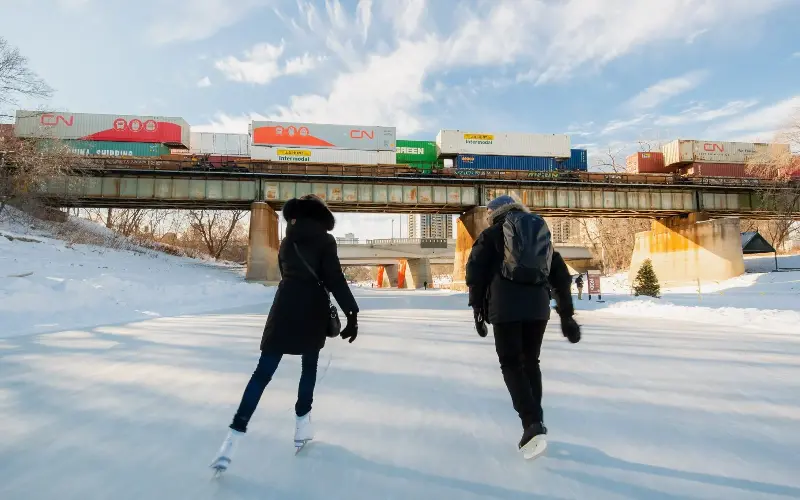
Finally, we go to the city’s famous Forks, as the confluence of the rivers is called. A 4km skating track has been laid out on the ice and entire families whizz past – on skates, on pedal driven ice chariots, on sleds for children made to look like animals.
Wooden frames have been left out for the new and inept (us). We join the stream while above us, against the chill blue sky, vast freight trains bellow as they cross an old iron bridge, riding rails that will, we realise, too soon carry us away.
How to do it
Ruaridh Nicoll was a guest of Tourism Winnipeg and Destination Canada. Rooms at the Fort Garry hotel start at Can$145 (£80). Winnipeg can be reached either by ViaRail’s Canadian transcontinental train or Air Canada.