



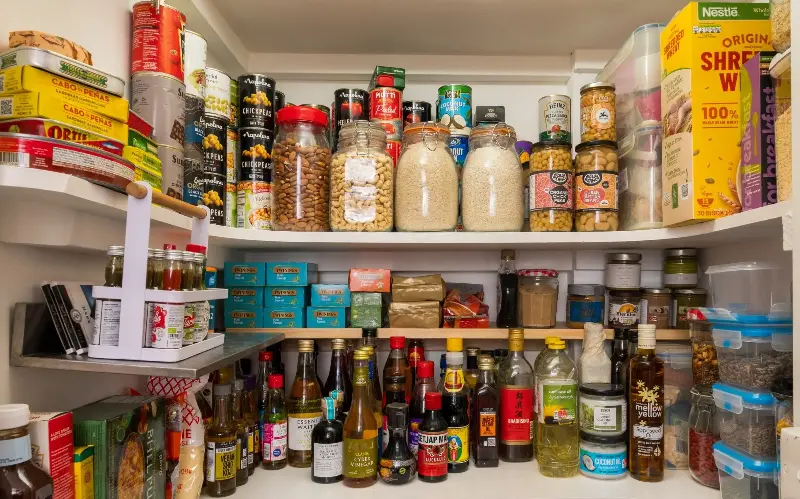
Do you lust after a large, well-ordered cupboard filled with jars and spices in perfect formation? You’re not the only one. According to a survey by the home-improvement website Houzz, 82 per cent of those who had their kitchen renovated in 2025 added a speciality storage space such as a cabinet, prep kitchen or walk-in pantry.
Is this a burst of nostalgia for the pre-refrigeration era, when everyone had a larder? Al Bruce, founder of Olive & Barr, which designs and makes bespoke kitchens, attributes the return of the pantry (a term which these days is interchangeable with larder, though the latter was traditionally a cooler space in the house) to something more contemporary. “Kitchens have become multifunctional living spaces that serve as home offices, social spaces and shared areas often for multiple generations,” Bruce says. “Considered storage, such as a pantry, has become an essential part of thoughtful kitchen design.”
Whether it’s a walk-in room, an under-the-stairs cache or a large cupboard, the modern pantry is a status symbol, suggests Saff Michaelis, whose online series, Don’t Panic, Check the Pantry, illustrates that well-stocked shelves are key to impromptu hosting. “Those who can give away vital square footage to a pantry are basically saying: ‘Behold, I cook and entertain so much, this space is vital.’ For a society that seems to crave in-person community more than ever, that’s really the dream,” Michaelis says.
So what to stow and how to stow it? The experts share their tips.
Dried goods
Non-perishable dried foods – rice, pasta, pulses, oats – form the bedrock of pantries, but these days they’re aesthetically pleasing as well as practical. “In most cases, we find customers are looking for a pantry that provides beautifully organised storage for dry goods – somewhere to place everyday essentials, baking ingredients and items that can easily be stored in glass jars,” says Bruce. As for their environment, he advises slate shelving – “a great way to help keep groceries and dry goods cool, while also regulating the surrounding temperature”.
Tins
Tinned goods are a no-brainer when it comes to convenience (according to The Grocer, we bought 1.8 million kilos more tinned fish last year than in 2024 – the equivalent of 12.4 million tins of tuna), and a pantry is the perfect holding pen. The same report found that we’re choosing branded tinned tomatoes and beans over supermarket own-label products – so is the pantry trend making us shop fancier? “You only need to look at a can of Perello olives or a jar of Bold Beans to see that pantry basics don’t have to be boring,” says Michaelis. “They can be the star of the show,” sparking joy whenever you walk into the space – or open a well-ordered cabinet in front of guests.
Spices
A pantry is the ideal place to host the spice rack of your dreams, but don’t go overboard, warns Kumar. “The pantry is all about respecting ingredients and preserving their integrity,” he stresses. “I recommend buying spices in smaller quantities and storing them in airtight, opaque containers away from heat and direct sunlight,” he says. “I’d suggest keeping them whole, as they retain their character much longer and grinding them little and often. Ground spices are best used within four to five weeks, as their essential oils fade quickly once exposed to air.” You can store your spice grinder beside them, too (see electricals below).
Vegetables
If you have the space in your pantry, you can use it to free up capacity in your fridge, says Paul Bidwell, root vegetable buyer at Waitrose. “Root vegetables like potatoes and onions thrive in a pantry or a dedicated ‘dark drawer’,” he explains. His hack is to line a wicker basket with blackout fabric or use burlap/hessian sacks hung from S-hooks. “The total darkness prevents ‘greening’ in potatoes, while the natural airflow of the wicker or hessian prevents the moisture build-up and rot which is often caused by plastic packaging.”
Preserves and condiments
If you’re the sort to make preserves from a glut of fruit or vegetables (or the regular recipient of potted goods from a kindly friend or relative) your pantry could easily be filled with an array of vintage marmalade, jams and chutneys. Temperature stability for these, as well as relishes and sauces, is key, says Arun Kumar, executive chef at Dishoom: “Unopened items are best kept in a cool, dry space, ideally below 20C.” Once opened, he warns, condiments benefit from refrigeration to maintain freshness, especially those containing natural ingredients, so move them to the fridge – leaving room in the pantry for the next batch.
Wine
For oenophiles concerned about preserving their bottles, traditional pantry storage isn’t ideal because the spaces “aren’t typically temperature controlled,” says Massimo Buster Minale, founder of kitchen design company Buster + Punch. But there is a trend for integrated wine fridges, he says, “often with dual zones, so bottles can be kept at the right temperature, ready to serve.” In the market for a “walk-in pantry with a dedicated bar-style zone as well, with wine, spirits and glassware alongside a small prep surface?” Now we’re talking…
Butter
Modern pantries can’t replace the fridge but Shaun Young, co-founder of The Estate Dairy, encourages us to use them to store butter – if the space is cool. “Butter was never intended to be stored in or eaten straight from the fridge,” he explains. “Provided it’s kept in a cool environment and is properly covered, butter can sit outside the fridge – in a pantry or larder – for a few days and will taste noticeably better for it. Cold temperatures mute flavour,” he says. “Allowing butter to soften slightly transforms the experience. It spreads properly and the richness and gentle acidity become far more pronounced.”
Electricals
Why bother with a pantry over a good old-fashioned cupboard above the kitchen worktop? Because it is the perfect place to sequester the big, ugly stuff. “People want a functional space to stash away appliances that might otherwise be on show, like toasters, air fryers and coffee machines,” says Minale. “It’s a solution that makes the kitchen feel calmer, more considered and ultimately, more premium.”