



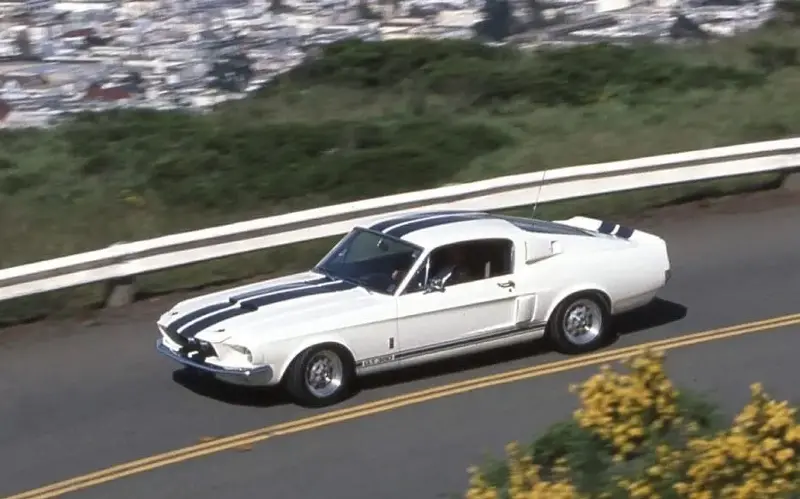
Every middle-aged man fantasises about owning an American muscle car – and with good reason. As a chap’s libido starts to flag, his lustful gaze must turn to pastures new, and where better than the sensual curves of a classic 1968 Buick Wildcat with the added purr of a 430-cubic inch (that’s just over seven litres) V8 engine. I mean, come on.
I was in my 30s when I experienced my first midlife crisis and, although I couldn’t afford the aforementioned Buick or a Dodge Challenger, I did manage to scrape together enough to buy a classic Ford Capri Mk2 – the UK equivalent of a muscle car but without the er… muscles. I thought the old girl might give me some added sex appeal. I was wrong.
These days I hanker after the real, all-American deal not because I hope to attract the ladies, but because I yearn to own something spectacularly decadent before I snuff it. If you’re going to buy a car in midlife, you may as well go large. Time accelerates as you head towards the home straight, so I’d like a car that can keep up.
Cynics may argue that while thundering along the Pacific Coast Highway in a convertible Pontiac or Mustang reeks of cool, pootling along Pinner High Street in something similar borders on tragic.
Those same Honda Jazz owners will also point out that narrow UK roads weren’t designed for super-sized American motors, and that the cost of upkeep makes them impractical.
Understanding the thrill
Gary Byrne, who runs the Coleshill classic car club in the West Midlands, disagrees. “These people have obviously never heard the growl of a six-litre engine,” he beams, “or experienced the thrill of owning a genuine piece of Americana.”
With more than 5,000 club subscribers, Byrne understands the appeal of muscle cars more than most. And he quickly dismisses my concerns about running costs by pointing out that beer is far more expensive than petrol, £9 to £13 per litre compared with £1.30 to £1.50.
“Most club members have given up boozing and treat muscle car ownership as the new ‘going out’,” he says. “You get far more ‘smiles to the gallon’ than with a regular car and you can’t put a price on that. Mind you, when my wife asks how much I’m spending on parts I quickly change the subject.”
Reliable – but thirsty
David Barton, an enthusiast from Guildford, admits he only gets around 10mpg from his 1973 Plymouth Barracuda, which works out at about 50p per mile. But he’s able to forgive his car’s expensive drinking habit because, like many classic muscles, the Barracuda is relatively cheap to insure at around £400 a year. “Brokers love us because we tend to be extra-cautious middle-aged collector types,” he says.
As long as you keep them serviced and drive them regularly, classic muscles are surprisingly reliable considering their great age.
According to Barton, owners fall into two categories: those who obsess about keeping their pampered “garage queens” in mint condition, locking them away in air-conditioned garages and only bringing them out for shows, versus those such as Barton who believe that cars exist to be driven and so what if they get knocked about a little?
Visceral experience
For Neil Dyer, the proud owner of a 1970 Chevy Camaro RS/SS 454 Big Block, it was the sexy profile and distinctive engine sound that first grabbed his attention. “Driving a muscle car is such a raw, visceral experience,” he says. “The American V8 engine is utterly intoxicating, especially if it has been tuned with a lumpy cam; the noise and feel of the engine ticking over, almost cutting out, then screaming and howling back to life sounds like Satan in a thrash metal band.”
Byrne bought his first American classic, a 1958 Chevrolet Bel Air, for his 50th birthday and has never looked back. Since then his driveway has been home to a 2004 Dodge RAM 5.7 Magnum, a 2013 Dodge Challenger R/T and his current squeeze, a sleek cherry-red 1969 Pontiac GTO convertible with a boombastic 7.4-litre engine. “I bought her from a distraught American guy who had to let her go when he returned to the States,” he says.
Part of the family
It’s notable how many enthusiasts refer to their beasts in gendered terms. Paula Thomas, who also lives in the West Midlands, describes her Dodge Viper as part of the family. She even chose to forgo having children, fearing motherhood might detract from her true love: “The reason I named my 1974 V8 Pontiac Firebird Trans-Am ‘Eric’ is because my dad, Paul, christened me Paula and I wanted to call my own baby something more imaginative.”
Thomas’s love of American muscle machines goes back to her childhood, when instead of obsessing about David Bowie she chose to adorn her bedroom wall with posters of bellowing Pontiacs and Dodge Challengers. “Growing up, all I could think about was cars, it’s the reason I became an engineer,” she says. She notes that although muscle cars tend to be the preserve of middle-aged blokes, women are increasingly falling in love with the excitement and camaraderie that comes with ownership. “Men sometimes assume I’ve borrowed the car from my partner but they are always respectful at club gatherings.”
While some muscle fanatics focus on the latest European-specification, right-hand-drive iterations such as the seventh generation Ford Mustang GT or new Charger Daytona, Dodge’s first all-electric model, Thomas prefers the gritty charm of the 1960s and 1970s left-hand-drive originals as “the newer models are too generic for my liking”.
Her advice to anyone wanting to purchase a classic is to do your homework because there are a lot of dodgy Dodges around. Older models imported from the US are more susceptible to rust, so shop around for one that comes from a dry western state such as California or Arizona – and walk away if there is any sign of corrosion, since parts have to be shipped from the US, which can be costly. If you’re looking for maximum authenticity, the most fastidious owners prefer cars that retain their original engines, although these are much harder to come by.
A way of life
Thomas’s friend, Lucy Pearce, who runs a dog grooming salon in Wordsley, describes her love affair with muscles as bordering on obsessive: “For me it’s far more than just driving, it’s a way of life.” Her 2010 Dodge Challenger is currently off the road so she’s taken to cruising the mean streets of South Staffordshire in a huge Dodge RAM pick-up. “The RAM is such a blast to drive, especially with my trusty Alaskan malamute, Shelby, by my side. When people hear the rumble of that massive engine approaching, they immediately know it’s me. And it’s such a joy watching their faces light up,” she says.
Pearce says regular cars just don’t cut it any more. “When the RAM was off the road recently I had to borrow my mum’s Toyota RAV4. It was terrible, it just didn’t feel like me driving it.”
For UK fans, muscle cars embody that uniquely American sense of optimism, where taking to the road in an ostentatiously powerful automobile is synonymous with freedom and the thrill of endless possibilities. It’s a feeling you don’t really get with a ubiquitous, high-volume Japanese car or European hatchback.
After witnessing at first hand the sheer joy these engineering masterpieces unleash in their owners, I’m more determined than ever to trade in my Ford Fiesta 1.0 EcoBoost for something bigger, better and altogether more alluring. Oh dear, I feel another midlife crisis coming on.