



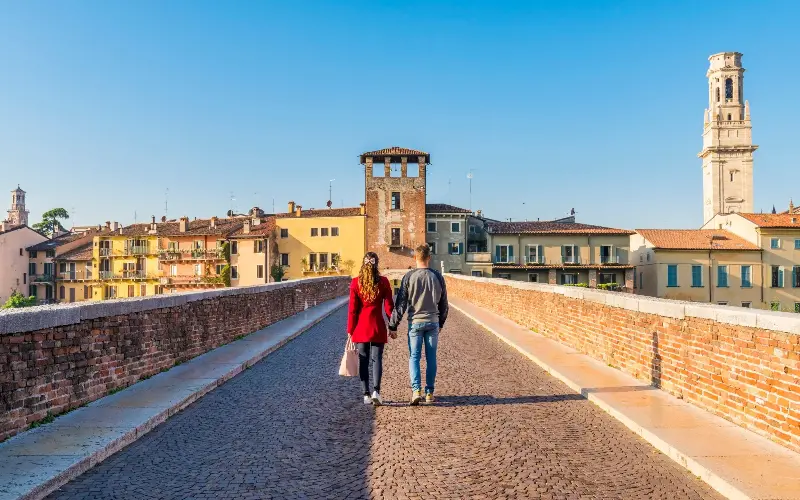
My first trip to Verona was not a success. It was peak summer and my partner and I were planning to stop by on our way to the Dolomites. After just 40 minutes, we were overwhelmed by the crowds and the heat, and fled instead to spend a few hours at Lake Garda.
The second time, however, we nailed it. Our trick? Visiting in late December, after the crush of summer has faded and the city has turned festive and unhurried.
The first pleasant surprise was how affordable our flights were (£70 for a return), while already similar flights in August 2026 could cost more than £200.
Upon arrival, the streets were practically empty, except for a gentle buzz of Italians doing a bit of shopping. Two of the main squares (Piazza Bra and Piazza delle Erbe) were taken over by Christmas markets. We calmly perused gleaming piles of nougat, cheese and hand-painted baubles, sipped bombardinos (an Italian concoction of hot eggnog, whipped cream and cinnamon) and grazed on creamy polenta with forest mushrooms.
The city was radiant – crumbling Roman gates and frescoed Renaissance palazzi illuminated with the glow of Christmas decorations, chichi boutiques festooned in wreaths and bows, golden panettones and pandoros shining like jewels in bakery windows, and osterias beckoning one in with the flicker of candlelight.
The lack of crowds meant we breezed into all the main sights. No being elbowed as we snapped photos of the balcony and house that supposedly belonged to the Capulet family of Shakespeare’s Romeo and Juliet (it’s somewhat less romantic when you learn that the balcony was actually bolted onto the courtyard wall as part of a Fascist-era push to boost cultural tourism, and might originally have been a sarcophagus).
And no queues as we waltzed straight into the Arena (a Roman amphitheatre that is also less romantic when you learn it was later used for sack races and “greasy pole climbing” competitions).
Serious savings
The winter season meant the hotels were quieter and cheaper. The five-star VISTA Verona was deliciously empty. The hotel has an excellent little spa with a sauna, steam room and indoor pool with various hydrotherapy jets (which we had all to ourselves).
From the top-floor restaurant, we could enjoy sparkly views of the city as the chef dished up a stunning wintery menu of plump pink pigeon, gnocchi in a moreish caramelised liquorice sauce, and tender beef cheek that succumbed at the slightest nudge of a fork.
The low season means you can get big discounts on pricier hotels. Rooms at VISTA Verona start from €590 per night (including breakfast) compared with €800 in August.
Similarly, at the top-end Hotel NH Collection Palazzo Verona you can find rooms in January for €182, whereas in August prices range from €265 to €641. The latter has palatial rooms with clawfoot bathtubs and a sumptuous buffet breakfast of salmon cream cheese croissants and marmalade tarts.
Winter is also the time when Veronese food and drink really come into their own. Traditional dishes like risotto all’Amarone (rice in rich Amarone red wine) and pastissada de caval (slow-cooked horse meat stew – yes, really) just make more sense when it’s cold outside and there’s a roaring fire. Try the former at Osteria Il Bertoldo and the latter at Trattoria Al Bersagliere.
A toast to Verona
The city is blessed by the fact it neighbours Valpolicella, one of the best wine regions in the world for bold, wintery reds, including Amarone.
We spent half a day at Villa della Torre – a Renaissance jewel of a mansion now operating as a winery under the helm of Marilisa Allegrini (known as “the Lady of Amarone” as she helped to make the wine famous internationally).
A tour of the Roman-style villa was followed by a tasting in front of an monumental 500-year-old, 3m-high fireplace in the shape of the gaping mouth of a lion. Tours cost €20 and wine tastings €40 per person. It is a bit of a faff getting there – you can take the 103 bus then a taxi or taxi the whole way – but there are dozens of other wineries that you can access more easily by bus from the city.
Of course, you can’t mention festive food in Verona without a nod to pandoro, the Italian Christmas cake invented by Veronese baker Domenico Melegatti. The most historic place to buy one is Michael Turco 1909, a fourth-generation bakery. The cakes were bigger than my head and cost €38 per kilo, so bringing one home in my luggage felt impractical – however, some bakeries sell it by the slice.
If you haven’t had your fill of festive cheer after all that, you can jump on a one-hour train to Trento, another city with medieval bones and a Renaissance face, built on Roman foundations.
We visited Buonconsiglio Castle, with its charming ornamental gardens (€10 for an adult ticket). Inside the castle were intriguing art and archaeological exhibits, including the famous Cycle of the Months frescoes, which offer a unique glimpse into what medieval life was really like, from snowball fights to peasant labour.
Once you’re in Trento, it’s only an hour or so’s drive to the mountains – so you could combine your city break with a ski holiday.
For those wanting to visit Verona and its surrounding delights in the off-season, it now much easier to do so. Manchester and Bristol have new direct winter flights to Verona (with Jet2 and easyJet, respectively).
From February, Edinburgh will join them with a new Jet2 route. My only wish is that tickets came with their own pandoro baggage allowance.
Marianna Hunt was a guest of Destination Verona Garda, the Trento tourist office and VISTA Verona (destinationveronagarda.it; visittrentino.info/en; vistapalazzo.com/verona/vista-verona).