



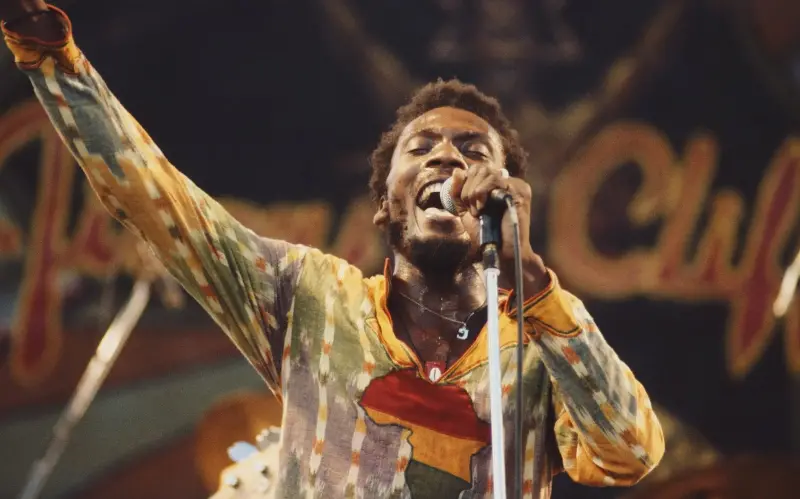
Jimmy Cliff has crossed his final river. The great Jamaican singer and songwriter has died aged 81. He was the possessor of a profoundly emotive voice that expressed a sweet and sensitive personality, and I truly think he made some of the most beautiful records anyone could ever hope to hear. Cliff was the man who put soul into reggae and helped bring the genre to the world.
I met him once in 2012, and he was as gentle, thoughtful, good-humoured and humble a presence as any fan could have hoped. Although he wrote his own material from a very young age, he admitted to me that he never thought of himself as a singer-songwriter. “I needed songs to sing, and where else would I get it from?” was his attitude.
One of the original stars of the 1960s ska boom, Cliff had his first hit in Jamaica in 1962 aged just 14, after walking into a record store singing a song to the owner, producer Leslie Kong. He was born James Chambers, but Kong renamed him, and they scored many local hits together, including Hurricane Hattie, King of Kings and Miss Jamaica.
Chris Blackwell, the great Island Records founder and reggae advocate, spotted Cliff’s crossover potential and brought him to London in 1965. Between them they concocted a sweet blend of Cliff’s Caribbean rhythmic roots with the bluesy pop, rock and soul of the London club scene. His tender, yearning voice floated above light, organ-driven arrangements swirling with longing melodies amid their bobbing rhythmic buoyancy.
His adaptation of Stax, Motown and Sixties psychedelic pop would become hugely influential on the sound of commercial reggae music. Yet it took a while for Cliff to achieve real success. He first started to make waves with his fantastic second album, Jimmy Cliff (1969), which contains two of his greatest ever songs, Wonderful World, Beautiful People and the utterly extraordinary Many Rivers to Cross.
That song still sounds like a miracle to me, surely one of the greatest pop recordings of all time, with Cliff’s tender vocal rising up through the churchy ambience of a hymnal Hammond organ, while gospel singers echo his desperate testament to a life of struggle: “I’ve been licked, washed up for years / And I merely survive because of my pride.” Cliff was only 25 when he recorded it, but it is a song that resonates with the wisdom of the ages.
“When I came to the UK, I was still in my teens. I came full of vigour: I’m going to make it, the Beatles and the Stones were happening and I’m going to be up there with them,” Cliff told me, decades later. “I found it wasn’t really going like that. I was touring the clubs, I wasn’t breaking through. I was struggling with my identity; I couldn’t find my place in the Bible – frustration fuelled the song.”
One thing that always struck me about this strange, magical record is the reference to the white cliffs of Dover, where the young Jamaican is wandering and lost. Cliff told me that he would see them every time he returned from touring Europe, and they became a reminder of his struggles. But then he added: “And, you know, Dover was a good rhyme with ‘cross over.’”
Cliff initially kept Many Rivers to Cross back from recording sessions for his breakthrough album, because he wasn’t sure he should be singing ballads. It was only on the final day of doing overdubs and backing vocals at the Record Plant in New York in 1969 that he presented it to Blackwell.
“It was the end of the session, the musicians were getting up to go, and I said, ‘Excuse me, please, I have this one song idea, do you mind to have a listen to it?’ And they grumble a little bit, ‘Ah, we’re finishing,’ because they work off union time. But they gave me a few minutes. I took up my guitar and they gave me a mic and I played the song. Nobody said anything, the organ player just said ‘OK, 1, 2, 3…’ I started singing, the band came in, and that was it. Once. That was it. And then Chris said ‘OK, let’s put this one in to fill out the album.’ That’s the story of the song. It became a classic, because everyone can relate to it, everyone at some point asks, ‘Who am I? Why am I here? What am I going to do?’ Everyone has rivers to cross.”
It was his starring role as Jamaican outlaw Ivanhoe Martin in the cult film The Harder They Come (1972) that made Cliff reggae’s first international star. It was a low-budget film, much of it shot guerrilla-style on the streets of Jamaica, and the production kept running out of money and grinding to a halt.
But the rough-and-ready tale of a doomed outlaw had a universal resonance: “A guy coming to the big city thinking he could make it, a rebel, a kind of a freedom fighter.” Its raw vitality introduced Jamaican culture to new audiences and paved the way for the success of Cliff’s close friend and Island label mate, Bob Marley.
Cliff scored a fistful of hits in the late 1960s and early Seventies that still sound untouchable, including definitive covers of Johnny Nash’s I Can See Clearly Now and Cat Stevens’s Wild World, plus Cliff’s own immaculate classics You Can Get It If You Really Want and the title track of The Harder They Come. His songs have been covered by the Clash and the Pretenders, and over the years he has performed with many admirers, including the Rolling Stones, Bruce Springsteen, Joe Strummer and Elvis Costello. Bob Dylan hailed Cliff’s song Vietnam as the greatest protest song ever written.
Even after the hits dried up, Cliff continued performing hundreds of shows a year until recently. His superb later album Rebirth (2012) showcased a talent undimmed by age. He deserves to be remembered as one of the greats. “I never get tired of singing Many Rivers To Cross, and you know why?” Jimmy Cliff told me in 2012. “Cause I still have many rivers to cross. They’re just different rivers.”