



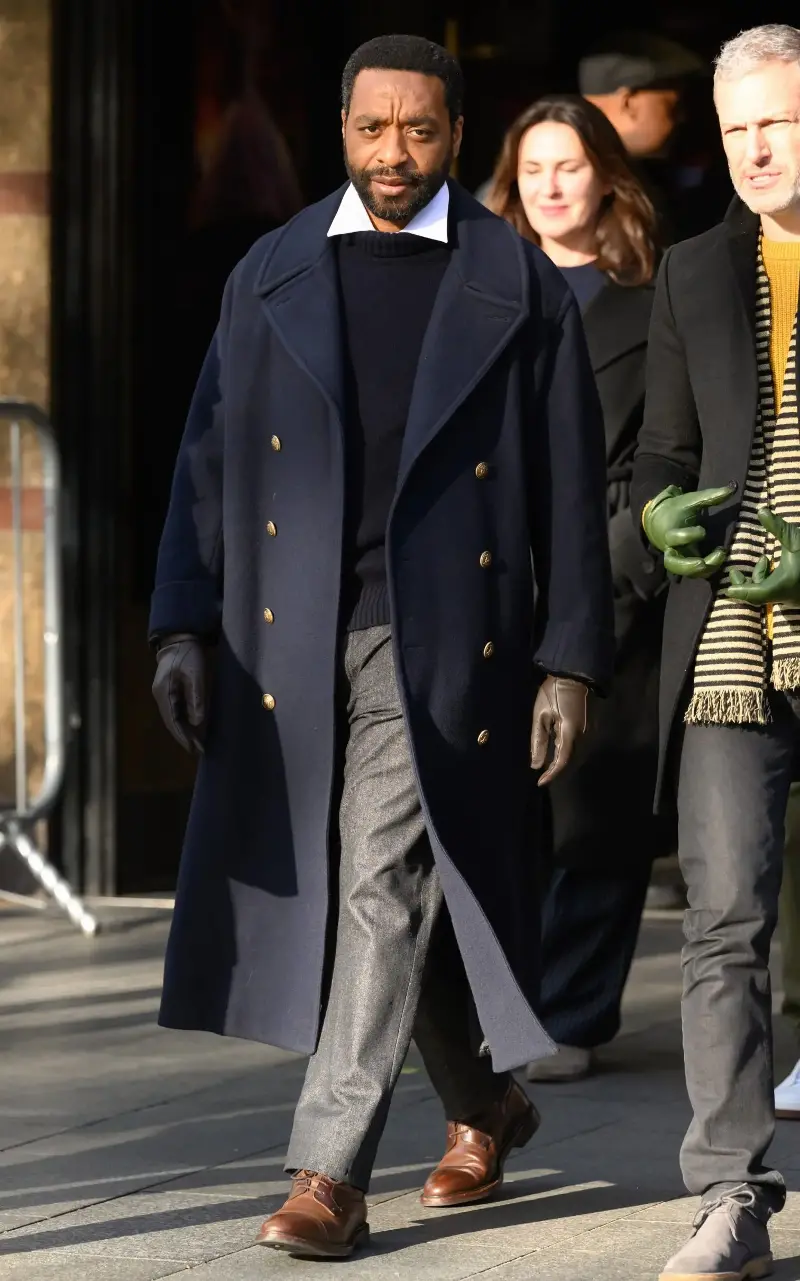
Chiwetel Ejiofor arriving at a recent Bridget Jones event wearing a naval coat so commanding that one expected him to be piped into the red carpet. What his Dunhill coat reminded us of was that the British military has spent a few centuries perfecting designs that make even the most ordinary men look cinematic, heroic even. Put one of the many martial coats on today and it gives a man a sense of direction, even if the only battle he fights that day is the queue for his daily coconut matcha. In the words of the coat’s designer, Dunhill’s Simon Holloway; “Military clothing endures as one of the most powerful influences on menswear. Conceived as uniform to impose power and authority, yet designed for endurance and practicality. Military clothes bridge the awkward gap between tailoring and outerwear.”
Movie stars we may not be, but we can still take Ejiofor’s lead, here’s how…
The Great Coat
The British Army’s uniform heritage is a catalogue of wardrobe staples, even down to the buttons on jacket cuffs, which were added for medics, who needed to be able to roll their sleeves up to treat fallen comrades. However, for pure bombast, we should start with the great coat. A mighty and august coat, you can still see them in military use today if you head to Buckingham Palace and watch the Changing of the Guard in the winter months. The design characteristics include a collar that can do up at the neck to protect the face and cuffs that can roll down to protect the hands in inclement weather. It should be long enough to go well past the knees and have large pockets, which were initially designed to allow soldiers to carry dry goods while on sentry duty, which is why it was originally also known as the “watch coat”. An off-the-parade-square version was introduced in 1914, popularised by Churchill, and is known as the “British warm”.
If the great coat seems unusually grand for something designed to keep soldiers from freezing to death, that’s because the 18th and 19th centuries treated uniform design like a form of architecture. Militaries across Europe; Britain, France, Prussia and Russia were effectively early fashion houses, codifying silhouettes that communicated hierarchy at 50 paces. Officers needed broad shoulders, heavy melton wool, and double-breasted fronts not only for warmth but to project discipline and command.
Trench Coat
Known the world over as the Burberry mac, largely because the 100 per cent cotton gabardine that makes the modern trench coat was invented by Thomas Burberry in 1879. The mac part refers to its predecessor, which used a rubberised material between two layers of wool to waterproof it, invented by Charles Macintosh. It was somewhat stifling however, so benevolent designers attempted an upgraded version – including a man named John Emary, who invented a raincoat called Aquascutum, which translates as “water shield”. Just before the First World War, Burberry released the Tielocken, a great-coat-inspired raincoat with no buttons and just a strap and buckle, which became legend when Lord Kitchener supposedly went down in his ship wearing his. Updated designs for the Great War included large pockets for maps, D-rings for hand grenades and a patch on the right shoulder that was used for keeping water out of one’s gun barrel. As it was used on the front line, it picked up the name, trench coat.
After the war, the coat was popular for civvy street use and has become a fashion staple, and from Bogart in Casablanca to Alain Delon in Le Samouraï, a filmic icon too. A more contemporary filmic trench debut would be Harrison Ford in Blade Runner. Ford’s worn, rain-darkened trench is arguably one of the most influential in film history; the trench at its atmospheric peak.
What makes the trench coat endure is how ruthlessly it evolved. Before Burberry refined it, soldiers wore four-pocket field tunics designed purely for survival: capacious map pockets, riveted hardware, storm guards and belted waists. The Tielocken simply distilled these necessities into elegance. The epaulettes, the gun flap, the throat latch weren’t conceived as stylish flourishes but engineering solutions for rain, mud and the grim logistics of war.
Pea Coat
The pea coat is naval through and through. The term “pea coat” actually stems from the Dutch term pijjekker, meaning coat of coarse cloth, which goes right back to the 18th century. Another story is that Edgard Camplin, a clothier who sold clothes to the Royal navy from his eponymous shop that he founded in 1850, targeted NCOs of the Senior Service, specifically Petty officers, so the “P-Coat” was born. Whatever the origin, the characteristics of an authentic pea coat remain the same; a midnight blue wool, large buttons to help with ease of fastening with cold, wet hands on a six, eight or 10 button stance, vertical slit pockets, an Ulster Collar and, critically, cut short to offer greater freedom of movement for the sailors who wore them. James Dean was a great wearer of them, as was Robert Redford in Three Days of the Condor.
The coat’s enduring power lies in a kind of engineered certainty. Every detail came from necessity: buttons large enough to fasten them with frozen hands, a collar designed to barricade the face against Atlantic winds, a short hem for climbing rigging without losing balance. Naval coats never looked indecisive because they weren’t allowed to be.
Hollywood understood this immediately. Marlon Brando wore his like emotional armour in On The Waterfront, Robert Redford intellectualised it in The Way We Were, and modern designers have sculpted the original navy silhouette into everything from strict luxury to architectural exaggeration.
It has a big brother – a coat for officers – called the bridge coat, the difference to the pea coat is the length – if one needs to climb rigging and maintain balance moving around deck, the shorter the better. But for officers who didn’t need to move, but command, a longer version was viable. The detailing of the brass buttons, the almost monastic severity. This is what Ejiofor was wearing, and Holloway says of it that: “A distinguished glamour resides in an authoritative Navy Bridge Coat or its shorter sibling: Inky Naval blue British melton, a substantial collar – snapped to attention, a martingale half belt, heraldic brass buttons. These coats have heft and presence.”
Duffel Coat
Sir David Stirling, founder of the SAS, is largely remembered, through statues and existing images of him, donning a duffel coat. The crew of HMS Iron Duke posed for a picture in them in 1919. Its nickname is the “Monty”, because it was a favourite of Field Marshal Montgomery, indeed it seems that the duffel coat was used as a kind of democratic garment, exhibiting equal mortal status between the ranks. In film, matinee idols David Niven and Gregory Peck wear them in The Guns of Navarone and frankly, that is all the endorsement you need.
Part of the duffel coat’s appeal is that it has always been democratic. Its fabric, Duffel, was originally woven in the Flemish town of the same name, used for medieval cloaks before seafarers adopted it as protection against North Sea winters. When British naval officers formalised it in the 19th century, they kept the oversized hood, the rope loops (metal rusted at sea), and the toggles big enough to use with gloved hands.
After the Second World War, hundreds of thousands of them flooded into Europe as relief supplies. Students, artists, dockworkers and newly liberated civilians all wore them in a gesture of quiet gratitude to the British forces. By the time Gloverall refined the silhouette in the 1950s, the duffel had completed its transformation from naval staple to a symbol of British resilience, bookishness and egalitarian warmth.
It is easy to forget on civvy street that many of the coats we button up each morning were born in far sterner circumstances. Every epaulette, every throat latch, every oversized collar is a footnote in Britain’s outright stubborn, brilliant habit of taking practicality and turning it to style. When we make a coat, it stays made, and wearing one now is a small act of continuity, a link to the inventors, tailors, engineers and soldiers who finessed these silhouettes for reasons far more serious than looking good in cold climes. Slipping one on still adjusts a man’s posture.
They carry the ghosts of cavalrymen and sailors, officers and engineers, students in draughty post-war halls and lovers moving through fog on winter streets. On screen they have signalled authority, vulnerability, defiance or longing, sometimes all at once.