



Ordsall Hall has to be the most surprising heritage site in the UK. Historian Nikolaus Pevsner recognised it as “the most important remaining timber-frame building not only of Salford, but, now that Manchester is so disgracefully neglecting Baguley Hall, of Manchester as well.” It has parts that date from 1360 (and goes back in name to the 12th century). It is stunningly beautiful. It is completely free to enter.
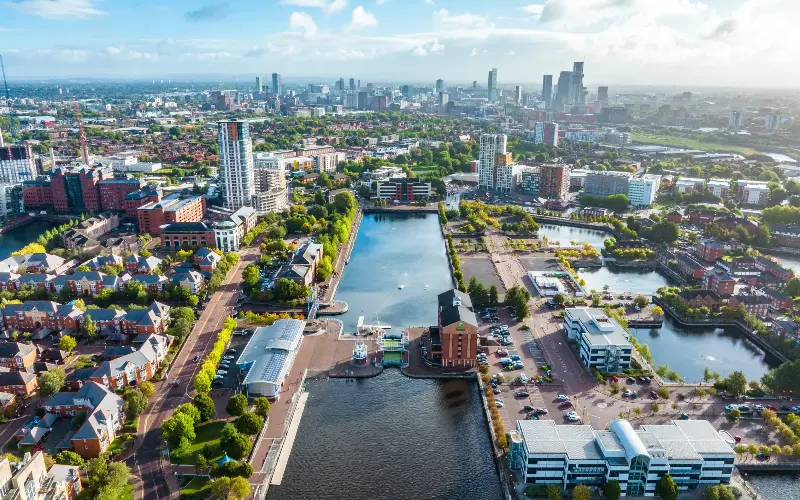
But the biggest shock is the location, for this tremendous manor house sits in the middle of a housing estate, bordered on one side by Salford Quays and Media City, and on the other by rows of apartment blocks, themselves overshadowed by the vaulting erections of Manc-hattan just across the river.
Salford, which celebrates its centenary as a city on Apr 21 (we’ll get into the matter of dates and status in a moment), is well used to being overlooked and bullied by its cocky neighbour – and bypassed by tourists tripping in for culture, nosh, hedonism or a match.
But in skipping Salford, what are they missing?
From grinding poverty to Smiths shrine
I caught the train here from my home near Clitheroe, Lancashire, the county that Salford still belongs to (Mancunians, take note), to Salford Central. It’s the station closest to the bridge over the Irwell, and in the past I often did what most people do, crossed the border into Manchester.
This time I stayed on the Salford side of the river and followed its right bank roughly southward, eyeing the geometric Aviva Studios and other eye-catching buildings across the way, but also clocking how Salford has changed from its days as an industrial sprawl.
I’m familiar with the borough thanks to cultural references: Love on the Dole, A Taste of Honey, Coronation Street (Ordsall was the model for fictional “Weatherfield”), John Cooper Clarke, the Fall. Robert Roberts’ The Classic Slum painted a stark picture of a smoky, sooty, marginalised Edwardian Salford of grinding poverty. If you watched the recent BBC documentary LS Lowry: The Unheard Tapes, you’d have to be obtuse to feel nostalgia for the old Salford – even if it had communitarian aspects that are missing today.
Pevsner complained in the 1960s: “There is not much walking to be done. Salford has no centre. Of the medieval centre nothing is left, and today’s centre is one long street, shattered by traffic.” This is truer than ever, but I would still recommend on-foot exploration to see the highlights: the mural on the “gas works wall” on West Egerton Street, said to be the inspiration for Ewan MacColl’s Dirty Old Town; Weaste Cemetery, to see the memorial to Charles Hallé and the grave of the Manchester United wing-half Eddie Colman, who died in the 1958 Munich air disaster; and Islington Mill, a rare surviving monument to the textile era.
There’s also Salford Museum & Art Gallery, which contains a fun replica of a Victorian street and which, together with the Peel Building next door, is a fine example of proud red-brick civic architecture.
I made a long stop at Salford Lads Club, because I grew up with the Smiths. It’s a handsome Grade II-listed building, officially opened in 1904 by Robert Baden-Powell. Red roses adore the sign above the iconic green door. The rest of the façade – more of that magnificent red brick – was wrapped in scaffolding, following the award of a £438,000 conservation grant by Historic England. While I loitered, Smiths pilgrims had their photos taken in front of the building, aping the image of the band’s four members featured on the inside sleeve of the 1986 album The Queen is Dead.
Inside is a Smiths Room, plastered with paraphernalia. People have their weddings here. “It’s become a spiritual experience,” said Leslie Holmes, the club’s project manager. “They can reconnect with their teenage angst. We’ve had people cry so much they can’t see the room properly.”
Quiet pints and surprising antiquity
Occasionally, it rains in this part of the world, but there are places to shelter convivially. For a quiet pint, the New Oxford on Bexley Square and Eagle Inn on Collier Street both feature on The Telegraph’s 500 Best Pubs in England list. The former reopened in 2024 after an extensive, heritage-respecting refurb. The latter, a much-loved music and comedy venue, is loomed over by tumorous new-build, but inside is as aesthetically welcoming and atmospheric as the boozer in Early Doors.
Of course, you can always go down to the Quays, see the Lowry paintings, eat a flash meal in a corporate bistro and perhaps cross over to Trafford to see the bellicose offerings of the Imperial War Museum North. But that’s the Salford that has been sold to us for decades now – the one that seduced the BBC while frightening some of its soft-palmed presenters when they were asked to relocate.
It’s also easy to forget Salford’s antiquity amid the glass and steel of Media City. The large Anglo-Saxon Hundred of Salford is in the Domesday Book. Salford became part of the County Palatine of Lancashire in 1182 and gained a market charter in 1230. The ship canal made it an internationally renowned commercial centre. Though absorbed by the non-historical entity known as Greater Manchester in 1974, the metropolitan borough of Salford retains city status and has a population nudging 300,000.
How different does it feel? How individual are its people?
Nick, from Higher Broughton, says, “Salford always seemed much tougher and grittier than Manchester. It was predominantly working-class. Thanks to the Docks, it also had the exoticism of a port, attracting people of all races and cultures.
“My dad worked on the Manchester Liners for a time and, leaving our terraced house with his duffel bag to get the bus, we always felt like he was going away ‘to sea’. In fact he was just sailing down the Ship Canal to dump sewage from Urmston into the mouth of the river Mersey.”
“We’re rougher round the edges, in a good way,” agrees John, another local. “If there was a fight, someone from Salford would beat someone from Manchester.”
Connections abound. The Bridgewater Canal runs through Salford, as does Stephenson’s 1830 railway. Motorways and main roads criss-cross. But there are also superb green spaces, linked by the 50-mile Salford Trail at Peel Park, Kersal Moor, Chat Moss and RHS Garden Bridgewater. All these resonate with historical associations, from Chartism to merchant wealth to Lowry, once again.
But that’s the thing with Salford. Everywhere you turn, wherever you step, major events happened, influential people opined, talent bloomed. The most surprising place in the UK? That’s definitely a maybe, to half-quote a band from not far away, but another city altogether.
Chris Moss is the author of Lancashire: The Historic County that Made the Modern World, published by Old Street