



Ask someone to name a truly spectacular view, and their answer will probably take in an overseas location of unimpeachable beauty: the Taj Mahal at dawn, perhaps, or the vast grasslands of the Serengeti.
And yet, such splendour is also on offer closer to home. Britain, too, has its panoramic moments – those locations which make you stop and gaze, enthralled at the majesty of our own islands.
Where are these places? We’ve sought the subjective opinions of 10 Telegraph Travel writers, whose picks cover everything from Somerset hills and Essex estuaries to metropolitan Merseyside.
Sgùrr na Strì, Isle of Skye
It’s not the easiest of Skye’s viewpoints to get to, or its most celebrated. Those honours go to the Quiraing’s faltering landslip and the Old Man of Storr’s alien film-set pinnacles. But it is one of the emptiest, and the hike to Sgùrr na Strì delivers a glen of wild solitudes, as well as an almost secret viewpoint where sea, loch, summit and sky collide. It’s like striding into Lord of the Rings, albeit in a fluorescent cagoule with a flask of tea.
The journey starts at the Sligachan Old Bridge, beside a statue of John MacKenzie and Professor John Norman Collie, two 19th-century pioneers of British mountaineering. The intent is that they’ll inspire you along the 7-8-hour (15-mile) out-and-back hike into the knife-cut Black Cuillin, Skye’s most haunting mountains.
At the summit cairn, you’ll be swaddled by extreme Highland scenery. I remember the hazy shorelines of Rùm and Eigg on the horizon. The deep blues of Loch Coruisk and silver sands of Loch Scavaig below. The soaring crags of the Cuillin Ridge to the west. It’s a memory I’ll always carry with me.
How to do it
A six-night guided walking holiday with Wilderness Scotland, including a trip to the Black Cuillin around Loch Scavaig and Loch Coruisk, costs from £2,965 per person.
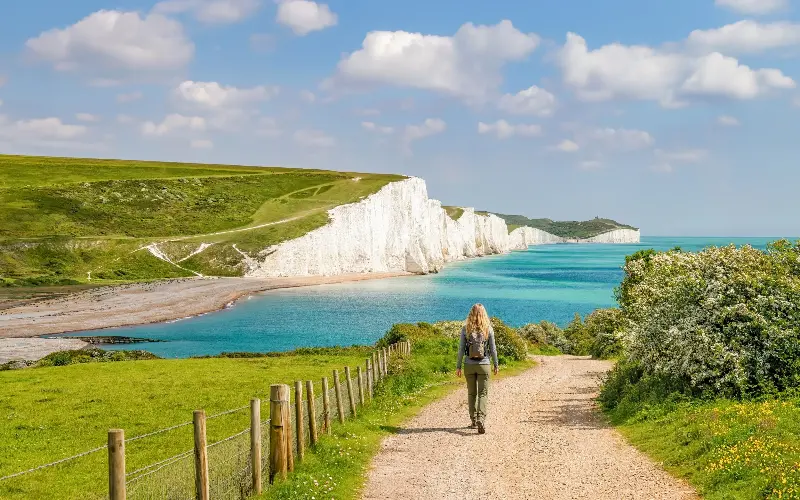
Cuckmere Haven, Sussex
It was the view that launched England’s King Charles III coastal path: The Seven Sisters. These dazzling cliff faces between Seaford and Eastbourne have some picture-postcard viewpoints, with the foreground of clifftop cottages at Cuckmere Haven a favourite, but anywhere along the 13-mile coast path offers spectacular panoramas.
I have hiked it many times while visiting and caring for my late parents who lived in Eastbourne. Just a couple of years ago, my father strode with me up one of those clifftops from Birling Gap. Happy memories. Up and down the path goes, a steep roller-coaster of green sward and white chalk with the red-and-white lighthouse at the foot of Beachy Head.
It’s a world-famous view now, thanks to social media, and it can be busy. People stand perilously close to the edge for photographs. Telling them the cliffs are so white because they keep crumbling away rarely seems to register...
How to do it
Southern Rail runs twice-hourly services to Eastbourne from London. From Eastbourne, take the Coaster 12 bus to Seven Sisters Country Park Visitor Centre. On the coastal path, Belle Tout lighthouse is a six-room B&B with doubles from £210. In Eastbourne, The View Hotel has rooms with sea views and balconies.
Little Solsbury Hill, Somerset
I’m loath to mention my favourite view – it’s my local. Though I guess Peter Gabriel let the cat out of the bag in the 1970s, when he wrote his song, Solsbury Hill. An Iron Age hill fort, Little Solsbury isn’t big, rising just 191m, but feels much mightier.
Several hills hug Bath, but no other has a lookout like this. You can see in all directions: east along billowing, green Box Valley (where Gabriel founded a recording studio); south, down the Avon, to Westbury White Horse; west over Bath’s golden rooftops; north up the Swainswick Valley, where “the caterpillar”, an iconic ridge-top row of trees, presides.
This aspect is marred by the A46, the building of which drove protestors to camp on Solsbury in 1994. They lost the fight, but helped change opinion and stop other road schemes. And anyway, skylarks almost override the traffic and, if you get lucky with a cloud inversion, you feel transported back a few thousand years.
How to do it
Little Solsbury Hill is around three miles east of central Bath. Bus or walk (via the canal and toll bridge) to Batheaston to make a 3.3-mile loop (bathscape.co.uk). Straw Bale Lodge, a cabin for two on Solsbury’s flanks, costs from £200pn.
Liverpool waterfront
Waterfronts, like mountains, are most glorious not for those who are there, but for those looking at them. Thus, while I have always been drawn seaward by the Pier Head at Liverpool, and almost race down to the dockside every time I visit, it was a view of the city from a ferry that floored me for its sheer beauty and wondrousness.
It was a clear morning, and just after dawn when the boat from Belfast entered the Mersey. The waterfront was backed by a deep, orange sky, but the buildings were already glowing as if from some internal illumination – the famous Three Graces (Liver Building, Cunard Building and Port of Liverpool Building), two extraordinary cathedrals, Radio City Tower, Albert Dock, Queensway Tunnel tower, and the mass of the city rising up behind on its seven mythic hills.
You can see this view from the little river-crossing ferry and, from slightly further away, from Birkenhead – perhaps with binoculars. Liverpool is the UK’s Manhattan; its history is as storied and the face it shows to the world as confident and glorious.
How to do it
Liverpool Lime Street station is well served by trains from across the UK. It’s a 30-minute walk, downhill, to the waterfront. Catch one of the commuter ferries from Pier Head (also known as Gerry Marsden) across to Seacombe on the Wirral. Returns from £4.20. Alternatively, book a 50-minute Explorer Cruise for £14. Stay at the Scandi-style Hope Street Hotel, in the Georgian Quarter. Doubles from £160.
Gummer’s How, Lake District
To enjoy a panoramic 360-degree view of fells in the Lake District usually demands sweat and toil to gain the required lofty height. But Gummer’s How, a small fell above the south-eastern shores of Lake Windermere, is almost unfairly easy to climb, yet offers as reward some absurdly wonderful views.
Take the narrow road, Fell Foot Brow, that branches off the main lake-skirting A592, and in the direction of Bowland Bridge. After around a mile, a path leads off to the left and crosses rough pasture and bracken, gently rising – with occasional short and steep-ish rocky sections – before, 30 to 40 minutes later, depositing you at the 1,053-foot summit. Oh boy! Providing it’s a clear day, below is the serpentine length of Lake Windermere; across the lake, looking west, the Coniston fells; turn to the north to spy the Langdale Pikes; turn again to the east to see the Pennines; while to the south, glinting shyly, is Morecambe Bay.
How to do it
The Fell Foot Brow turn-off from the A592 is one mile from Newby Bridge to the south and six and a half miles from Bowness-on-Windermere to the north. This narrow road rises steadily where, after a mile, a small car park on the right-hand side is handily opposite the start of the walk, marked by a signpost on the left-hand side. The family-friendly Swan Hotel and Spa at Newby Bridge has colourful rooms, a spa and restaurant; doubles from £160, including breakfast.
Zennor Head, Cornwall
Of countless captivating places on Cornwall’s gnarled toe, Zennor is perhaps the most enchanting. It’s a hamlet as distinctive as its moniker, derived from the Celtic St Senara; her ancient church features a medieval mermaid pew end, recalling the local legend of a lost lad lured away by a siren. Sink a pint of Mermaid Ale in his memory at the adjacent, seven-century-old Tinners Arms.
But the real magic lies just to the north-west. I vividly recall the midsummer afternoon I first made the half-mile stroll to Zennor Head, a natural fortress of lichen-mottled granite, greenstone and slate that bears signs of human presence stretching back four millennia.
Below unfurled a glinting expanse of pellucid sea, out-turquoising the Aegean. To left and right, the switch-backing coast was speckled with sea thrift and sheep’s-bit scabious. The dorsal fins of basking sharks cruised offshore, while seals guffawed in the rocky cove below. Beyond, the wide Atlantic: next stop, Newfoundland. End-of-the-world wondrous.
How to do it
Zennor Head is a six-mile walk along the South West Coast Path from St Ives. The White House connected to the Tinners Arms has bright, fresh en-suite doubles from £150 B&B. A couple of miles further along the coast, and a step up in gastronomy, is the Gurnard’s Head, with B&B doubles from £175.
Leith Hill Tower, Surrey
Leith Hill, at 965 feet, is the highest point in south-east England. It was made a mountain by 18th-century landowner Richard Hull, who put a Gothic tower on the summit, raising the height to 1,029 feet and gifting me my favourite view.
To the north, London, Wembley Arch, Big Ben and St Paul’s, the Shard flashing skywards like a fiery sword in the sunset. South, the Weald, with the tower of the church where I was married peeping through the trees,.Kipling’s “whale-backed Downs” rolls towards Beachy Head, the sea shines silver through Shoreham Gap, watched over by the world’s biggest college chapel at Lancing.
Below, Palladian Leith Hill Place is where the piano resides on which Ralph Vaughan Williams composed Britain’s favourite piece of music, A Lark Ascending. 13 counties, the world’s greatest city, history, happy memories, music and beautiful England all in one sensational view.
How to do it
There are several car parks on Leith Hill, which is in the Surrey Hills, about seven miles south of Dorking. The best one for the Tower is Starveall Corner, the first one you come to when approaching from the north, which is free. From here it is a gentle 15-minute climb to the tower, and 78 spiral steps to the top. The Tower is run by the National Trust and is open 11am-4pm every weekend and bank holidays in the summer.
The Colne estuary, Essex
You know the Essex clichés of hen parties and fast cars. Even the coastline – which, depending on the metric you use, can amount to 350 miles of waterfront – is not immune to hackneyed disparagement, with critics focusing on the slot machines and melted ice creams of Clacton and Southend, rather than the wildlife-rich marshland and tidal estuaries which help to shape the county.
The River Colne is a case in point. Though it winds for just 39 miles, beginning north-west of Colchester, it packs a great deal of beauty into its short journey. Pick up its thread where it passes the picturesque harbour town of Wivenhoe, and it can be the star of an afternoon stroll – a silver ribbon which widens steadily as it moves towards its endgame between the soft shoulder of Mersea Island and the quiet resort of Brightlingsea.
There was once a railway here, and some of the path runs along the dead embankment, so that, with every step, you are following in the tracks of Victorian tourists 150 years ago. The panorama cannot be much different today – chaffinches twittering unseen in the branches, black-headed gulls leaving webbed footprints on the sticky mudflats, the air heavy with sea-salt, and the water levels rising and falling to the sea’s rhythm. Gorgeous.
How to do it
Holiday Cottages has a selection of properties in Brightlingsea, including the one-bedroom Salty Dog (ref OC-77638), which can be rented from £435 per week. All Trails offers full details on a “Wivenhoe and the Colne Estuary” hike which explores the area via a six-mile circle.
Cadair Idris, Wales
Unlike Yr Wyddfa (Snowdon), there’s no cheating by taking the railway up to Cadair Idris – you have to earn the view from its 2,930-foot summit. And don’t think that its more modest height dilutes the drama. Whether you hoof it up the Pony Path or the rugged, tougher Minffordd Path, you’re in for a stiff 10-mile round trip, past a wild wooded gorge, and drystone walls running riot over steep hillsides.
But when you reach the top, my, what views! Provided the weather plays ball, that annoying puff of cloud will magically lift for a panorama embracing the moody peaks of Snowdonia, the dragon’s tail of the Llŷn Peninsula and the glinting west coast. If it’s really clear, you can spy the Wicklow Mountains across the Irish Sea. Mythical? You bet. Cadair Idris is named after mediaeval king, giant and astronomer Idris Gawr, and legend has it that if you overnight at its summit, you will either wake up a poet or a madman.
Drop over the ridge on the descent of the Minffordd Path to brave a wild swim in the depths of a “bottomless” glacial crater lake, Llyn Cau. A Welsh dragon captured by King Arthur apparently lurks in its icy, inky depths, and the cliffs flinging above the cirque are Tolkienesque.
How to do it
Check the weather before setting out, as it can be notoriously fickle. Spring and autumn are less crowded, as are weekdays. Bring hillwalking gear and take all provisions. Dolgellau has a sprinkling of places to stay, but particularly charming is The Old Vicarage in Corris near the Minffordd trailhead, with B&B doubles from £140.
Blackford Hill, Edinburgh
This breathtaking city of vertiginous uplands and volcanic crags is said to have been built on seven hills, a legend putting it on a par with Rome. As a student here, I often enjoyed three of them, schlepping up the great mound of Arthur’s Seat, gazing from the top of Calton Hill, and sauntering up the Royal Mile to the citadel on Castle Rock. It took me several return visits post-university to redress my neglect of the other peaks: Corstorphine Hill, Craiglockhart Hill, the Braids and Blackford Hill. I inadvertently left the best to last.
A couple of miles south of the city centre, Blackford Hill was an eye-stretching revelation when I finally explored this steep oasis of green. The easiest climb to the top is via the Royal Observatory, part-way up, but the hill is laced with more challenging footpaths and etched with heart-pumping steps. Reach the trig point, and you’re rewarded with spectacular panoramas south to the Pentland Hills, north-east to the hulk of Arthur’s Seat and, most dramatically, over the city, taking in a mosaic of land and sea as you gaze over spires, castle and rooftops across to the Firth of Forth and over to Fife. It is inevitably as blustery as it is beautiful.
How to do it
From central Edinburgh, the best bus route to Blackford Hill is the number 41, which passes from the Mound to Marchmont and then runs close to the Royal Observatory. Nearby Braid Hills Hotel offers doubles from £129 with breakfast.