



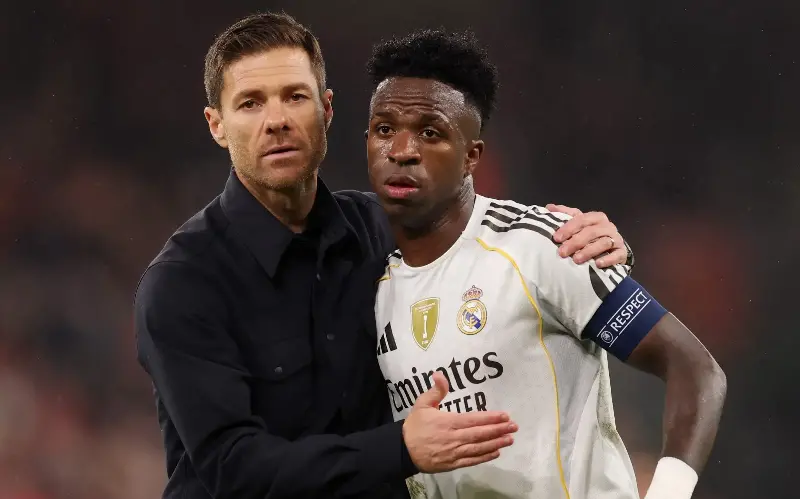
The late-night radio shows in Spain that cover the intrigue and politics of life in the Real Madrid dressing room have been abuzz of late with the latest theories of discontent between manager Xabi Alonso and the global celebrity footballers he manages.
Taking the temperature of Real is never a simple task but the reporters from the likes of Cadena Ser and COPE are usually as close as anyone to the home dressing room and the characters in it. Beyond the players such as Vinícius Júnior, Kylian Mbappé, Jude Bellingham and Thibaut Courtois, there are scores of agents, family members, associates, PRs, social media apparatchiks, chefs, fitness trainers and general hangers-on. It is fertile ground for gossip and the talk for some time has been of a problematic relationship between Alonso and his players.
It got worse last weekend for the man who was, just six months ago, appointed at Real as the brightest young coach in Europe. Defeat at the Bernabéu on Sunday by Celta Vigo led to the home crowd turning on the players and, for many previous incumbents, that would have been curtains. Although for now Alonso, 44, has the protection of a stellar playing career and a scorching start to his top-flight coaching life in Germany.
But still, the suggestions are that a bad defeat by Manchester City at home on Wednesday night in the Champions League could even be the end for Alonso. The 2-0 loss to Celta included two avoidable red cards for Real and, for his second goal, the talented Swedish striker Williot Swedberg simply walked the ball in. “Soft on the players,” was the verdict from many quarters – although it is Alonso’s more prescriptive approach to his squad that seems to have fed the whispering campaign against him.
That defeat followed a win away at Athletic Bilbao on Wednesday that itself ended a run of three draws on the road in the league. There are fresh injuries in the last week for Trent Alexander-Arnold and Éder Militão. Many trace the problems back even further, to Alonso’s team being beaten 4-0 by Paris St-Germain in the semi-final of the Club World Cup in New Jersey on July 9. A result that looked even worse when Enzo Maresca found a way to beat the Champions League winners in the final.
The new Real coach was once a very fine player himself at the Bernabéu. Alonso was one of the best players of his generation, a Champions League winner at Real and Liverpool, and a World Cup winner with Spain. More than 700 games at Liverpool, Real and Bayern Munich as well as his hometown club Real Sociedad. In short, a top-tier CV for a top-tier footballer.
There was also a seriousness about him, captured beautifully in that farewell picture taken at the end of his Bayern career in 2017, traditional black Adidas Mundials in his right hand, a glance over the shoulder, a cursory wave. No tattoos, and the same haircut his whole career, Alonso was a superstar without any of the trimmings. Which was fine as part of the blend of a team – but different, it seems, as an ascetic manager determined to build a team’s approach from the bottom up.
The biggest rift appears to be with Vinícius, who is at a contract impasse with the club and a free agent in 2027. The suggestion is that the Brazilian has found it hard to connect with his new manager, who is much more dogmatic with his players in terms of their preparation, and the latitude he gives them in the game plan. Vinícius is a major figure in world football, and as a mini-corporation himself, he comes with a sizeable entourage.
They too have been told that they cannot enjoy the unfettered access to the squad’s inner sanctum at the training ground that they might once have enjoyed, according to those Spanish media reports. It can be hard to know where the modern superstar player stops and his attendant business interests start. Like Vinícius, Real’s biggest star, Mbappé, is also an investor and an entrepreneur in his own right. He too has a stake in a football club – in his case the controlling stake in Caen in France’s Ligue 2. These are players who are accustomed to being in control.
The latest suggestions are that some of the players are unhappy flying to away games in Spain on the preceding day. They would rather do so on match day. Real have had a lot of away games recently – five in La Liga and two in the Champions League. That was at the request of the club so the Bernabéu could accommodate the NFL game between the Miami Dolphins and Washington Commanders on November 16. The rebuilt stadium is multi-purpose but changing usage takes time.
Alonso may be one of the few coaches with the kind of status to manage the modern Real – in both his playing career and coaching record. Yet taming the modern Real is another proposition altogether. At Bayer Leverkusen club insiders say that the players were in awe of him. Florian Wirtz, who emerged as one of the Bundesliga’s biggest players under Alonso, would stay after training to work with his coach. So too Álex Grimaldo, a Spain international whose career bloomed relatively late under Alonso.
At Real, the mood is different. Also on the list of complaints listed on the late-night radio shows is Alonso’s practice of speaking to the players daily at the training ground at the start of the day. Some of them are said to find that diary commitment a little onerous.
It can sound like a list of grievances from a group of fabulously wealthy footballers who do not appear to know how lucky they are. It is by no means all of them and the picture remains fuzzy. Those who preferred the way it was under Carlo Ancelotti and Zinedine Zidane will point to six Champions League titles in the previous 13 seasons and three of the last six league titles. But if you hire a meticulous young coach like Alonso, then do not be surprised if he coaches in a meticulous way.
In the end, there is always the president to decide, the 78-year-old Florentino Pérez, who has reigned supreme for 23 of the last 25 years. A brutal succession battle is building for the day he quits but, in the meantime, Pérez’s plate is full. He is trying to do what none of his successors have – effectively to privatise the membership-owned club as a way of recapitalising. Even doing so with an experimental five per cent of the entity is proving fabulously complex – with wide-ranging tax implications. For a sale, full or partial, to be possible, it may require new legislation to be passed.
Pérez will have heard all the complaints. Vinícius’s hard-balling over a new contract and, if the reports are true, the Uruguayan midfielder Federico Valverde’s unhappiness at being played at left-back. Pérez may take the view that his long-delayed move to PLC status for Real requires more of his time than the dissatisfaction of some famous footballers. But then at big football clubs it is always the results that set the mood and what preoccupies those who play is what tends to preoccupy those who run the club.
As things stand, Real are not in the kind of danger that Liverpool have encountered in recent months, or indeed Manchester United in recent years. Real play in a domestic league with much less jeopardy for a club of their wealth and they are currently in second place, only four points behind Barcelona, whose financial situation is much more perilous. Real are fifth in the Champions League table.
Real’s big-name players over the years have tended to get their way over coaches. That was certainly the case when they had nine managers in seven years between Vicente del Bosque leaving in June 2003 and José Mourinho’s appointment in 2010. Ancelotti’s last four years were the longest in post since Miguel Muñoz’s 16-year reign ended in 1974. In his two spells, Ancelotti was, famously, not trying to rebuild the club in any particular way. He was often a light hand on the tiller.
But for Alonso’s generation of coaches, that is not the way. At Leverkusen, where he broke Bayern’s run of 11 straight titles, the hierarchy was clear: the sporting director was king and the coach was expected to drill and organise a squad recruited largely by others. All elements – tactical, fitness, sports science, data – were applied and every player was subject to those demands. Some are more equal than others, but none can afford to step outside the system.
At Real the ultimate power lies with Pérez, who has dominated the membership for so long that the club are a one-party state. From him it also flows to the famous names in the dressing room and they have seen how predecessors have flexed that muscle at times.
Are Real ready for a young, progressive coach like Alonso who is eager to make big changes? They do not tend to appoint young coaches and, excluding Jorge Valdano in the 1990s and later Zidane, who were both internal hires, you have to go back a long way to find someone younger. Benito Floro, appointed in 1992 aged 40, is not among the club’s most celebrated coaches.
Alonso is coaching as he has learnt to do – according to the rigour of his profession in the modern era and in a similar fashion to his contemporaries. It certainly worked in Germany. The question is whether it works in Real, where not everyone seems to like it.