



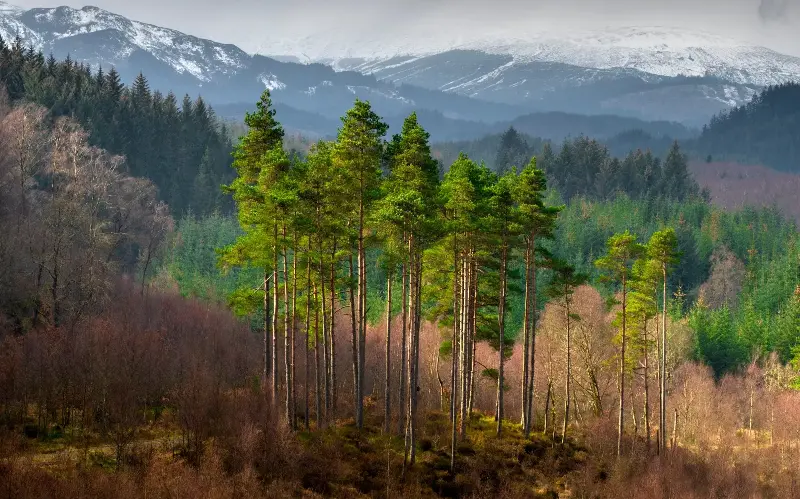
The Scots pine could be wiped out in the UK by climate change, horticulturalists have warned.
The evergreen conifer, which can grow up to 120ft tall and live for 700 years, is the only pine native to the UK and can be found in the once extensive Caledonian forests of Scotland.
But Sally Petitt, the head of horticulture at Cambridge University Botanic Garden, has now warned that Scotland’s national tree is “suffering” in the rolling heatwaves and lack of rain.
Ms Petitt said: “Himalayan pines and Scots pines are suffering here. We have lost two mature Pinus wallichiana (Bhutan pine) in recent years, which we believe is due to lower rainfall and high temperatures.”
In 2025, the UK endured its driest spring in 132 years combined with the hottest summer since records began in 1884.
The Environment Agency has warned that even if England receives its full average winter rainfall, areas such as Cambridge will remain in drought conditions until early next year,
Horticulturalists at the 40-acre gardens have been modelling which trees and plants will be resilient to more extreme weather conditions in the UK.
Experts at the botanic gardens have been considering alternatives to the struggling coniferous evergreens, including the Portuguese, Holm and Hungarian oaks.
Sweet chestnuts, oriental beech and ginkgo have also been noted as “good climate-resilient trees”.
The botanic garden has also been tracking the effects of climate change on more than 90 trees across the site, finding some are losing their leaves earlier and some later.
Horticulturalists said climate change has already led to thinner tree canopies while repeated stress of drought in summer and cold winters can leave plants vulnerable to disease.
Scots pine is susceptible to red band needle blight, root and butt rot, needle cast disease, and pine stem rust, while the pine tree lappet moth also poses a risk of serious defoliation.
Loss of Scots pine can have a serious impact on the ecosystem, as the conifer supports about 1,600 species, such as the red squirrel, capercaillie woodland grouse, and wildcats.
Scots pine supports about 215 species of wildlife, including the Scottish crossbill – the UK’s only endemic bird.
Ms Petitt also warned that the days of gardeners tending to manicured lawns and banks of brightly-coloured perennials such as phlox and snake’s head could also be numbered.
She said: “The traditional herbaceous border – which is high-maintenance and needs a lot of watering – is becoming outmoded.
“A better way of growing in future will be to use plant mixes that are better aligned to the specific conditions of your garden.
“We need to try and adapt away from the mindset that a British garden must have a traditional lawn, and grow meadows or alternative grass species that do better in drought conditions.
“That’s going to be a big shift for many UK gardeners.”
In 1990, the botanical gardens installed a “dry garden” using drought-tolerant plants like catmint and California poppy.
The team has been studying the climate ranges of different species, particularly the temperatures and level of rainfall plants can tolerate.
“Plants in the dry garden have leaves that are leathery, glossy, small or hairy, all of which are adaptations to help mitigate the effects of heat and UV light,” Ms Petitt said. “We also use bulbs like daffodils, which flower early and are then dormant when the weather is most extreme.”
Ms Petitt said gardeners could create dry meadows by clearing the top layer of soil and replacing it with free-draining sand, before planting species such as cowslips and oregano alongside South African berkheya “silver spikes” and Missouri evening primrose.
Ms Petitt, who has dedicated nearly 40 years to the garden, recalled winters so bitterly cold that chores became impossible.
“Some winters we couldn’t even go out and rake leaves because they were all frozen solid. That’s unheard of now,” she said.
Margeaux Apple, the assistant curator of living collections at the garden, said: “We don’t know exactly how our climate will change in future.
“Different models predict the UK climate will become more Mediterranean, or more like north-west France or northern Greece.
“What we do know is that a lot of the world is going to experience novel climate conditions that aren’t happening anywhere right now.”
She added: “We’re trying to better understand the water-holding capacity of our soils, to inform where we plant different species across the site.
“Studying the topography – the rises and dips in the landscape – can tell us where water is likely to collect. If extreme wet periods become more frequent, we may need to adapt our planting based on the topography, catering to plants that like their feet wet or plants that will rot in too much moisture.”
The botanic garden, established in 1846, is home to 8,000 species from around the world.