



Beyond the obvious attractions of sun and sea, it’s the ancillary elements that make Spanish beach culture the all-encompassing pleasure it is: the stroll along the palm-lined promenade, the chargrilled sardines at the chiringuito, the big G&Ts at sundown.
Spain has almost 5,000 miles of beach, divided between an ocean and two seas: the Atlantic, the Cantabrian and the Mediterranean. In contrast to other European countries, Spain’s beaches belong firmly in the public domain – any attempt to privatise, build on or restrict access to the beach is prohibited.
With a total of 677 Blue Flags – currently more than any other country – the overwhelming majority of Spain’s beaches are clean, well maintained and in a good state of environmental health.
Even after three decades of construction along the Spanish coasts, it’s still possible to stumble on lonely tracts of sand where the only footprints you’ll see are those of seabirds. Here’s our pick of the 20 best beaches in Spain.
1. Playa de Cofete, Fuerteventura, Canary Islands
Best for windswept walks
Fuerteventura may be best known as a cheap-and-cheerful package holiday destination, but it has a secret side: the elongated peninsula at the island’s south-western tip, most of which belongs to the protected Parque Natural de Jandía, whose mountainous spine has peaks of up to 800m.
Getting to Cofete, the nearly nine-mile (14km) undeveloped stretch of wild coastline on the peninsula’s northern side, involves a long drive by 4x4 on rough tracks from Morro Jable. Once at your destination, there’s little to do but wander along the beach, marvelling at the great wall of mountains rearing up behind it and its desert-like tones of reddish ochre, seeming to blur into the deep golden colour of the sand.
There’s a windswept wildness about Cofete that may not be for everyone. Certainly, its pounding Atlantic waves, while heaven-sent for surfers, are less than ideal for lovers of gentle dips in mirror-calm waters. Above the beach stands Villa Winter, the imposing former residence of purported Nazi agent Gustav Winter after the Second World War. Now abandoned, the house only adds to Cofete’s rough magic.
How to do it: You’ll need an off-road vehicle to make the one-hour journey from Morro Jable on the southern side of the Jandía peninsula. The dirt road winds along the coast before turning north to cross the mountains. Stop to take in the mind-expanding view from Mirador de Cofete. Sol Fuerteventura Jandía All Suites in Morro Jable has suites from £127. Fly to Fuerteventura Airport.
2. Playa de la Concha, San Sebastián, Basque Country
Best for people-watching
Where city beaches are concerned, Spain has a number of worthy candidates – but there can be only one winner. La Concha is aptly named: its extraordinary shape, a perfectly regular arc, recalls the graceful form of a seashell.
If San Sebastián is generally agreed to have a stellar quality of life it’s largely due to this stupendous beach, which stretches from the old-town harbour in the Parte Vieja round to a rocky outcrop, where it officially gives way to another fine beach (Ondarreta).
La Concha is all things to locals of all ages and conditions. On a calm winter morning, it’s a magnet for dog walkers and cold-water swimmers. During the San Sebastián Film Festival in September, it becomes a suitably glamorous backdrop for a photo shoot with cinematic luminaries. On a Saturday in summer, it can seem as though the entire city, including its sizeable tourist population, has laid its towel on these golden sands.
Life on the promenade mirrors the action on the beach itself, what with runners and strollers, buskers and street entertainers. Some of San Sebastián’s swankiest hotel bedrooms are found along this strip: for a sea view to conjure with, try the Hotel de Londres, a classic revived, or the chic Villa Favorita.
How to do it: The Hotel de Londres has double rooms from £289. Fly to San Sebastián Airport.
3. Carnota, Galicia
Best for rivers and marshland
Despite being unfortunately named from a marketing point of view, the Costa da Morte (Coast of Death) is a spectacular and under-visited coastline on the wild north-west corner of Galicia. Fabulous sandy beaches are strung along this costa like pearls on a necklace, but none is more precious (or longer, at more than four miles) than Carnota.
Raised wooden walkways lead from Carnota village through marshy flatlands around the meandering Valdebois River, a protected natural area rich in bird species such as the Kentish plover Charadrius alexandrinus. Otters are also known to inhabit the foreshore.
The jaw-dropping scale of the beach itself, which follows a gently curving bay backed up by rolling dunes, means it rarely feels crowded. But there’s a wild side to Carnota’s idyllic beauty. Depending on the prevailing wind, the waves pounding the beach can make entering the water a tricky business, and powerful offshore currents can be a challenge even for strong swimmers. Special care is particularly required at low tide.
For a panoramic view of the beach in all its splendour, walk to the top of nearby Monte Pindo, a granite peak sacred to the ancient Celts.
How to do it: There is ample parking behind the beach, the most convenient place being Boca do Río at the northern end. Nidos de Carnota has wooden cabins on stilts, from £190. The nearest airport is A Coruña Airport.
4. Ses Illetes, Formentera, Balearic Islands
Best for crystal waters
If Formentera resembles a dog bone hanging off the end of Ibiza, Illetes is the string. A half-kilometre of fine white sand as squeaky-soft as caster sugar, “little islands” is one of the Mediterranean’s most swooned-over beaches a major FOMO-inducer on Instagram. The main reason being the sublime pinky-turquoise tones, deepening into a rich medicine-bottle blue, of its shallow, glassy waters.
Infrastructure is thin on the ground, with a chiringuito and Juan y Andrea, a Formentera beachside classic restaurant since 1971 (but keep your eye on the prices here).
From the northern tip of Illetes on a dead-calm day, if you’re an intrepid type, you can swim or wade across the narrow strait to reach the idyllic islet of S’Espalmador.
High summer – when half of Milan seems to pitch up here and bling yachts crowd the bay – may not be the best time to enjoy Illetes. Don’t tell a soul, but it’s in the low season (especially in the bright Mediterranean winter) that you’re more likely to discover the essence of its serene and silent beauty.
How to do it: Drive north out of Sant Ferran de ses Roques, near Sant Francesc Xavier, Formentera’s pocket-sized capital, and park in the car park behind the beach (price €6/£5; electric vehicles free). Though be sure to get there early – the car park fills up quickly. Or take the shuttle bus from the port of La Savina (€8/£6.70 return). Cas Saliners Illetes has double casitas from £172, room only. Fly to Ibiza Airport.
5. Playa de Torimbia, Llanes, Asturias
Best for scenery
Notwithstanding its reputation for soggy weather and overcast skies the northern region of Asturias commonly features on hot lists of Spain’s prettiest playas. The competition around here is fierce (Gulpiyuri, a unique back-to-front beach, is a much-“liked” Insta favourite). But Torimbia, a majestic arc of fine golden sand, cradled in a landscape of ferns and lush green pastures, is surely among the loveliest anywhere.
In summer, a small chiringuito serves grilled fish, drinks and ice-creams; otherwise you’ll need to bring food and water. You might not need clothes, since Torimbia famously welcomes naturists as well as nature lovers, but some kind of sunshade is desirable. Be sure to look for a spot above the high-water mark or you’ll be caught by the tide.
How to do it: Leave your car in the small clifftop car park or in the nearby Niembro village. Take the easy 15-minute walk down a winding track. Hotel La Portilla (closed October to March) has double rooms from £69, including breakfast. The nearest airport is Asturias Airport.
6. Cala Trebalúger, Menorca, Balearic Islands
Best for avoiding the crowds
This secluded cove on Menorca’s south coast was saved from large-scale development in the Eighties and so is pristine in the real sense – of something in its original condition. A freshwater river slinks down to the sand from a rocky gorge through wetlands, sea-grass and strands of bamboo.
Trebalúger’s USP is the harmonious feng shui of its combination of dunes, cliffs and surrounding pine forest. You won’t find sun loungers, showers, bars or facilities of any kind here. And the half-hour’s walk around the coast from Cala Mitjana does a great job of keeping the crowds away.
How to do it: Leave your car in the car park behind the beach at Cala Mitjana. Take the coastal path in a westerly direction (Trebalúger is signposted). Hotel Rural Binigaus Vell has double rooms from £266. Fly to Menorca.
7. Playa de Famara, Lanzarote, Canary Islands
Best for surfing
Famara’s fame as a surf beach precedes it. Behind its nearly four miles (6km) sweep looms the mighty Risco de Famara, a wall of purplish volcanic stone rising to 670m; just over the water huddles the magical island of La Graciosa. Especially appealing on a hot day, when they’re naturally air-conditioned by the trade winds, Famara’s sprawling sands (which double their size at low tide) are popular with runners and walkers, surfers and kitesurfers. The adjoining village of Caleta de Famara has various surf schools, as well as fish restaurants, hostels and a large car park. Calima Surf School has been operating since 1996 and is a reliable choice for surf classes in Famara.
How to do it: Park in the sandy streets of Caleta de Famara village. Hotel Palacio Ico in Teguise has double rooms from £194. Fly to César Manrique-Lanzarote Airport.
8. Playa de Sopelana, Bilbao, Basque Country
Best for beach sports
If Bilbao lacks a beach of its own, Sopelana, 12 miles (20km) north out of town, is practically Bilbao-on-Sea. In summer, much of the city decamps here at weekends, though it’s much less well known among outsiders. A series of beaches in varying degrees of size and wildness, from the spacious sands of Arrietara-Atxabiribil to the pebble cove at Meñakoz, offer widescreen views, glorious sunsets and surfing breaks in abundance.
The beautiful 750m stretch at Barinatxe, also known as La Salvaje (“the wild one”), is a big draw for paragliders, who swoop off the cliff edge and over the beach. Rest at the post-surf bar El Peñón de Sopelana, above Atxabiribil – for pintxos, glasses of cold txakoli and sea views.
How to do it: Sopelana is best reached by Metro (it’s a 40-minute trip from downtown Bilbao; get off at Larrabasterra). Moana Eco Surf House has double rooms from £75. The nearest airport is Bilbao Airport.
9. Calblanque, Murcia
Best for swimming
Though they do lie alarmingly close to the overdeveloped La Manga and the deteriorated Mar Menor, the virgin beaches of Calblanque are among the most sublime in the Spanish Mediterranean. Dirt trails meandering across the arid slopes behind the coast take you past a series of yellow-sand beaches and calas (coves), each lovelier than the last – from Playa Larga, the biggest and busiest, to Playa Parreño and the remote, lonely Playa Negrete. All of them are tailor-made for lazy swims in waters of astonishing clarity. Bring a snorkel and sunshade. When swimming, keep your eye out for sea turtles – Calblanque is a refuge for them.
How to do it: From Los Belones village head south towards the nature reserve of Calblanque, Monte de las Cenizas y Peña del Aguila (there’s a car park, or take the shuttle bus). Grand Hyatt La Manga Club Golf & Spa has double rooms from £267. The nearest airport is Murcia International Airport.
10. Praia de Figueiras, Cíes Islands, Galicia
Best for white sands
Where Praia de Rodas, the world-famous beach on the Cíes Islands off Galicia’s west coast, forms a huge and graceful arc, nearby Praia Figueiras is smaller and tucked away in a magical setting – with big rocks abutting the cove and pine forests tiptoeing down towards the sea.
The beach is simply stunning, with snowy-white sands that creak as you walk on them and water of a Caribbean pinky-blue. The Cíes are best visited in September or October, when the holiday crowds have abated and the Atlantic is at its warmest (though it’s never less than chilly).
Pack a picnic before leaving Vigo; an empanada, the Galician flat pie with various fillings, would be perfect.
How to do it: Take the Mar de Ons ferry from Vigo harbour to the Cíes Islands. Once on the island, take the path to the right, turning off at the sign for Praia Figueiras. Gran Hotel Nagari in Vigo has double rooms from £125. Fly to Vigo Airport.
11. Playa Nueva Umbría, Huelva, Andalucía
Best for naturism
There’s an exhilarating Atlantic flavour to coastal Huelva’s breezy climate and refreshing waters. Just over the river from the village of El Rompido lies Nueva Umbría, a fabulous seven-mile (12km) stretch of honey-coloured sand backed by dunes and seaside vegetation. Protected as part of the Parque Natural Marismas del Rio Piedras natural park, Nueva Umbría appeals as much to naturists as nature lovers: it’s a haven for the clothes-off crowd, and comes recommended by the Spanish Nudist Federation.
How to do it: From Huelva it’s a 30-minute drive to El Rompido on the A-497. From there take the ferry across the river. Hotel San Miguel in El Rompido has double rooms from £85. The nearest airport is Seville Airport.
12. Cala Aiguablava, Girona, Catalunya
Best for boating
Aiguablava means “blue water” and this cute Costa Brava cala, with its shallow waters the colour of lapis lazuli, is aptly named. Only the brave or foolish would attempt to lay their towel on these fine sands during the months of high summer – but there’s a cunning plan. Staying at one of the hotels above the beach means you’ll be well placed for a peaceful dip when the beach has emptied out at sunset.
Another idea is to hire a motorboat from Costa Brava Boats and putter along the coast, nipping into those secret calas that can’t be reached on foot. Or walk around the bay to the tiny cala of Fornells (20 minutes).
How to do it: Take the AP-7 coastal motorway, turning off at Lloret de Mar/Vidrieres and following signs for Aiguablava. The Parador de Aiguablava has double rooms from £204. The nearest airport is Girona-Costa Brava Airport.
13. Cala Jondal, Ibiza, Balearic Islands
Best for glamour
This U-shaped cala on the south coast of Ibiza is a global hub of seaside chic, where a few hours on a sunbed might set you back as much as a night in a five-star hotel. This is a pebble beach: it hardly matters.
Situated here is Jondal, a chic chiringuito, and beach club Blue Marlin, where big-name DJs serenade you as you nibble idly on an ambitiously priced snacks or lounge on your Big Bed (around £300 on a Saturday in August). Leaving their yachts moored in the bay, the well-heeled party people come to laze and graze among the pines.
How to do it: There’s a large sandy parking area behind the beach. Petunia Ibiza has double rooms from £427. Fly Ibiza Airport.
14. Playa de los Genoveses, Cabo de Gata, Andalucía
Best for being unplugged
Among Cabo de Gata’s 40 miles (63km) of almost entirely unsullied Mediterranean coastline is Playa de los Genoveses – with its sweeping grandeur and bucolic setting, surely one of Spain’s most sensational beaches.
This is not a beach for folk who like to shower and lunch on paella after their sea-bath. There is nowhere at Los Genoveses to buy water, ice-cream or sun cream – you’ll need to take everything with you. What it has to offer the visitor is almost insultingly simple: a less-is-more experience of the Spanish Mediterranean, with nothing more luxurious than natural beauty and cloudless skies.
How to do it: A bus leaves the village of San José every hour between 10.30am and 8pm (€2 per trip). Cortijo La Joya de Cabo de Gata, aka Charo’s Houses has individual casitas from £172. The nearest airport is Almería Airport.
15. Playa de Bolonia, Cádiz, Andalucía
Best for history
The road to Bolonia winds down to the sea through fields where cows graze on the roadsides. And then you see it: a great curve of a white-sand beach with, at the far end, an enormous dune like something out of sci-fi adventure film Dune.
Be sure to visit Bolonia’s very own Roman ruin: the remains of Baelo Claudio, a fishing community founded in the Second Century BC. From here on it’s a few minutes’ walk along the beach to the great dune itself – a natural marvel worth fighting your way up (don’t try it under a hot sun) for the views from the summit.
How to do it: There is extensive parking space in and around the beachside hamlet of El Lentiscal. Hotel La Sacristia has double rooms from £161. The nearest airport is Jerez Airport.
16. Playa de la Patacona, Valencia
Best for reduced mobility
If it’s access that matters on a beach, La Patacona is worth making a note of. But the impressive list of facilities provided at this kilometre-long stretch of fine yellow sand, easily reached from downtown Valencia, runs from lifeguards and first aid to free public changing rooms and showers, information about sea conditions, children’s playground, sun-shade and hammock rental. La Patacona also makes a special effort to help people with reduced mobility issues. Book ahead for the free service (call 0034 963 542323) that provides crutches, amphibious chairs for bathing, and flotation equipment.
How to do it: The 19 bus connects Plaça del Ajuntament in Valencia with Playa de la Patacona. Hotel Neptuno Playa & Spa has double rooms from £131. Fly to Valencia Airport.
17. Platja de Magaluf, Mallorca, Balearic Islands
Best reinvention
Laugh all you like, but Magaluf continues to undergo an exemplary renaissance. This much-maligned beach is not only a curvaceous beauty in its own right, but for the last few years a major rebrand (starting with the name, now Calviá Beach) has been parlaying it into a surprisingly sleek resort.
Three-star hotels repointed as five-stars jostle with fashion-forward hangouts like Nikki Beach, the Mallorca branch of St Tropez-based lounge club. It’s now possible to see how Calviá Beach could be to Mallorca what South Beach was to Miami – a down-on-its-luck seaside enclave that found its place in the sun.
How to do it: Take the 104 or 105 bus from Estació Intermodal (Palma). The Meliá Calviá Beach has double rooms from £168. The nearest airport is Palma de Mallorca Airport.
18. Playa de las Canteras, Gran Canaria, Canary Islands
Best for culture
Unfurling along the northern edge of the city of Las Palmas, Las Canteras is more than just an adjunct of the city but a community in its own right. In recent years a creative crowd has colonised the busy streets behind the beach, with a new crop of bars, restaurants and hangouts like the unclassifiable Talleres Palermo. The surfboard carried in the street is par for the course.
Just behind the beach at its southern end stands the great culture-castle that is the Auditorio Alfredo Kraus (designed by Oscar Tusquets), where evening concerts regularly feature world-class singers, musicians and orchestras.
How to do it: Take the number 17 bus from Teatro (downtown Las Palmas), getting off at Fernando Guanarteme 118. Boutique Hotel Cordial Plaza Mayor de Santa Ana has double rooms from £70. Fly Gran Canaria Airport.
19. Playa de la Malagueta, Málaga, Andalucía
Best for seafood
Cities that don’t have beaches wish they could have one like La Malagueta. This 1,200m long stretch of greyish sand is up there with Pablo Picasso as an irreplaceable element of malagueño life. It’s where locals like to head for an evening paseo along the palm-lined prom – possibly followed by a dip in the sun-warmed sea.
But La Malagueta’s best-loved attraction is the beach-front chiringuitos where fresh sardines are grilled on vertical spikes known as espetos, filling the air with their savoury fragrance. Chiringuito El Cachalote offers a plateful of espeto-grilled sardines for the modest price of €5.50 (£5).
How to do it: Walk to the end of Málaga’s Muelle Uno dock and turn left onto La Malagueta Beach. Palacio Solecio has double rooms from £380. The nearest airport is Málaga-Costa del Sol Airport.
20. Cala Pilar, Menorca, Balearic Islands
Best for hiking
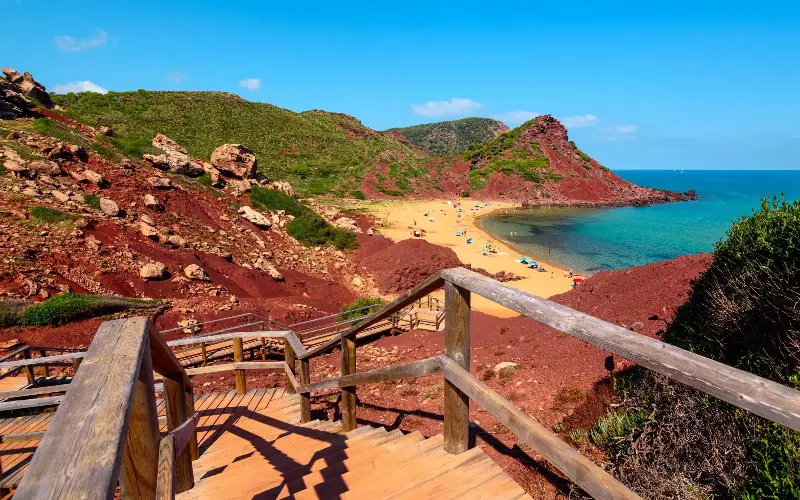
No apologies for including Menorca twice in this list. Like many of the island’s best beaches Cala Pilar – breathtakingly wild and beautiful with its pinkish-orange sands – lies directly on the Cami de Cavalls, an ancient walking route encircling the coastline. The Cami, at one time an important conduit for commerce and communication, has waymarks placed along its 10 stages. A particular pleasure of hiking this route is that you get to rest your bones on beaches as spectacular as Cala Pilar.
How to do it: The Cala Pilar car park is about a mile (2km) from the beach. From there, access is on foot: wooden walkways zig-zag down over sandy slopes towards the sea. Agroturismo Son Vives has double rooms from £258. Fly to Mahón Menorca Airport.
This article was first published in July 2024, and has been revised and updated.