



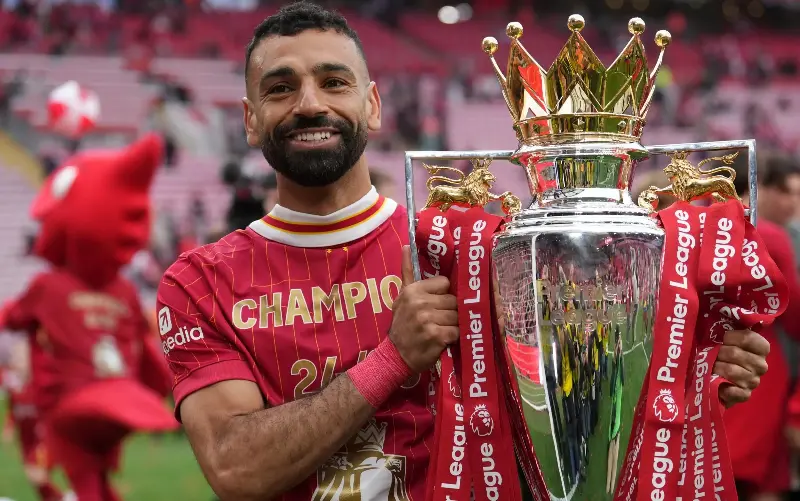
Mohamed Salah’s imminent Liverpool departure marks not just the end of an extraordinary era for the club. It means the Premier League will soon be deprived of another world-class, generational talent.
Liverpool’s loss is English football’s loss.
Following Kevin De Bruyne’s exit from Manchester City just last season, Salah’s Anfield farewell brings down the curtain on another career in this country which has illuminated our stadiums.
Until others step up to fill the huge void, we may risk suffering a “superstar famine”.
In the pantheon of overseas attacking players to have excelled in England, only Thierry Henry eclipses Salah’s output and consistency. While many will argue the merits of players like Cristiano Ronaldo, Eden Hazard, Gianfranco Zola, Dennis Bergkamp or Eric Cantona, none of them produced the same devastating numbers as consistently, season-after-season, as the Egyptian.
Ronaldo’s time at Manchester United, both initially and upon his return, was either side of his absolute, Real Madrid-peak years. Salah edges ahead of him when judging strictly on Premier League performance and impact. In an all-time Premier League XI, Salah is an automatic inclusion in the front three alongside Henry and Ronaldo.
The true measure of Salah’s greatness was brought home to me recently. Only a few days ago, my old club requested that I name my top-10 greatest Liverpool players. The usual suspects formed the core of my top choices: Steven Gerrard, Sir Kenny Dalglish, Graeme Souness, John Barnes and Ian Rush. The ultimate compliment I can pay to Salah is that he was the immediate name to follow them on that list.
Whenever the glorious, transformative Jürgen Klopp era is remembered, Salah will forever be synonymous with the success that delivered both Premier League and Champions League glory. If Klopp was the charismatic and visionary stage director, Salah was the inspirational leading man. His prolific goals propelled Liverpool to heights many feared would not be reached again, particularly considering the club’s standing upon his arrival in 2017.
Under Klopp’s guidance, and thanks in large part to Salah’s genius, Liverpool rapidly evolved from a club struggling simply to qualify for the Champions League to one that genuinely believed it had the capability to win the competition every single time they participated.
The greatness of Bill Shankly’s reign at Anfield was best symbolised by his transformative recruitment of Ron Yeats and Ian St John in the early 1960s, and Kevin Keegan and Emlyn Hughes in the early 70s. Bob Paisley will be forever associated with the pivotal signings of Dalglish and Souness, while Dalglish’s own managerial career was transformed by bringing in Barnes and Peter Beardsley. In the Klopp era, the two outfield stars who altered the course of the club’s history were Salah and Virgil van Dijk.
Alongside the equally brilliant Sadio Mané and Roberto Firmino, Salah formed part of the most devastatingly effective attacking trio in Premier League history. José Mourinho once joked that the front three were being hyped as “the last wonder of the world”. The truth is, for four magnificent seasons, they were special.
While Pep Guardiola may have evolved the idea of the “wide forward” with David Villa at Barcelona, Salah took the concept to a new level with his phenomenal goal-scoring rate. His success effectively forced managers across the world to rethink how they utilised players in wide areas. The traditional, old-style winger, who operated close to the touchline, aiming to get “chalk on his boots” and feed a conventional No 9, was replaced by the more natural, goal-hungry wide attackers who were now judged primarily on their goals and assists, rather than just crosses.
Aside from his prolific goalscoring and pace, there is another, more underrated quality that must always be remembered when discussing Salah’s rightful place among the greats.
It is his extraordinary availability. Across nine seasons at the highest level, Salah has made 435 appearances – an average of just over 48 games every single year for his club. These are extraordinary numbers given the relentless physical and mental intensity with which he and his team have played for most of that time.
Nothing impresses me more in the game than world-class footballers who possess that desire never to miss a game. In Salah’s case, he would visibly sulk if he was substituted and had to miss even a single minute of action. Such demonstrations of petulance were often frowned upon by others. But give me the star who can’t stand sitting on the bench or in the stands over those who cannot get off the pitch quick enough, clutching a slight niggle. That hunger and resilience is a mark of true greatness.
The timing of Tuesday’s announcement strikes me as both perfect and clever. There will, inevitably, be retrospective suggestions that the decision is a year too late, and that it would have been better for all parties had he sought his farewell when the club won the Premier League trophy last May.
However, no one was saying that this time last year, when Salah was winning the PFA and football writers’ player of the year awards. It was virtually impossible for the Liverpool hierarchy to ignore his numbers and his remarkable fitness levels, and attempt to persuade him and the fanbase that it was the right time to leave. The new contract at that time kicked the can down the road, setting the stage for the inevitable moment when the one thing Salah could never outpace – time – finally caught up with him.
There are those who will inevitably list the occasional public disagreements between Salah and myself over the years and claim that there was some underlying personal problem between us. Let me state without any hesitation: as a player, I absolutely love Mohamed Salah. When he delivered the occasional social media post or interview criticising the club or its decisions, it was my natural, instinctive reaction to defend Liverpool and take a dim view, in the same principled way I defended Chelsea against Enzo Maresca, or Manchester United against the perceived attacks of Ruben Amorim, which all occurred around the same time this season. My allegiance is, and always will be, to the club.
As a soon-to-be ex-Liverpool player, he will soon come to view the place where he made his name – as I do – as part of his extended family. He will understand my point of view if or when anyone criticises Liverpool in the future. And he will also understand that while it is always sad when a great player leaves, no one is irreplaceable. Another Anfield hero always emerges.
Confirming his intentions now guarantees the kind of emotional, grand farewell that a player of his standing deserves, which is why it was so critically important that neither he nor the club entertained any offers for him in the January window.
I have one final admission, however. While I will celebrate his career, I have no wish to be part of a grand Anfield farewell after the club’s final Premier League fixture in May. Every Liverpool fan has something far better and more dramatic in mind. Knowing Salah’s mindset and competitive spirit, he will be setting his sights on the greatest of all possible goodbyes a week later: inspiring his team to victory in the Champions League final in Budapest.
Do not bet against the perfect send-off.