



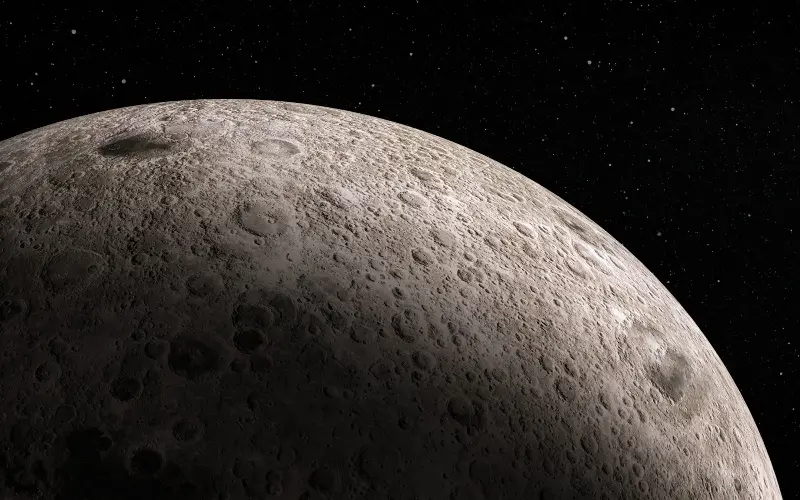
When the Artemis II astronauts reach the far side of the Moon on Monday their world will fall silent as communications with Earth are blocked by the bulk of our nearest neighbour.
During the almost hour-long communication blackout the three Americans and one Canadian aboard will be making scientific observations that could help shed light on the origin of life on Earth.
The crew will be floating alone, cut off from Earth and gazing down at a part of the Solar System that human eyes have never seen before.
What they see will be nothing like the calm, smooth, silvery disc that lights up our night sky.
The far side is never seen from Earth. It has borne the brunt of billions of years of bombardment and is a pock-marked golf ball of deep-shadowed overlapping craters.
But these scars of a violent past are also a record of what the early Earth may have experienced, and could offer vital clues as to how life formed on our planet.
The astronauts have been told to pay particular attention to two key lunar features on the far side of the Moon – the Orientale basin and the South Pole-Aitken basin. The latter is the largest impact crater – and possibly the oldest – known to exist in the Solar System.
Both the basins date back about four billion years to a period known as the Late Heavy Bombardment, when a large number of asteroids were peppering both the Moon and the Earth.
This period coincides with when life was first getting started on our planet.
One theory of how life on Earth started is that the first seeds of existence arrived on one of these asteroids. Evidence of these rocky lifeboats could still be lurking in the craters on the far side of the Moon.
“The Moon is like a witness plate for everything that’s actually happened to Earth, but has since been erased by our weathering processes, and our tectonic processes, and our other geologic processes,” Christina Koch, an Artemis II astronaut, said before launch.
“We can actually learn more about Solar System formation, more about how planets form, maybe around other stars, more about the likelihood of life out there, starting with studying the Moon.”
Only the Apollo astronauts have seen the far side of the Moon, but it was largely in darkness and they flew closer, which meant their field of view was smaller.
Artemis II soars much higher than Apollo, about 4,600 miles above the lunar surface, giving astronauts a wider view and allowing them to see areas and features of the far side that humans have never witnessed directly.
Dr Megan Argo, a reader in astrophysics at the University of Lancashire, said: “The far side of the Moon is never seen from Earth, which made it impossible to study before the development of space flight.
“Having trained astronauts now carefully observing the view and describing what they see will be extremely useful for lunar experts trying to understand the history and evolution of the Moon, and what it tells us about Earth’s history.
“The entire surface of the Moon is a history record of the Solar System in a way the Earth’s surface is not.
“On Earth we have plate tectonics, weathering, and other geological processes that alter the nature of rocks – melting, reforming, and wearing them away, and changing their chemical composition.
“This means that we cannot easily study the history of the Solar System using the Earth because much of the evidence has already been wiped away.”
The Moon rotates exactly once each time it orbits Earth so the same side always faces our planet, a phenomenon known as tidal locking.
The side we see has a thin crust, so large impacts in the early part of the Solar System’s history cracked the surface, allowing molten lava to flood the crater floors and form the vast “mare” – or seas – that we see from Earth.
In contrast, the crust on the far side is much thicker, preventing cracking and keeping them as a well-preserved time capsule.
From their vantage point, the astronauts will be able to study the strange triple debris rings of the Orientale crater, located on the extreme western edge of the Moon, which formed about 3.8 billion years ago.
One study suggests that the rings formed when a 40-mile asteroid struck the surface, blasting about 816,000 cubic miles of debris into the sky 62 miles above, before it came crashing back down.
The material would have sloshed back and forth for two hours, eventually settling into the rings.
“It turns out there is 60 per cent of the far side I think that has never been seen by human eyes,” said Reid Wiseman, the Artemis II commander, before the launch. “When we see Orientale – human eyes have never seen that.”
Likewise, it will be hard to miss the South Pole-Aitken basin – a gigantic impact structure some 1,600 miles wide, which features a strange heavy area that extends about 200 miles down.
Scientists have speculated that this heavy “anomaly” could be the iron-nickel core of an ancient asteroid that became lodged into the Moon some 4.3 billion years ago.
The Aitken crater also contains thick piles of rubble towards its northern rim, a pattern that might be expected if an asteroid barrelled into the surface from a southerly direction. This, too, may be visible to the astronauts.
The impact was so devastating that it probably “rolled” the Moon, removing so much material that it shifted on its axis to adjust to the lower mass.
Scientists expect that studying the crater will help pinpoint when the bombardment phase ended in the early Solar System, with conditions calming down enough for life to form on Earth.
Some of the Moon will be in darkness when the astronauts fly over, with the illuminated and shaded divided by a line known as “the terminator”. In the dark areas, the astronauts should see the impact flashes from micrometeorites.
Humanity has only ever successfully landed one mission on the far side of the Moon, and that was when the Chinese space agency put Chang’e-4 on the edge of the Von Kármán crater in the Moon’s southern hemisphere.
The largest far side features are Mare Moscoviense (Sea of Moscow) in the upper left and Tsiolkovskiy crater in the lower left.
Artemis II’s astronauts will also witness a solar eclipse, where the Moon will be blocking the Sun.
Lori Glaze, of Nasa’s exploration systems development mission directorate, said: “This is pretty unique. They will be able to see the Sun’s corona, so they’ve been having a lot of science lessons over the last couple of days to learn about that, so they’re prepared to make those solar observations.”
While the astronauts may feel a little uneasy during their communications blackout, scientists believe the dark and quiet far side could provide the ideal spot for peering into space.
Nasa has plans to make better use of the far side of the Moon in the future, as the protection from Earth’s noise makes it the perfect place to look for signs of alien civilisations.
Two far-side projects are already in the pipeline, including a plan to construct a telescope in a lunar crater as well as a six-mile-wide low-frequency radio telescope array known as Farside.
The European Space Agency has also been carrying out feasibility studies to find out whether equipment for a small observatory could be delivered to the Moon on Argonaut, its European large logistics lander.
Nasa first proposed placing telescopes on the far side of the Moon in the 1960s, but after the Apollo programme was cancelled, projects on the lunar surface were mothballed.
Now, with the success of the Artemis launch, humans are expected to return to the Moon within two years and the far side may soon feel a little closer to home.