



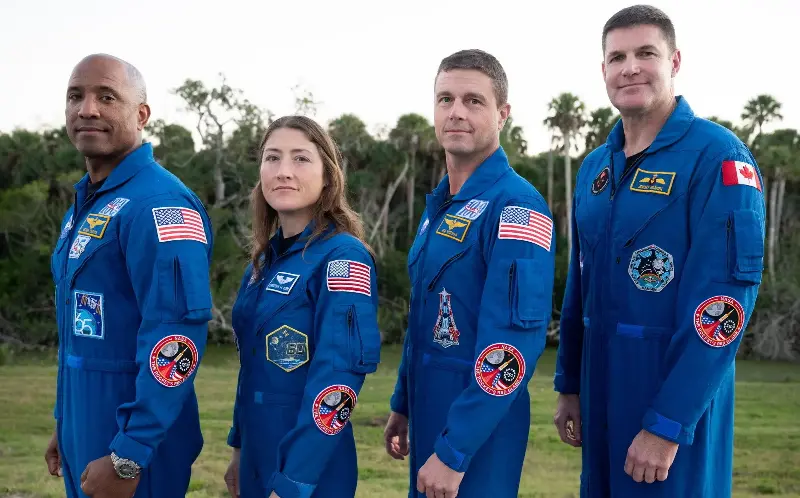
Artemis II’s astronauts are holed up in quarantine awaiting the first crewed mission to the Moon in more than 50 years.
Three Nasa astronauts – Commander Reid Wiseman, Victor Glover, and Christina Koch – and Jeremy Hansen of the Canadian Space Agency, are in a 14-day pre-launch quarantine at Kennedy Space Centre in Florida.
They must limit social contact, wear masks and avoid public places, while continuing their training, carrying out mission simulations and receiving medical checks.
Known as the health stabilisation programme, it will ensure that they do not pick up any illness that could delay their mission, or take any unwanted microbes into space.
The launch window opens on April 1, with opportunities for lift-off up to April 6 and then again on April 30.
It is the third time the crew has been in quarantine, after two launches were cancelled in February and March.
The crew live in the astronaut quarters of the Neil Armstrong Operations and Checkout Building, and are allowed contact with friends and family, if they agree to observe quarantine guidelines by social distancing and wearing masks.
“It’s a really cool feeling right now,” said Mr Hansen, at a virtual press conference before Wednesday’s launch. “We’re just down the hall from our space suits. Since we got here we’ve done a dress rehearsal, getting into the suits.
“The families arriving was pretty special, taking them out the launchpad, showing them the rocket.”
Mr Wiseman said: “Every chance we can, we’re going out to 39B [the launchpad] and looking at that amazing vehicle.
“This is an amazing place to be. The folks that are cooking for us are just covered in patches from previous missions. It is a really, very special place. This is where humanity began reaching for the stars.”
The delay means the science and geology of the 10-day mission have had to be altered because the Moon will be in a different place.
It means the crew may get to experience a solar eclipse and view areas of the far side of the Moon that have never been seen by human eyes, including the Orientale crater, which is almost entirely hidden from Earth.
While in quarantine, the crew has been retraining with geology teams about what to expect.
Mr Hansen said: “What’s interesting about this launch window is, depending on which day we launch, it really changes what we’re going to see.
“The early parts of this window, we’re going to see an eclipse, so we’ll see the Sun go behind the Moon.”
The crew will also look at the lofting of dust, a phenomenon where dust particles on airless bodies such as the Moon gain electric charge and lift from the ground.
Mr Hansen said: “The lofting of dust is something that has been observed by a couple of astronauts during Apollo, but there’s no real documentation of what is causing this, and so this provides an interesting opportunity to look at that.”
Although they are highly trained, the novelty of the mission means some nerves are expected, said Meganne Christian, a British astronaut.
“I often get asked whether astronauts are scared during launch, and generally the answer is no, just because they’ve had so much preparation and so they know exactly what’s going to be happening in any moment,” she said.
“But of course, this is the first time humans have gone to the Moon in a very long time. So it’s something quite new for this period in history, and there might be a little bit of trepidation.”
Astronauts are chosen to be especially resilient to stress and to stay calm under pressure, but also undergo winter and sea survival training to boost their ability to cope with difficult situations.
The crew will be confined in the tiny Orion capsule for the mission, which is 10ft by 10ft. It offers roughly 330 cubic feet of habitable volume, so learning to get on with each other is key.
“Getting sick during the mission wouldn’t be great, you really have to be on the top of your form,” Ms Christian said.
“This period of quarantine is an important one, because it’s an important time for them to be together and get into the psychology of the group, and they’ll be very close together in a capsule for quite a while.”
The crew said they were ready for lift-off, but also prepared for another aborted launch.
Mr Wiseman said: “This is a test flight, this is the first time we are going to try this, this is the first time we are loading humans on board.
“The four of us are ready to go, the team is ready to go, the vehicle is ready to go, but not for one second do we have an expectation that we are going. We will go when this vehicle tells us it is ready, when the team is ready.”
Ms Koch added: “Things are certainly starting to feel real here at the Cape.”