



Given that I was on holiday and not seeking the commercial advantage of a trade shortcut between the Atlantic and Pacific Oceans, it might sound counterintuitive to actively head towards the notorious Cape Horn rather than avoiding it at all costs.
Since first being rounded in 1616 by Dutch mariners, Willem Schouten and Isaac Le Maire, seeking a quicker route from Europe to access the Far East’s spice riches, the ferocious nature of the Earth’s most southerly cape has wrecked over 800 ships and claimed 10,000 lives.
“Yet this is what guests want,” explained Esteban Hernández, our Chilean expedition-leader. “They say, ‘yes, I love the penguins and glaciers, but get me to Cape Horn.’”
We were on board Australis Cruises’ four-night cruise from Punta Arenas through Tierra del Fuego’s nebulous archipelago to Cape Horn – at the foot of South America.
“It’s something very unique to step ashore the Fin del Mundo, the last land south before Antarctica,” said Esteban. The chances of landing were around 75 per cent. “The weather changes quickly there. If the winds are too high and we do not have favourable tides, we cannot land.”
I experienced a shift in my perception of Cape Horn as we sailed closer. The stormy cape I had once experienced in mountainous seas when sailing to Antarctica, now became an all-consuming quest – whose reputation held fewer terrors.
Perhaps my newly acquired Dutch courage was down to the calm assurance of a rather lovely voyage shared with 64 other guests on a Chilean vessel that routinely reaches Cape Horn. The staff on board the ship, Stella Australis, are largely Chilean, along with Argentinians, Colombians and Venezuelans.
Restrictions by the Chilean navy tend to favour access to home-grown ships, and those that do pass through – like Stella Australis with its shallow draft – need to be highly manoeuvrable in tight situations, making this voyage only accessible to very few. I never saw another cruise ship throughout my journey.
Stella Australis is also very uncluttered – there is no WiFi, jacuzzi, sauna, televisions or wall-to-wall lectures on board. So many modern expedition vessels have too many distractions that can dilute the sense of place. My cabin on the fourth of five decks was plainly decorated with a framed print of Cape Horn, but more importantly, the huge window encompassing most of my starboard wall invited Tierra del Fuego to flood, metaphorically speaking, into my space.
The lack of distractions ensured I spent time either out on deck absorbing Tierra del Fuego’s visceral glaciated wilderness or socialising, inhibitions eased by a complimentary bar that served a humdinger of a cocktail: a calafate (local berry) pisco sour. The bonhomie continued into the restaurant, where I was assigned a fixed table.
As a solo traveller, this can be a source of trepidation, wondering if you will have anything in common with your dining companions. Fortunately, I was seated with a charming Brazilian-Argentine couple, Sonia and Mauricio, and Mexican documentary maker, Luis, and his physician father. We became friends, as opposed to ships passing in the night, changing tables every day. Meals focused firmly on Chilean produce, with locally sourced ingredients like king crab and Chilean seabass, presented with gourmet aplomb.
If an army marches on its stomachs, we were a plump, happy brigade heading into Cape Horn’s crosshairs. During the first two days, we steamed south, dissecting the Magellan Strait shadowed by freewheeling black-browed albatross. The snow-capped Darwin Cordillera mountain range ahead presented a considerable barrier in Alberto de Agostini National Park, so called after an Italian priest who came to evangelise the indigenous Yaghan people and became rather fond of them.
Typically, two off-ship trips are offered each day by Zodiacs. The first morning at Ainsworth Bay, we hiked through an ethereal forest of Nothofagus (otherwise known as southern or false beeches), where I learned I could eat the Indian bread fungus growing on its trunk and prickly heath berries. A hot chocolate with whisky waited when re-boarding from the walk. “To warm you up, sir,” said the steward. It was a sunny 12C, yet it was gratuitously consumed nonetheless.
Later, we were royally entertained by Magellanic penguins at Tucker’s Islets. Patterned white with rings of black, they emerge unphotogenically muddy from burrows where their chicks nest, so the trick is to snap them when they materialise pristine clean from the sea.
I’d first come across them in the Falklands, where they’re uncharitably called jackass penguins. This was the fault of Portuguese explorer Ferdinand Magellan, who doesn’t deserve this species to be named after him. “When he sailed by in 1520, he described them as stupid birds with calls like donkeys,” explained our Zodiac guide, Alicia.
The next day, after slipping through the narrow Gabriel Channel, which pinches to 920 feet wide – no sweat for our nimble vessel – I sat on a glacially polished boulder in front of the magnificent Pía Glacier watching its powder-blue tinged teetering facade rumble away, then calve – the collapsed ice’s displacement rippling the floury brackish water bay.
Finally, D-Day arrived. It was blustery outside, and the slate-grey sea was choppy as we entered the treeless Horn Islands at 55.9ºS. Esteban announced the swirling 17mph winds and lashing rain constituted a good day at the Cape. So at 6.30am, we launched.
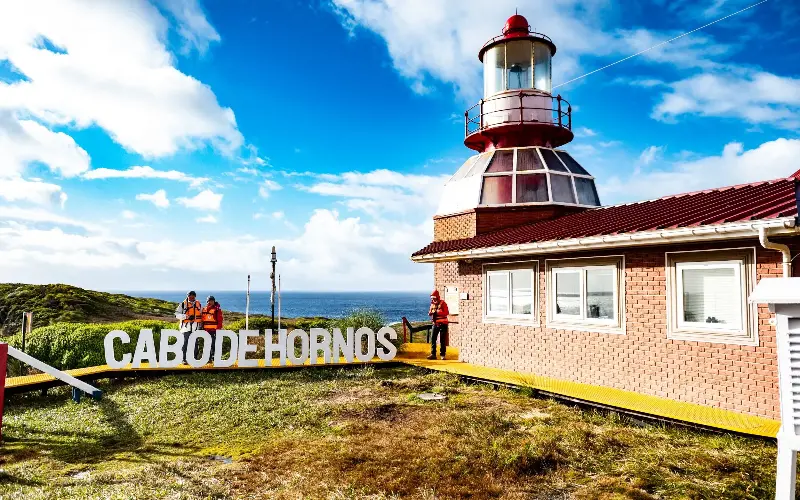
Access onto Cape Horn is by a steep wooden staircase, then via boardwalks that protect the heathland of its national park. I walked to its hilltop monument – a metal disk hollowed out to resemble the 15-foot wingspan of a wandering albatross. This big bird symbolises the lost souls of those who have perished around the Horn. I looked south from the monument down the Drake Passage towards Antarctica and thought of the sacrifices made in the name of Indo-Malay riches.
At Cape Horn’s small manned lighthouse, the resident Chilean naval keeper, José Luarte, and his wife were holding court, although their bright daughter, 15-year-old Sofia, did most of the talking in between selling her home-drawn postcards. The family had lived their castaway lifestyle for three years, yet Sofia told me she didn’t miss the outside world. “I love nature, being with my family, and studying online.”
But Sofia never underestimated the meteorological chaos of her surroundings – the previous lighthouse occupants had seen their roof blown off the keeper’s brick cottage. “Recently, we had winds of 95mph, and the sea was crazy. A boat got into trouble, and three men drowned,” she recalled.
Her story served as a sobering reminder of Cape Horn’s unpredictable power and devilment, which made the achievement of reaching it, which was far less hair-raising than I could’ve imagined, taste sweeter than the barman’s calafate pisco sours.
Mark Stratton was a guest of Australis Cruises. A four-night Fjords of Tierra del Fuego itinerary costs from £1,848pp, based on two sharing. Includes all meals, shore excursions, and open bar. Excludes international flights and transfers.
About our expert
Mark Stratton
Four-time winner of UK travel writer of the year, Mark Stratton has built up a reputation for writing and photographing small expedition-style voyages to some of the remotest places on Earth, especially Antarctica, which he’s sailed around over a dozen times, passing Cape Horn often, sometimes at its frolicking worst.