



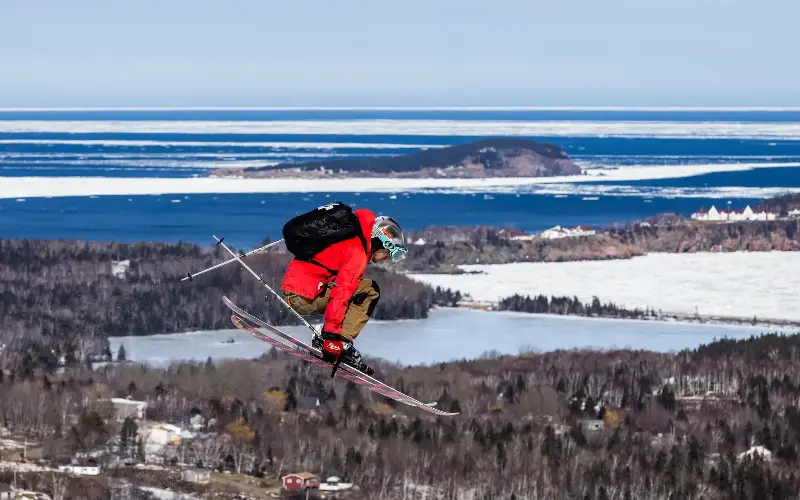
Cape Smokey, on Nova Scotia’s Cape Breton Island, distinguishes itself as a ski destination where you can carve turns above the Atlantic and surf those same waters at après-ski. Here, adventure in Canada’s pristine wilderness pairs unexpectedly well with creature comforts.
Fiddle music – more Scottish than Scotland – and fresh oysters, sushi and sandy beaches, and the region’s unique blend of Acadian, British and Mi’kmaw cultures make for a refreshing departure from Europe’s fondue-and-frites. Best of all? The near-total absence of people.
For decades, the modest 320m (1,049ft) ski hill at Ingonish was a pleasant diversion along the winding 298km (185 miles) Cabot Trail, one of the world’s most beautiful coastal drives and fringe benefit of the four-hour journey from Halifax via direct Air Canada flights from Heathrow.
Its fortunes waned in the early 2000s, but in 2019 a small group of Czech investors purchased a shuttered resort and began a full-scale overhaul. Today, a sleek eight-person gondola rises above the Atlantic, high-tech snow-making tops up generous easterly storms, and a constellation of ocean-front accommodation dot an antediluvian coastline speckled with pilot whales and harbour seals. There are the beachside Lantern Hill & Hollow cottages and the new Cormorant Rock villas, plus the magazine-worthy Red Head Cliffs mansion.
“Cape Smokey is about disconnection and reconnection,” said CEO Martin Kejval, a 31-year-old former World Cup ski racer, of the four-season, multi-phase redevelopment. “People say we have deep pockets, but each thing we build pays for the next thing.”
Quintessential Canada
I made my own rewarding disconnect from terra firma the next morning. After I squeezed into a neoprene drysuit, gloves and booties, my kayak bobbed in two-degree ocean chop while a bald eagle stretched its 2m wingspan high above. Eight miles out, a freighter etched a faint line across the horizon as a snow squall rolled in. Now this was Canada.
Earlier, the affable Bernie from Surf and Turf Adventures had pulled up in his van chock-full of paddles, boards, wetsuits – even spare timber. (“Didn’t need the wood. Friend needed a few dollars.”) After a brief skirmish with an onshore breeze on a paddle board, he promptly reappeared with sturdy kayaks and pointed towards Ingonish Island.
It would be a 1km crossing to the extinct volcano and traditional Mi’kmaw territory, where arrowheads were crafted from ancient rhyolite for millennia. With only the sound of the surf in the air, stepping ashore felt like a privilege. As a wedge of geese sliced past, Bernie grinned. “I can’t stand all that noise and traffic.” Later, he drew me a map to find the moose hanging around his yard.
If paddling were poetry, the high-octane scream of a 1,000cc snowmobile spelt testosterone in all caps. Turk of TNT Outdoor Adventures led me on a spirited expedition through boreal forest that attracts more moose than humans.
With the heated throttle on high, my powerful Polaris surged from zero to 60kmh in the blink of a frozen eyelash. Forty thousand riders a year frequent these more than 1,000 kilometres of groomed wilderness trails – a way of rural Canadian life.
Our halfway point was Cape Clear, a dramatic 91m (300ft) overlook onto the snowy Highlands. Four hours and 125km (77 miles) later, Turk summed it up: “Wicked day, eh,” he grinned. “Couldn’t beat it with a stick.”
An exclusive ski playground
Back at the mountain, skiing goes beyond the groomers. With the blue Atlantic filling the horizon below, Mateusz “Matty” Lisowski guided me through shin-deep powder towards Hawley Lake.
“Exegi monumentum,” he declared, skinning elegantly through birch trees thick with snow. (In addition to having the highest possible mountain rescue certification from his native Poland, the Cape Smokey COO is also a student of the classics.)
Matty and the team are committed to Cape Smokey’s renaissance – ski lift and dam construction, snow-making, pipelines, communications, grooming machines, even 22 local kids in the ski racing programme – all the trappings of modern skiing made-to-measure for this bijou playground on the sea. “It’s not every time you get a chance to leave a monument,” he said. “We put science into our snow-making – that’s our advantage.”
While Cape Smokey’s 10km of pistes won’t trouble the Trois Vallées, the longest run is a satisfying 1.5 miles, and black diamonds such as the aptly named “Check Me Pants” bake in challenge.
Plus, there’s an air of excitement in this small fishing community, for now and what’s to come. Expect a doubling of skiable terrain and a new chairlift in three to five years. Plans for a second uber-luxe Red Head Cliffs mansion are being executed, alongside more villas and a hotel, creating a four-season adventure hub where skiing is served with a side of surfing, kayaking, snowmobiling and fresh lobster. “We’re in it for the long burn,” Kejval told me.
I had arrived with modest expectations – exceeded from the very first salt-tinged, sea-facing moments and crowned with my daily pleasure of beach-combing for perfect pebbles. For Cape Smokey’s greatest luxury may be precisely what it lacks. As Matty put it: “If you wait just a moment, you’ll be alone. In that way, we are exclusive.”
Essentials
Lantern Hill & Hollow sleeps up to six from C$370 (£202) a night. Red Head Cliffs Mabey Ski offers five nights at Red Head Cliffs with two days’ resort skiing, one day of guided back country skiing and one day of snowmobiling, with a surf or paddle board lesson, from C$5,500pp (£2,950).
A five-night Ski & Stay package at the new Cormorant Rock ocean-front cottages including lift tickets and rentals start at C$1,025pp (£555) based on four people sharing. Air Canada offers a direct year-round service between London Heathrow and Halifax, Nova Scotia; a return flight from Heathrow to Halifax starts from £704. Downhill skiing and snowboarding at Destination Cape Smokey costs from C$69 (£37) a day.