



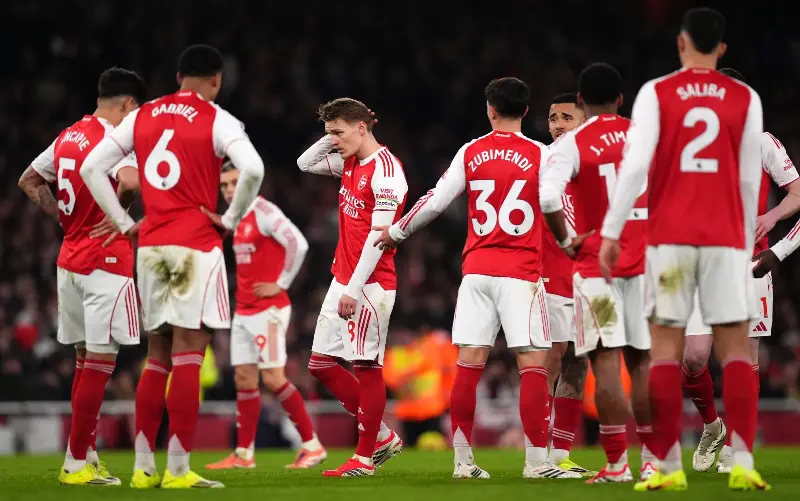
The balance between risk and caution has always been a delicate one for Mikel Arteta, a manager who wants his team to dominate matches but never wants to leave them exposed. On this agonising afternoon for Arsenal when they lost 3-2 to Manchester United, he and his players got that balance all wrong.
Too cautious in the first half, Arteta then lurched in the other direction when he made a remarkable quadruple substitution after 58 minutes against United. It was a totally uncharacteristic – bordering on reckless – move, and the near-complete reconstruction of his midfield certainly did not help Arsenal’s cause.
An unfortunate truth for Arsenal is that almost all of their worst results in recent seasons have come when the team has been too careful, too afraid of taking risks in attack. It is rare indeed for Arteta’s Arsenal to be overly open or daring. In times of stress, the dial has often been turned down, away from adventure and towards control.
That has largely been the case over the past three league games, in which Arsenal have endured back-to-back goalless draws and then suffered this gruelling defeat by United. In the first half here, they played as they had against Liverpool and Nottingham Forest in recent days: precise and careful, but without real menace.
“They look tentative, they look a bit nervous,” was the verdict of former United midfielder Roy Keane at half-time. “It’s a bit like the Liverpool game here a few weeks ago. They are afraid to embrace the challenge. They are more concentrated on not losing the game.”
This is not a new criticism of Arsenal in the biggest games. At the conclusion of the title race in 2023-24, Manchester City midfielder Rodri said the difference between the two teams was that Arsenal “just wanted to draw” when they met in a crucial match in March of that season.
In previous games against the big sides this season, too, Arsenal supporters have grumbled about the team’s perceived lack of adventure. In seven matches against the so-called “big six” this season, Arsenal have won twice. In five of those games, fans have been unhappy with the team’s attacking ambition.
Perhaps Arteta had those accusations in mind when he chose to make his quadruple substitution here: Martin Odegaard, Martín Zubimendi, Gabriel Jesus and Piero Hincapié off, Viktor Gyokeres, Mikel Merino, Eberechi Eze and Ben White on. It was the sort of decisive tactical decision that the home fans craved, although the result was a destabilisation of the team over the next 15 to 20 minutes. Was it too much, too soon? It felt like Arsenal swung from overly cautious to overly bold.
Arsenal’s attacking difficulties can be seen in the recent scoring returns of their forwards. Bukayo Saka has not scored in 13 games in all competitions. Gyokeres has not scored from open play in 11 league games. Gabriel Martinelli has gone 13 league games without a goal. Noni Madueke has not scored a league goal since he was a Chelsea player. And Leandro Trossard has scored once in his last 11 games.
It is clear that Arsenal’s attack is not functioning at its best, despite the overall excellence of a team that is top of the Premier League and Champions League. Their expected goals from open play against United was just 0.39.
Extraordinary angst of the crowd
On top of this, there is a secondary issue for Arsenal which must be addressed if they are to succeed in their pursuit of trophies this season: the emotion inside the Emirates Stadium. It may seem extraordinary to more casual observers that some home fans booed at the final whistle here, but anyone who has watched Arsenal regularly will not have been surprised.
The anxiety in the red half of north London is off the charts. It has been high over the past few months – home games against Wolves and Brighton, especially, were most memorable for the extraordinary angst of the crowd – and it reached another level here. The sense of desperation in the stands is unmistakable.
Such emotional intensity is easy to explain. Simply put, Arsenal fans are scarred by three consecutive second-placed finishes, and by two decades of underachievement in the Premier League.
Paying supporters cannot be told how to feel or how to act, but the atmosphere at the Emirates is not helping the team’s performance. The groans in the stands are undoubtedly affecting the players on the pitch. “It has been so long since Arsenal won the title,” said former Arsenal captain Patrick Vieira on Sky Sports. “Of course they are feeling the pressure and the expectation from the fans. It is about managing that.”
The louder the home crowd’s discontent, the more Arsenal clammed up. This is a club that must find a tactical balance on the pitch — and an emotional balance off it.