



I’m not sure what it is about bears that keeps me coming back for more. Perhaps it’s simply that when my wife, Sarah, and I managed safari camps in the African bush, we saw lions virtually every day. But never a bear. I can’t imagine why.
My first experience of these remarkable creatures was in Yellowstone National Park in my early twenties, when I was cycling coast to coast across America. It was 5am and I was luxuriating in a hot spring tending to my sore leg muscles when a family of grizzly bears came down to drink from the Yellowstone River – thankfully on the opposite bank.
This time Sarah and I were visiting Vancouver Island, off the west coast of Canada. Around 285 miles long by 60 miles wide, the island is a two-hour ferry ride from Vancouver itself. The island is made up of rainforests, mountains, beaches and wilderness areas alongside a mix of cities and small coastal towns. Victoria, the largest city, is also the capital of British Columbia.
Before exploring its highlights with friends who live on the island, our first mission was to visit the bears of the Great Bear Rainforest. This remote 24,700-square-mile wilderness is north of Vancouver Island, along the longest fjord on the British Columbia coastline. The area is one of the world’s largest old-growth rainforests, a pristine landscape of Douglas fir trees, 300-foot-tall Sitka spruce and 1,000-year-old western red cedars.
As our Otter seaplane banked sharply over Knight Inlet, our pilot pointed out the scars of old mining operations that had once threatened this pristine environment. Thankfully, conservation has largely won out, with 85 per cent of the region under protection and ownership transferred to the many First Nations groups who live here. Where once bears were hunted for $25,000 per animal and logging was an ongoing threat, far more revenue is now generated through wildlife tourism.
The bear necessities
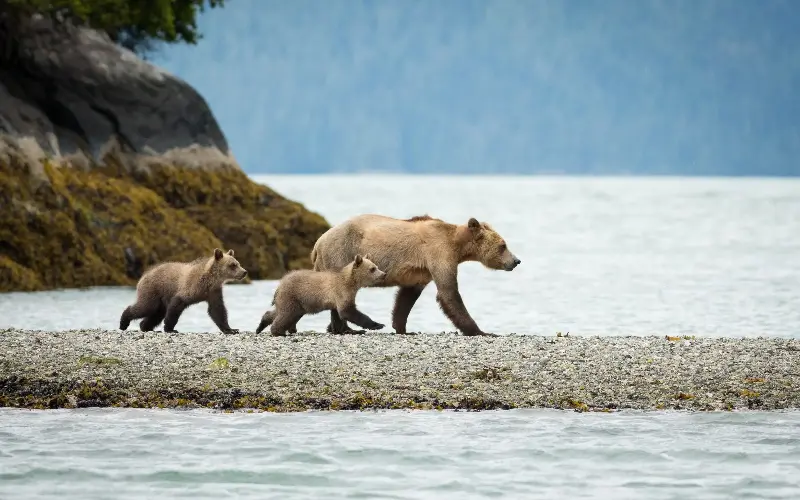
Our guide Jess greeted us at the floating dock, from where we were soon exploring the surrounding fjord in our six-seater boat. There are between 30 and 40 bears living in the region of the camp and it wasn’t long before our first sighting. Greeted by a palpable surge of excitement, Thimble, a mature female grizzly bear, emerged from the forest with her two cubs, just months old. She was moulting, her coat a patchwork of blonde, black and brown. Watching her teach the cubs to forage in the sedge grass for berries was mesmerising.
“Her mum was the old matriarch, but now that she’s gone, Thimble has taken over,” Jess told us. “Females usually stay with their cubs for three years. Around 25 years is considered a long life for female bears, with five to seven litters. The lives of coastal bears are up to 10 years shorter than inland bears as their teeth become ground down from eating mussels.”
Thimble and her cubs were foraging for berries, but in the late summer, most of their diet is salmon, which gives them essential fat stores before hibernating during the winter. Thimble is a grizzly bear, known for having a hump, a big forehead and rounder ears. Black bears are smaller.
More bear sightings followed over the next two days. One of the most memorable was during a riverside walk with Bryn, another guide. As we stopped for coffee, perched on huge boulders, a hummingbird in full hover darted in front of Sarah’s face. Luckily, Bryn still had his eyes on the prize and was soon gesticulating frantically but silently towards the other side of the river. “That’s the closest I’ve seen black bears on one of these walks in five years of guiding,” he told us later.
Going wild
Our next destination was Clayoquot Wilderness Lodge, a luxury resort in Clayoquot Sound, on the west coast. Accessible only by boat from the town of Tofino or seaplane from Vancouver, it is surrounded by 600 acres of a Unesco Biosphere Reserve. Accommodation consists of luxurious glamping-style canvas tents and antique furnishings inspired by turn-of-the-20th-century prospectors.
First Nations communities have lived in Clayoquot Sound for 10,000 years, since the end of the last Ice Age. In 1993, more than 800 people were arrested for protesting clear-cut logging, and successfully protected significant portions of old-growth forest. From our base at the lodge, we explored the sound itself, the surrounding river valleys and snow-covered mountain peaks by boat, on horseback and by helicopter.
On our journeys along the Ursus Valley, on foot the first day and on horseback the next, we passed 1,000-year-old trees whose trunks were more than 10 feet across and looked like pillars holding up the sky. Our guides, Adam and Chloe, shared their belief in the importance of recognising our interconnectedness with the natural world. It was a passion shared by all the staff at the lodge.
As well as seeing two more bear families, breaching humpback whales, dolphins and sea lions, our most memorable sighting was a “raft” of around 200 sea otters resting on the surface of the water, paws crossed in front of them as though stretching out on sun loungers. “They have up to a million hairs per square inch,” our guide informed us, “the densest fur of any animal on Earth.”
And then there was our helicopter flight to the top of the snow-covered mountains behind the lodge. “Heli Doug”, our extravagantly moustachioed pilot, is a local legend, with more than four decades of flying experience. We landed on Ursus Mountain, where Sarah and I dived into a freezing lake while a table was set up for tea and cocktails we’ll never forget.
Return to civilisation
Victoria (with a population of around 100,000) felt like a veritable metropolis after our time in the wild. We explored the centre on foot, as the sound of street musicians mingled with the cry of gulls overhead. Standing adjacent to the neo-Baroque architecture of the Parliament Buildings, with their distinctive green domes, the famous Fairmont Empress Hotel oozes Edwardian elegance. To the north of the city, the Butchart Gardens are where, in 1904, Jennie Butchart transformed an exhausted limestone quarry into a 55-acre estate that ranks amongst the world’s finest gardens.
Further around the southern peninsula is the town of Port Renfrew, adjacent to a coastline with woods of old-growth cedar and Sitka spruce. The Botanical Beach Loop in Juan de Fuca Park is about two miles long. Here the sands are scattered with driftwood, and orcas, grey whales and humpbacks are often on view. We walked it at low tide, pausing to spot colourful starfish and sea urchins in the tide pools.
Further along still, we emerged at the Pacific Rim National Park Reserve, where ancient rainforest meets the Pacific surf. Long Beach, which stretches for 10 miles between the towns of Tofino and Ucluelet, is famous for having the best surfing in Canada, which can be enjoyed year-round by surfers of all ages and abilities.
Our final day of exploring took us to Cathedral Grove in MacMillan Provincial Park, near the town of Port Alberni, at the end of a long estuary in the centre of the island. Here, we walked through a forest of Douglas firs up to 200 feet tall, which have stood for more than eight centuries. Along the way, we passed a couple who nodded politely as we crossed paths. “Wasn’t that Woody Allen and his wife?” asked Sarah. “It certainly looked like them.” “The island’s very popular with celebrities,” I observed, “I think Prince Harry and Meghan even considered moving here.” “Perhaps we should join them,” came the reply.
How to do it
A 17-day self-drive holiday through British Columbia and Vancouver Island with Journeyscape (0203 733 4413; journeyscape.com) starts from £12,381 per person. The price includes car hire, excursions, ferry tickets, boat transfer and accommodation in top hotels including Knight Inlet and Clayoquot Wilderness Lodge, but excludes flights.