



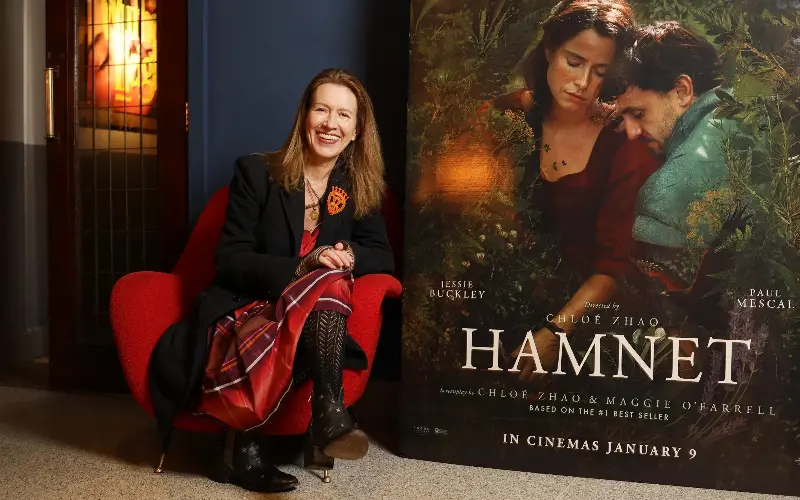
There’s something awry when a film is surging towards its emotional crescendo – signalled by a swell of tear-jerking music – and you find yourself suppressing an urge to giggle. Yes, I am that movie-going anomaly – the middle-aged woman who didn’t cry at Hamnet.
As I walked out of the Olympic Cinema in London’s Barnes, I looked in amazement at one woman my age who was still wiping her eyes and wondered if she’d had a cynicism bypass. I’d even go as far as saying that it’s the most overwrought example of mawkish silver-screen melodrama since the ludicrous Hilary and Jackie (about the death of cellist, Jacqueline du Pré), which also left me shaking with laughter.
The odd thing is that I enjoyed Maggie O’Farrell’s excellent novel (on which the film is based), and I’m a notorious weeper. My sons have long been mortified by my readiness to cry at Disney and Studio Ghibli animations – Bambi and Porco Rosso have me in floods.
Like most film lovers, I go to the cinema with the express aim of indulging in an immersive, cathartic group experience. I sobbed so violently at Lars von Trier’s Breaking the Waves that I had to be led out by friends. Ditto for Claude Berri’s Jean de Florette. In recent years, Past Lives had me blubbing into a hanky and reaching for a stiff Scotch afterwards. In fact, I only have to think of Jenny Agutter saying, “Daddy, my daddy!” in The Railway Children, to mist up.
But all the films I’ve mentioned pull off the magician’s act of dismantling a viewer’s emotional guard before their inner sceptic notices. Hamnet, on the other hand, feels like you’re being bludgeoned over the head by a dead fawn from start to end. Neither the radiant talent of Jessie Buckley, playing Shakespeare’s wife, Agnes, nor the burly-but-sensitive lad schtick of Paul Mescal as the playwright (as previously sampled in Normal People and Gladiator II) can save it.
This is made weirder by the fact that the film revolves around the death of the couple’s young son – a scenario almost guaranteed to make me howl with grief as the mum of two boys. When six-year-old Walter Hutton died of croup in the BBC’s 2007 adaptation of Cranford, I keened so loudly my husband thought a relative had died.
But you can’t lament when you’re drowning in treacle-thick sentiment. Every frame of Hamnet, from the sun-dappled mythic forest to the grey Shaker-chic attics, announces, “This is soulful!”
Portents abound. Doomy water floods the room where Agnes gives birth to her twins, a dark aperture in the roots of an ancient tree that is hilariously reminiscent of the Upside Down in Stranger Things. Mescal’s Shakespeare tells a banal version of the story of Orpheus and Eurydice to a saucer-eyed Agnes.
I can swallow a giant dose of folkloric Wiccan woo when it’s dished up in the right place like Excalibur, The Green Knight and The Wicker Man. But Buckley’s forest-child turn as Agnes increasingly set my teeth on edge. I say that as a huge fan of hers, one who’d have given her a gong for 2018’s Wild Rose. None of this is the poor actress’s fault. Or O’Farrell’s, whose novel had a great deal of subtlety.
Chloé Zhao’s leaden direction requires Buckley to don the tedious mantle of a nature child, whose pure elemental nature feels perilously close to simple. Granted, Buckley’s performance is far superior to Mescal’s turn as a ruggedly dopey malcontent who kinda likes poetry on the sly. He summons all the passion of a castrated dormouse while tugging down his breeches to tup ethereal Agnes on a pantry table – the film’s one genuinely lamentable sex scene.
I wasn’t a massive fan of Shakespeare in Love, but at least Joseph Fiennes manifested swagger. But who can blame Mescal for his lack of panache? I’d be cruising along on autopilot if asked to sit on a ledge above the Thames and contemplate suicide while reciting, “To be, or not to be, that is the question.” I just wish he’d shown mercy on the audience and thrown himself in.
By the film’s end, when Buckley’s exuding panto levels of incredulity turned to childlike rapture – as an audience member for a performance of Hamlet – I found myself musing, “Shakespeare meets Forrest Gump.” Followed by, “Cinema is like a box of chocolates, you never know what saccharine goo you’re gonna get.”
None of this is helped by the scene in which Mescal’s Shakespeare is transformed into the whey-faced ghost of Hamlet’s father. This was supposed to be meta, but just felt beta.
Yes, I fully understood the scene signalled the manifestation of the playwright’s grief for his deceased son, but you’d have had to have a heart of stone not to laugh. Especially when the ghoul was followed (spoiler alert) by a fleeting vision of the dead boy himself, looking unnervingly like Prince George. This apparition neatly answers the playwright’s existential question about where his dead son has gone – the Globe Theatre, as it turns out.
You can tell the filmmakers don’t trust the film to evoke pathos on its own dramatic merits because moments of sorrow come laden with a soaring Max Richter soundtrack – the one composer practically guaranteed to have an audience prostrate in the aisles with raw grief. They even nick Richter’s 2004 grief masterwork, On the Nature of Daylight (written as a lament for the Iraq War), which has been used like a musical JCB in Shutter Island, Arrival, The Last of Us and The Handmaid’s Tale to do the emotional heavy lifting.
In Hamnet, the music’s message is blindingly obvious, as signalled by Buckley’s disco-ball bright eyes – yes, love can survive the grave! Have I mentioned the ghosts? But then this is the sort of drama where our heroine declares early on, “The women in my family see things that others don’t.”
I could mention other scenes that creased me up with inappropriate mirth – Agnes free birthing amidst those mythic tree roots or angrily ranting at her husband, “He died in agony… and his little body was racked in pain, and you weren’t there,” – but you may begin to suspect I have a lump of granite in my chest.
I, too, might have paused to wonder whether there was something wrong with me, were it not for the fact that, in my defence, I could feel my younger sister’s shoulders shaking against mine as she, too, battled fits of laughter. The truth is, we were both in hysterics by the end – just not in the way the director intended.