



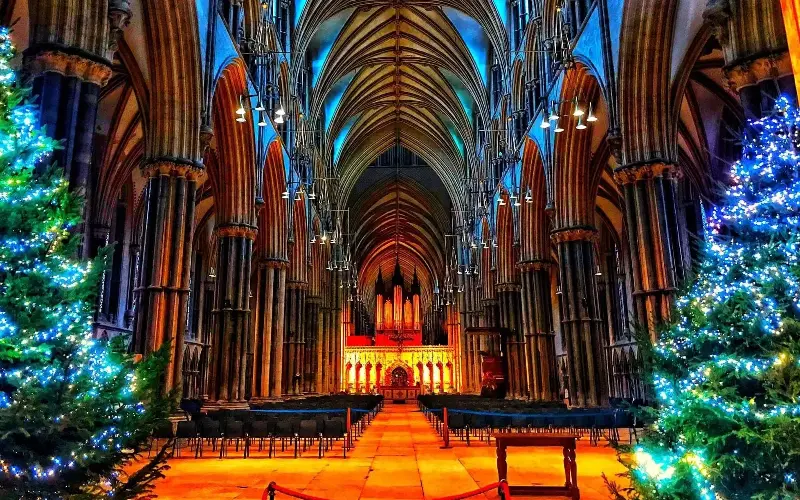
Britain does do a good cathedral. Especially the medieval ones, which were designed to inspire, intimidate, absolve and awe. Indeed, they remain some of the country’s greatest buildings, featuring the handiwork of master craftsman, containing priceless treasures and holding centuries of stories. They also provide good focal points for fascinating city breaks at any time of year – but especially around the festive period.
For expert guidance, join Martin Randall Travel’s nine-day, 10-city Cathedrals of England tour (£3,660pp; May 6 or September 2 2026; martinrandall.com). Alternatively, visit these ecclesiastical edifices to discover what makes the consummate cathedral.
1. Soaring spires
A look-at-me steeple makes clear a cathedral’s location but also literally points to the heavens, showing the way to God.
Head to… Salisbury, Wiltshire
Salisbury Cathedral has Britain’s tallest spire, piercing 123m into the firmament no less awe-inducing now than when it was completed in 1330. Special tours lead up the 332 spiralling steps to the roof-space at the spire’s base; twinkly twilight-timed tours run in mid-winter (entry £11; £22 with tower tour; salisburycathedral.org.uk).
There are also big views over the city, across the surrounding water meadows and out to the hill fort of Old Sarum, where the footprint of Salisbury’s first cathedral can be explored.
Stay at: The Chapter House (01722 341277; thechapterhouseuk.co.uk) has B&B doubles from £140 per night.
2. A gargantuan nave
Because size matters.
Head to… Liverpool, Merseyside
Liverpool’s Anglican Cathedral may be lacking in age – designed by Giles Gilbert Scott, it was started in 1904 and only completed in 1978 – but it isn’t lacking in size. At almost 9,688 sq metres, this neo-Gothic behemoth is the biggest cathedral in Britain and the fifth-largest in Europe.
As well as having formidable proportions, there’s some amazing contemporary art inside, including sculpture by Elizabeth Frink and a neon work by Tracey Emin; there are often temporary installations too. Book the tower tour to see the world’s heaviest peal of bells and to stand 152m above the city for 360-degree views (entry free; tower tour £7; liverpoolcathedral.org.uk).
Stay at: The Resident (0151 705 2626; residenthotels.com) has doubles from around £50, room-only.
3. Stunning stained glass
These coloured windows taught Bible stories to medieval Britain’s illiterate masses – though much didn’t survive the ravages of the Reformation.
Head to… Canterbury, Kent
The mammoth Mother Church of the Anglican Communion has many notable features: a Romanesque crypt dating to the 11th century, elegant fan-vaulted cloisters, the spot where ‘turbulent priest’ Thomas Becket was murdered in 1170, fuelling a huge pilgrim industry.
It also boasts some of the world’s oldest stained glass, including the Miracle Windows around Becket’s shrine and 43 surviving Ancestor Windows. There’s 1,200 sq metres of stained glass in all – take a specialist tour to learn more (entry £18; glass tour £5; canterbury-cathedral.org).
Stay at: Tucked inside the cathedral precinct, Canterbury Cathedral Lodge has B&B doubles from £115 per night.
4. Cracking cloisters
Resident monks required somewhere to study, stroll and mediate, protected from the elements.
Head to… Norwich, Norfolk
Norwich is greedy: it has two magnificent cathedrals. The Catholic iteration is a fine example of Victorian Gothic Revival, but it’s the 900-year-old Anglican building, with its 96m-high spire, that dominates the skyline.
Most impressive are its vaulted 14th-century cloisters – England’s largest – which are decorated with 1,200 hand-carved wooden bosses of Bible scenes and Green Men. Until spring 2026, there’s a contemporary sculpture exhibition here too, which spills into the Cathedral Close (entry free; cathedral.org.uk). Combine it with a visit to Norwich’s Norman Castle, fresh from a £27.5m refurbishment.
Stay at: The Maids Head is Britain’s oldest hotel, with doubles from £122 per night, room-only.
5. A cool crypt
Cathedrals need an atmospheric underbelly in which to store VIP bones and relics.
Head to… Ripon, North Yorkshire
Sitting on the edge of the Dales, teeny Ripon is more like a winsome market town with a disproportionately impressive place of worship than a city. The cathedral’s Saxon crypt is England’s oldest, dating back to the original church erected here by St Wilfred in 672; walk into these catacomb-like passages and it feels like little has changed since.
Also, Lewis Carroll’s father was a canon here in the 1850s, and the wood carvings – such as the gryphon chasing a rabbit down a hole in the choir – may have inspired Alice in Wonderland (entry free; riponcathedral.org.uk).
Stay at: Opulent Grantley Hall has B&B doubles from £645 per night.
6. Precious relics
As the most important buildings around, cathedrals were often repositories of rare treasures.
Head to… Hereford, Herefordshire
There’s been a church on the site of Hereford Cathedral since the eighth century, and the current Norman building – with its Cantilupe Shrine (a major medieval pilgrim site), tiny, fan-vaulted Stanbury Chapel and moving Traherne windows – is a beauty.
It’s also home to the 13th-century Mappa Mundi, the only surviving medieval world map on display, and the working chained library, now the world’s largest example. There’s an Escape Room in the cloisters too (entry free; Mappa Mundi £7.50; Escape Room £70 for six; herefordcathedral.org).
Stay at: Walkers embarking on the Golden Valley Pilgrim Way can sleep in the cloisters (£25pp donation; abbeydoredeanery.org). Alternatively, the Green Dragon Hotel has doubles from £102 per night, room-only.
7. Pilgrim appeal
One way to pull in visitors is to have a big name buried under your roof.
Head to… St Davids, Pembrokeshire
St Davids punches well above its weight. Britain’s smallest city, stranded in fabulous west Wales and home to fewer than 2,000 people, is the resting place of the country’s patron saint. Its cathedral was built in 1180 (on the site of the saint’s sixth-century monastery) and immediately became a significant pilgrimage site.
The Shrine of St David was restored in 2012 and still draws devotees, who also come for the nave’s carved oak ceiling, the beautiful rose window and the cafe’s Welsh cakes (entry free; suggested donation £5; stdavidscathedral.org.uk).
Stay at: The Art House has B&B doubles from £130 per night.
8. Quirky features
Not only monuments of faith, cathedrals were outlets of artistic expression.
Head to… Lincoln, Lincolnshire
It feels crass to laud this mighty Gothic cathedral – the world’s tallest building until 1548 – for its tiny details. But The Lincoln Imp, a devilish stone, grotesque in the Angel Choir, has become the stuff of legend and a symbol of the city; in 2024, it even got its own Imporium shop on Steep Hill.
The cathedral has many other eccentricities, including wonky walls, a tennis ball lodged in an arch since 1914, a monkey funeral carved into a misericord and centuries of graffiti – join a tour to learn more (entry £12.50; tours £7.50; lincolncathedral.com).
Stay at: The White Hart Hotel has B&B doubles from £109 per night.
9. A first-class choir
It was St Augustine (possibly) who said “he who sings, prays twice”; choirs have long been employed to amplify, unify and beautify worship.
Head to… Westminster, London
Built in striking early-Byzantine style at the turn of the 20th century, Westminster is England’s largest Catholic church, with one of its finest choirs. The choir was founded in 1901 and, under the direction of Sir Richard Terry, first Master of Music, revived forgotten Renaissance church works; today, it performs around the globe, as well as singing daily Mass and Vespers – come at 5pm for spine-tingling Evensong.
The cathedral also has a formidable Henry Willis III Grand Organ – there are recitals every Wednesday lunchtime (free; westminstercathedral.org.uk).
Stay at: The July Victoria has studios from £175pn.
10. High design
Cathedrals should look good, but also – via architectural tricks such as lighting, sight-lines and flow – facilitate worship too.
Head to… Clifton, Bristol
Clifton Cathedral pokes up from Bristol’s leafiest suburb more like an alien craft than a place of Catholic worship – indeed, it’s featured in episodes of Dr Who.
This Brutalist beauty, opened in 1973, was the first cathedral designed to meet new guidelines set by the Second Vatican Council, which aimed to emphasise congregational unity. With its innovative hexagonal plan, reinforced concrete spires, interior of exposed concrete and textured wood, and floods of natural light, some think it a monstrosity, others the apogee of spirituality, function and form (free; cliftoncathedral.org).
Stay at: No 38 Clifton has B&B doubles from £165pn.