



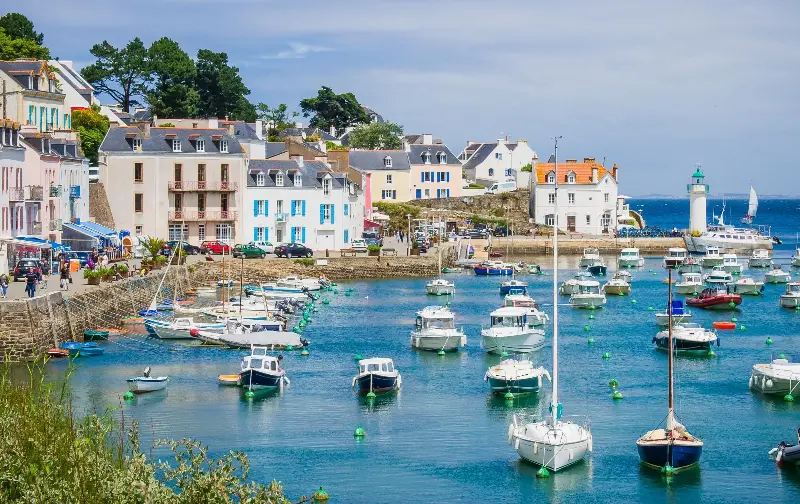
Brittany is not a place to stay still. Set off on foot, and there’s always something around the next corner, down the next lane, beyond the next headland. There’s so much on a small-enough scale that the joy lies in exploring an entire historic town, like the medieval gem Dinan, or circling the shoreline path around a tiny island like Bréhat.
Marvel at the prehistoric megaliths of Carnac and the Gulf of Morbihan, and the unspoiled woodlands of the Paimpont forest; and make for the water, whether on a river or sea cruise, or simply a surfboard.
All our recommendations below have been hand selected and tested by our resident destination expert to help you discover the best things to do in Brittany. Find out more below or for more inspiration, see our guides to the best hotels, restaurants, bars and beaches.
Find things to do by type:
Best for families
Île de Bréhat
Explore the ‘Island of Flowers’
Brittany’s gentlest, prettiest island, the Île de Bréhat, is a pink-granite wonderland. Benefitting from an oh-so-mild Breton “micro-climate”, and nicknamed the “Island of Flowers”, this verdant country garden of a place actually consists of two tiny islets.
Day-trippers cross a diminutive bridge from the southernmost of the two – home to great beaches and the only village – to picnic in wildflower meadows, or hike to a lighthouse perched amid the red rocks.
Insider tip: Regular ferries sail to Bréhat from the Pointe de l’Arcouest at the northeast tip of the Côte de Granit Rose, and, in summer, from other resorts along the coast. Some cruise right around the island before docking.
Website: brehat-infos.fr
Price: £
Saint-Malo
See Brittany’s has-it-all destination
Saint-Malo, one of the major ports of medieval France, is still encased within sturdy ramparts and remains Brittany’s principal ferry harbour. The perfect destination for a cross-Channel break, it’s bursting with romance and history, with great dining, shopping and hotels. Best of all, simply walk through the gateways piercing its mighty walls to reach a magnificent golden beach, where tiny fortified islets emerge from the waves at low tide.
Insider tip: Get out on the water with Compagnie Corsaire, which offers 10-minute trips across the mouth of the Rance to the stately resort of Dinard, longer cruises upriver to historic Dinan, and sightseeing excursions along the coast.
Website: saint-malo-tourisme.co.uk
Price: Free
Dinan
Discover a medieval citadel
Encircled by fairytale fortifications, Dinan is Brittany’s best preserved medieval citadel. Bars and crêperies throng its ancient alleyways, while half-timbered mansions cluster around a square where legendary knights clashed in hand-to-hand combat. Jousting returns during July’s Fête des Remparts, celebrated in odd-numbered years. Arrive by boat along the River Rance, then climb the Rue du Petit Fort to enter Dinan via a forbidding stone gateway.
Insider tip: For a lovely rural walk, set off south from the port on the riverside path. Cyclists can keep going all the way to Rennes, while a half-hour stroll brings you to charming Léhon and its ancient abbey.
Website: dinan-capfrehel.com
Price: Free
Belle-Île
Take the ferry to the ‘Beautiful Island’
Brittany’s largest island, Belle-Île, fully deserves its name. The “Beautiful Island” lies a half-hour ferry ride from Quiberon. Tourist facilities – including some gorgeous beaches and campsites – cluster along its northern, land-facing side, leaving the wilder Côte Sauvage, battered by the Bay of Biscay, to seabirds and hardy hikers. Visitors can bring their own cars, but it’s more fun to explore by bike.
Insider tip: For a truly unique stay, leave your own vehicle on the mainland, and pick up a vintage VW Combi van when you arrive. For all-inclusive rates, Belle Île Camper Vans provides restyled, fully equipped vans and recommends enticing overnight parking spots.
Website: belle-ile.com
Price: ££
Best for Breton culture
Musée de la Faïence
Learn about Quimper’s famous pottery
Originally the capital of the quasi-mythical kingdom of Cornouaille, pretty little Quimper is renowned for its faïence pottery. Brightly decorated with quintessentially Breton imagery, tin-glazed earthenware has been created along the banks of the Odet for more than three centuries. The riverside Musée de la Faïence traces the evolution in style, from early Chinoiserie, via earthy depictions of peasant life, to the flamboyant art deco era.
Insider tip: Alongside the museum in Quimper’s Locmaria quarter, the HB Henriot factory continues to produce faïence in traditional designs, while also commissioning contemporary artists to create their own variations. Pick up their products in the on-site boutique, or shops around the city.
Website: musee-faience-quimper.com
Price: £
The Port Musée of Douarnenez
Explore the historic waterfront
A century ago, Douarnenez was home to 800 sardine boats. While it’s still a functional fishing port, its entire historic waterfront, Port-Rhû, has become a living museum. The indoor Port Musée treasures several vessels, from dug-out canoes and coracles to the first motorboats. Larger boats moored along the quayside allow visitors to come aboard in summer, and inspect every detail.
Insider tip: Every two years, for a full week in July, the Temps Fête festival takes over Douarnenez. A thousand traditional sailing boats congregate in the bay, offering wannabe pirates a taste of the seven seas, with evening concerts and events on dry land.
Website: port-musee.org
Price: £
Carnac’s mysterious megaliths
Visit Europe’s oldest settlement
If you only know about menhirs (standing stones) thanks to Asterix and Obelix, Carnac may blow your mind. Europe’s oldest settlement, dating back 7,000 years, this little village is surrounded by prehistoric monuments on a massive scale. Alignements (rows) of stark granite columns weave across the moorland; others form ceremonial circles; and burial mounds lurk in the woods. Happily, Carnac also boasts fabulous family beaches.
Insider tip: Only if you visit between October and March can you wander at will among the alignements of Carnac. At other times, you can either admire them from behind a fence, or join a guided tour (available in English).
Website: menhirs-carnac.fr
Price: ££
Lorient’s Interceltic Festival
Celebrate the Celts
The world’s largest celebration of all things Celtic, the Interceltic Festival takes over Brittany’s south-coast town of Lorient for 10 days each summer. First celebrated in 1971, it now draws a million visitors a year, with participants from the entire Celtic diaspora, including Ireland, Scotland, Wales, Galicia, Asturias and Canada.
Insider tip: The festival features hundreds of organised events, culminating in a street parade on the final Sunday, but above all it’s a BYOB affair – bring your own bagpipes, or any other instrument, and you’ll be welcome at spontaneous jam sessions all over town.
Website: festival-interceltique.bzh
Price: ££
Best for being by the sea
The Gulf of Morbihan
Cruise the coastal islands
Said to hold an island for every day of the year, the Gulf of Morbihan – “little sea” in Breton – is a photogenic melange of islets, waterways, historic settlements and ancient ruins. Small-boat sightseeing cruises sail from the one sizeable town, Vannes, and several smaller harbours like Locmariaquer, lining the west of the gulf, and Port-Navalo, across the water at the western tip of the Rhuys peninsula.
Insider tip: The Morbihan region was a major centre for the megalithic builders. Sea levels have risen since then, stranding sites on isolated islets. On tiny Gavrinis, accessible from Larmor-Baden, guided tours penetrate the ornately carved interior of a pyramid-like dolmen.
Website: navix.fr
Price: ££
Île de Sein
Step back in time to Brittany’s historic islands
Five miles (8km) west of the “Land’s End” of France, the mist-shrouded Île de Sein turns its back on Europe to immerse itself in the mythic past. Its highest point is barely 20 feet (six metres) above sea level, and one French admiral called this the world’s most dangerous reef. People do live here, though, and the harbour village makes an unforgettable place to spend a night.
Insider tip: The Île de Sein has a proud history. Ancient megaliths poke out from the rocks, while Brittany’s Druids made their final stand against the Romans here, and the entire male population sailed to England to join de Gaulle in exile in 1940.
Website: pennarbed.breizhgo.bzh
Price: £
Pointe de la Torche
Surf the Atlantic Ocean
Open to the full force of the Atlantic, the colossal curve of sand at Brittany’s southwestern corner may be totally unsuitable for swimming, but it’s a paradise for surfers. Devotees rendezvous at the Pointe de la Torche, a low-lying peninsula jutting out close to its southern tip. Operators based here, including the Brittany Surf School, offer surfing and paddleboard rentals and lessons pretty much year-round.
Insider tip: The Pointe is also the place to try your hand at sand yachting, in which daredevil pilots steer wheeled, windblown chars à voile along the wide-open sands at ferocious speeds. Only to be attempted with expert guidance!
Website: esb-latorche.com
Price: ££
Cancale
Indulge in a seafood haven
For lovers of seafood, Cancale is Brittany’s most irresistible destination. This little fishing village guards the western tip of the bay of Mont Saint-Michel, scoured twice daily by the world’s largest tides. As the waves sweep across the sands, they irrigate a vast array of oyster and mussel beds. Quayside market stalls sell ultra-fresh shellfish, while more formal restaurants line the single waterfront street.
Insider tip: Energetic hikers who head north along the coastal footpath from the end of Cancale harbour reach the spectacular Pointe du Grouin in just under four miles (6km), enjoying dramatic views of Mont Saint-Michel’s spire-topped abbey forever prominent on the horizon.
Website: ot-montsaintmichel.com
Price: Free
Best free things to do
Paimpont Forest
Walk in Merlin’s woods
While Camelot itself lay in Britain, much of the magic and mystery of the Arthurian era unfolded across the Channel in Brittany (“Little Britain”). Known in legend as Brocéliande, the Paimpont Forest is the largest vestige of the Argoat, the vast ancient forest that covered inland Brittany. Woodland trails lead to the “Val Sans Retour”, where false knights languish in perpetual captivity, and even the Fountain of Youth.
Insider tip: Exhibitions and re-enactments in the Château de Comper tell hallowed tales of knights and nymphs, Merlin and Morgan le Fay, and celebrate Arthurian lore in popular culture, including France’s thriving graphic-novel scene.
Website: destination-broceliande.com
Price: Free
The Nantes-Brest canal
Cycle Brittany’s most idyllic route
Of all Brittany’s wonderful cycling routes, the most idyllic itineraries follow the towpaths beside the Nantes-Brest canal, created under Napoleon to protect waterborne trading vessels from British bombardment. This intricate cross-country network connects purpose-built canals with pre-existing rivers. Free from coastal winds, hills of any description and (almost) all traffic, it’s an utterly tranquil rural ride.
Insider tip: Cycling the entire 242-mile (390km) route typically takes around eight days. For an easier four-day jaunt, follow its central section through Brittany’s ancient heartland from Rostrenen to Redon, with potential overnight stops including the well-preserved medieval towns of Ploërmel and Josselin.
Website: francevelotourisme.com
Price: Free
Côte de Granit-Rose
Hike the coastline
The breathtaking Côte de Granit-Rose, halfway along Brittany’s northern shoreline, showcases some stunning coastal scenery. Sculpted into amazing contortions by the relentless waves, its pink granite rocks gleam and glisten in the summer sun. An easy hiking trail, the Sentier des Douaniers, follows its most dramatic stretch, from the exquisite beach at Ploumanac’h, via isolated coves and pink-tinged lighthouses, to Perros-Guirec.
Insider tip: The most memorable landmark along the Côte de Granit-Rose has to be Castel Meur, an ordinary-looking cottage squeezed between two enormous seafront boulders. Just outside Plougrescant, it’s not open to visitors, but coastal trails offer great views.
Website: bretagne-cotedegranitrose.com
Price: Free
How we choose
Every attraction and activity in this curated list has been tried and tested by our destination expert, to provide you with their insider perspective. We cover a range of budgets and styles, from world-class museums to family-friendly theme parks – to best suit every type of traveller. We update this list regularly to keep up with the latest openings and provide up to date recommendations.
About our expert
Greg Ward is Telegraph Travel’s Brittany expert.
“I first visited the region in early childhood, and returned repeatedly to write the Rough Guide to Brittany and Normandy. You can find me hiking in the wilder places or exploring the far-flung islands.”